Monday, March 16, 2009

The Good, the Bad and the Ugly

The Good, the Bad and the Ugly posterThe Good, the Bad and the Ugly (1966) is the final installment of director Sergio Leone’s Dollars trilogy, following A Fistful of Dollars (1964) and For a Few Dollars More (1965). The film centers on the mutually distrustful partnership between bounty-hunter Blondie (Clint Eastwood) and Mexican outlaw Tuco (Eli Wallach) as they compete against the mercenary Angel Eyes (Lee Van Cleef) to find a buried fortune in Confederate gold.

Angel Eyes is fully deserving of his moniker “the Bad” for his ruthless efficiency in mercenary killings and his penchant for torture. The film opens with Angel Eyes interrogating a former soldier for the alias of a man named Jackson. Upon finding out that the name is Bill Carson, he shoots the man and his son. Angel Eyes is later told that a Confederate unit escorting a box of gold coins was ambushed by Yankees and though three men were saved the box was not; Jackson was among them and disappeared after the hearing, reenlisting in the Confederate army as Bill Carson and living with a prostitute named Maria. Angel Eyes locates Maria and smacks her until she informs him that Jackson recently left with his cavalry unit for Santa Fe.

Meanwhile, we are introduced to the slit-eyed, cigar-chewing Blondie (a.ka. the Good) and the loud-mouthed, hot-tempered Tuco (a.k.a the Ugly). They set up a scam to repeatedly collect the bounty on Tuco’s head by having Blondie turn Tuco in, and then shoot him from the noose at his public hanging. However, Tuco’s agitation from a near-death experience and Blondie’s realization that Tuco’s worth is capped at $3000 prompts Blondie to terminate the partnership, which he unwisely does by abandoning his ex-partner seventy miles from town in the blazing hot desert. Tuco survives this and becomes hell-bent on revenge, tracking down Blondie and forcing him to endure a similar ordeal. Suddenly, in the middle of the desert, Tuco discovers a runaway carriage filled with dead Confederate soldiers and a barely alive Jackson who croaks that $200,000 in gold coins is stashed in Sand Hill Cemetery. While Tuco, with a greedy gleam in his eyes, dashes to get water for Jackson, Blondie hears the exact grave where the coins are buried before Jackson dies. Because Tuco has only half of the necessary information, he disguises himself and Blondie, who has lost consciousness from severe sunstroke, in Confederate garb and takes him to be revived in his estranged brother’s monastery.

After leaving the monastery, they are apprehended by a Union cavalry unit and sent to the prisoner-of-war camp where Angel Eyes has claimed de facto leadership. Angel Eyes sadistically orders his henchman torture Tuco to the sound of a patriotic melody played by a military band. Tuco surrenders the cemetery name, but Angel Eyes knows that torturing Blondie will be futile so he leaves with him for Sand Hill. Both men escape from their captors, reconvene in a war-torn town, and win a shootout against men working for Angel Eyes. With Sand Hill just over the horizon, Tuco and Blondie stumble upon a Yankee encampment and pretend to be volunteers. The commanding officer is drunk in a desperate attempt to forget the tragedy of his mission; he must defend an insignificant bridge from the Confederates across the river by sending hundreds of troops to be slaughtered. Blondie wants the Confederates to leave so that he can reach the cemetery, but he is also moved by the pointless loss of life, so in an anarchic act of protest he detonates the bridge. Subsequently, the Good, the Bad and the Ugly arrive at the gold-bearing grave, and Blondie suggests that its ownership be determined by shootout. Blondie secretly unloaded Tuco’s gun the night before, so his attention is undivided when he shoots Angel Eyes dead. The film closes with Blondie hanging Tuco from a tree for old time’s sake and shooting him down when he is at a safe distance with half of the loot, and then rides away with Tuco bellowing curses after him.

The Good, the Bad and the Ugly is one of the most celebrated Western movies, due in no small part to the profound images it projects of the tragedy of war. This is unexpected for a genre that generally glorifies United States history and justifies violence by the heroes. Taking an explicitly anti-war stance, the film portrays war as a failure by state institutions to work for the common good, creating situations that facilitate extreme cruelty (such as the prisoner-of-war camps) and allowing individuals to be collateral damage for dubious military gain (such as the battle at the bridge). This message, which has endured in importance long after the anti-war 1960s when the film was made, is important to the change in its critical perception. Time magazine critics, for instance, considered The Good, the Bad and the Ugly to be a “hokey” bloodbath flick in 1968, but today consider it among the 100 best films.

The development of the Mexican character Tuco is another interesting facet of The Good, the Bad and the Ugly. Even though he plays the sidekick to Blondie, he does not fit the sidekick archetype in the way that Angel Eyes fits the villain archetype, in that Angel Eyes is purely evil. His character has far more depth than Blondie, the stoic “Man with No Name” who has no relationships or history. Although, typical for a sidekick, Tuco is less intelligent and brave than Blondie and provides comic relief with his rambunctious behaviour, he is also far more accessible to the audience than the hero. Tuco is the only character with a personal life the audience can glimpse into (when Tuco argues with his brother at the monastery) and understand what motivated his criminal behaviour (out of dire financial need). As The Good, the Bad and the Ugly is a European film imitating an American genre, there is certainly more room for the reinterpretation of cinematic conventions, including imbuing the crude-talking Mexican sidekick with greater pathos than the noble American hero.

Labels: ,

Friday, February 27, 2009

One Night in the Tropics

One Night in the Tropics posterOne Night in the Tropics (1940) is a musical comedy about a topsy-turvy love triangle and is best known as the film debut of radio duo Bud Abbott and Lou Costello, who, although they steal the show with witty dialogues, play only minor roles in the main plot. The movie begins with the klutzy Steve Harper (Robert Cummings), who is unlucky with love in the way that he always has too many women at once. He’s falling head-over-heels (almost literally) for the beautiful Cynthia Merrick (Nancy Kelly) and the two plan to marry within the week; until Steve has several unfortunate run-ins with an elderly lady who ends up being Cynthia’s Aunt Kitty (Mary Boland). She forbids Cynthia to marry such a screw-up and Cynthia finally agrees when Steve inadvertently rips her wedding dress. While Steve tries to win Cynthia back over the phone, Mickey Fitzgerald (Peggy Moran) shows up and declares that no one will marry Steve except for herself. Steve is at odds until his best friend Jim “Lucky” Moore (Allan Jones) arrives with the proposition of offering Steve a million dollar ‘love insurance’ policy against his marrying Cynthia by Saturday. Seeing as Jim is about as lucky as they come for an insurance salesman, Steve accepts with the wisdom that he’ll obviously lose in his love insurance policy and thus marry Cynthia. All appears to be going to plan, as Cynthia has agreed to forgive Steve, until one evening when, while out at a restaurant, Cynthia, Steve, and Jim run into Mickey who sings a swooning love song to Steve. Cynthia becomes suspicious and her fears are soon confirmed after she discovers Mickey cornering a reluctant Steve into a kiss. Jim, who had met Cynthia only that night and immediately was bewitched, becomes fearful that he may owe Steve one million dollars if there’s no marriage that Saturday, not to mention a hefty bet that he laid with the intimidating restaurant manager, Roscoe. Cynthia storms off and is followed by Steve, who is followed by Mickey, who is followed by Jim, who is followed by Abbott and Costello, Roscoe’s unlikely henchmen, who are ordered to make sure Jim seals the deal between Cynthia and Steve.

Cynthia plans to board the S.S. Pan America with her aunt and head for the South American town of San Marcos. She is secretly pursued by Jim, Abbott, and Costello. When Steve fails to arrive at the boarding dock for the scheduled time of departure in order to win back Cynthia, Jim sends Abbott and Costello to investigate. Instead, the two nit wits become absorbed in their famous ‘baseball dialogue’ and when they finally arrive at Steve’s apartment they realize that he was being stalled by the conniving Mickey, who conveniently stole the ‘love insurance’ policy when Steve wasn’t looking. Steve takes the next boat to San Marcos while Mickey, flanked by a watchful Abbott and Costello, also manages her way to the South American city.

Meanwhile, on the steamer, Jim and Cynthia discover that they are interested in one another, but Jim keeps his distance, more to honour the insurance policy than his best friend. Aunt Kitty also takes a liking to Jim and upon arriving in San Marcos she insists that the young pair spend more time together. When night falls, the two lean in for their first moonlit kiss, accompanied by the hotel orchestra, but are interrupted by Steve who bounds up and tries to discreetly tell Jim that Mickey is also at the resort. This is all for naught when Mickey appears in Cynthia’s room that night and divulges the entire story to her. Cynthia joins forces with Mickey in order to beat the boys at their own game, thus making more of a love-square than a love-triangle. Mickey is all for it, as long as she is able to have Steve in the end.

The girls plan comes into action the next day when they attend a bull fight with the men and immediately send them into a state of jealousy with Mickey fawning over Jim to distract Steve, and Cynthia swooning over the bull fighter, Rudolfo, in order to distract Jim. They return to the hotel that night and spend the evening serenading their pretend partners while yearning to be with the ones they love, which leaves everyone pacing their verandas in anticipation of the wedding. The following day, Cynthia arrives at the ceremony to announce that the wedding is off, but is stopped when Roscoe appears and forces the minister to marry Steve and Cynthia so that he can win his bet. Jim spoils Roscoe’s plan by throwing grapes at him and then runs away with Cynthia; leaving Mickey behind who threatens the minister with the dropped gun to marry her and Steve, much to Steve’s delight. In the meantime, Cynthia and Jim race away from Roscoe through a maze of dancers in the square who are performing the country’s national dance, the Farandola, in honour of the wedding ceremony. The pair try to blend in, but to no avail. When Roscoe has them cornered, Cynthia pleads to Roscoe not to hurt Jim. Roscoe begins to laugh and says that the insurance policy has been fulfilled on account of Steve marrying Mickey and no one is going to get hurt. Jim doesn’t even hear this as he’s only focusing on how Cynthia tried to save him. He pulls her in close for a kiss as the final curtain falls.

In New York, the characters are constantly at odds with one another, and while the situation doesn’t appear to improve much after shifting locations to San Marcos, the trip’s intention of ending confusion and liberating love lives eventually transpires. San Marcos, in all its wonderful geographic ambiguity, is a site of escape and a refuge for stressed city-folk. Along with the oddness of its street vendors selling hot dogs under the name of ‘tamales’, even the ‘national dance’ of San Marcos appears out of place as it is actually a dance native to several regions in France. The bullfight brings the characters closer to the culture of Spanish heritage, but the tell-tale ignorance of foreigners in Latin America is flaunted when Aunt Kitty exclaims, “Oh, what a pretty bull!” as the beast appears in the ring, which clearly demonstrates that she is unaware of the expected outcome of a bull fight. The resources of this Latin setting are constantly being utilized to set-up passion for the complicated Americans, from the ever-present orchestra and rich moonlight, to the bullfighter Rudolfo who is used as an object to create jealousy. From the plot’s point of view, one night in the tropics, where “the chief import is love and the chief export is happiness”, is all that is needed to untangle a muddled love-triangle.

Labels: , ,

Friday, February 06, 2009

Forever Darling

Forever Darling posterForever Darling (1956), a typical Lucille Ball/Desi Arnaz comedy, begins with the blissful wedding of Lorenzo or "Larry" and Susan Vega (Arnaz and Ball, respectively). Susan happens to be from a wealthy family, while Larry (although it is never said outright) appears to be middle-class, as is first brought to our attention when Susan’s cousin Millie (Natalie Scafer) scoffs, "He’ll never fit into our set." Larry isn’t blind to these comments, but lets them slide, while lobbing back subtle remarks about why he wouldn’t want to be in their set anyways. The wedding guests discreetly wonder how long the couple will last. The film then fast forwards to five years later, with the predicted outcome of their marriage slowly going to ruin. Larry has become an esteemed chemist working on a new insecticide called "383," while Susan has followed in Millie’s footsteps to become a stuck-up socialite. The two barely speak, and one night Larry loses all restraint and tells Millie and her husband Henry what he really thinks of them. Susan is enraged that on top of all this, Larry wants to travel the world to do research on his insecticide. A domestic argument ensues in which they realize that their marriage is on its last legs, and separate sleeping quarters are arranged.

Suddenly the film takes a mystical turn as Susan is visited by a guardian angel, played by actor James Mason (as per Susan’s fantasies). At first she is frightened; but after discovering from her father that both visions and guardian angels run in the family, she promptly listens to the angel’s advice. He lectures her on love and stresses that she and Larry were destined to be together. On hearing this, Susan tries her best to see Larry in a different light and even volunteers to go on a camping trip to Washington with him to gather research on mosquitoes and his insecticide.

This turn of events induces the tried-and-true Lucille and Desi slapstick comedy. Susan’s lack of outdoors know-how tests the limits of Larry’s patience. Yet, despite some unfortunate incidents, Larry still manages to serenade his love to Susan while they sit by the campfire. But this all comes crashing down in the grand finale when Susan accidentally cuts a hole in their inflatable boat, which promptly puts them in the swampy river like drowned rats. This is the last straw for both of them until two officials from Washington arrive to see the insecticide in action. Here is where the guardian angel again intervenes so that "383" fails to work and Larry becomes devastated. Seeing Larry in this state, Susan rushes to his side and spouts everything she’s learned about love and that she will be with him no matter what, even to travel the world and look at insects. No sooner said than done, the officials interrupt to tell them that they tried "383" again and it worked, meaning a contract and some world-traveling for Larry. He looks dubiously at Susan who assures him that this is the life she wants and that she doesn’t "care if [they] never see Millie and Henry again." Larry replies incredulously in his Spanish lilt, "You dunt?" Susan smiles back before embracing him: "No, I dunt!"

It’s impossible to take in this film without realizing its relevance to the successful Ball and Arnaz TV show, I Love Lucy; it even replicates a silk sheet backdrop behind the opening credits. However, although Forever Darling and the couple's other feature film The Long Long Trailer, may have protagonists analogous to the couple on the show, it lacks the cultural nuances which made I Love Lucy such a hit. For instance, Larry is clearly of Hispanic descent in Forever Darling, but it is not clear where exactly he is from. In fact, the only Latin American country mentioned in the film is Puerto Rico, where Larry will have to go to research the effects of "383" on roaches . . . how charming! It appears that this typical "American couple" has truly been assimilated. As Gustavo Peréz Firmat observes, "Just as Vegas [Larry and Susan’s last name] is a Spanish name that has become an American city, Larry is a Hispanic man who has become a dyed-in-the-wool American" (Life on the Hyphen 68-69).

This is not to say that Larry has lost all traces of hispanidad. For instance, whenever he is emotional he uses his native language. This can be when he is angry with Susan, when he is incredulous, or when he is laughing at someone; but the similarity among these instances is that Larry is always talking to himself, thus creating a link between his culture and the isolation of being the only Hispanic-American in the film. This characteristic is reiterated when Millie points out that Larry will never belong. This remark may be interpreted in terms of wealth, as is Millie's suggestion, but this is unconvincing, as Larry has provided Susan with a luxurious home complete with hired help. Larry invites Susan into his culture as he serenades her in Spanish; however, she then asks him to sing the song again, this time in English. The only scene where Larry’s culture is acknowledged in any way is in the last few lines of the film when his pronunciation of "don't" as "dunt" becomes a comical connection between husband and wife. It appears as though Hollywood has made an icon of Arnaz and plans to keep him this way: petrified in film as the token Hispanic character, he maintains his difference from his counterpart, Lucille Ball, who is the icon of the American house-wife.

Labels: ,

Sunday, January 18, 2009

Week-End in Havana

Week-End in HavanaThis 1941 Fox romance musical is a Technicolor delight - and the backdrops were filmed in the real Cuba! The light comedic plot of Week-End in Havana begins when a cruise ship of the McCracken Cruise Company runs aground on a reef off of Florida and cruise company employee Jay Williams (John Payne) is sent down to ensure there are no lawsuits. He leaves his anxious fiancée, the daughter of the company’s boss, behind. The only guest on the ship who refuses to sign a waiver is Nan Spencer (Alice Faye), a Macy’s department store salesgirl who insists she have her vacation NOW. . . and refuses to sign until after she's had a good time in Cuba at the McCracken Cruise Company's expense! Jay is instructed to take Nan to Havana, put her up in a fancy hotel, and keep her entertained until he can get the waiver out of her.

In Havana, they go to a flashy nightclub where Rosita Rivas, played by a hip-swinging Carmen Miranda, is the main dancing and singing attraction. Bored of Jay’s bland conversation, Nan goes off to find some excitement. Enter Monte Blanca (Cesar Romero), a sleazy, comedic Cuban and Rosita’s manager and lover, who mistakes Nan for a filthy-rich American who can solve his money troubles, namely the gambling debts he owes to the nightclub’s owner, Sheldon Leonard. Blanca charms Nan into a date the following night at the club, where he takes her to the casino on the upper floor, hoping she will lose enough money at roulette to get Leonard to forgive his debt. When Nan loses $3000 and Blanca realizes she cannot pay for it, he is called to Leonard’s office, where he finds Jay Williams. Jay offers to make good Blanca's debt if Blanca keeps Nan entertained for the remainder of her stay in Havana. Blanca agrees, and proceeds with his courtship of Nan.

When Rosita Rivas finds out, she is enraged, and it is Jay's job to keep her away from Blanca and Nan. He fails, however, and in a comedic scene in a colonial restaurant, Rosita and Nan uncover the deal between Blanca and Jay. Furious with Jay, Nan demands he drive her back to the hotel. On the way, the car breaks down, and they are stuck in the balmy Cuban night to find their way home. A romantic, music-filled adventure ensues and they end up spending the night together. In the morning, Jay realizes he has made a grave mistake, and as he is about to tell Nan that he is in fact engaged, his fiancée storms into the room. Pushing her anger aside surprisingly quickly, she pays an insulted Nan to sign the waiver and takes Jay home to New York with her, despite his reluctance to leave the situation in such a state. Nan gives the money to Blanca so he can pay off his debts, and stays in Havana to continue her good time there. In the last scene, Nan, Blanca, and Rosita Rivas are all dancing rhumba on the colourful dance floor in the club when Jay shows up and professes his affection for Nan. They live happily ever after, in a perfectly choreographed sequence of singing, fruit-laden dancers led by Rosita.

The Cuba of the movie is an idyllic, colonial holiday destination with fancy hotels and tuxedo-clad, mustachioed locals mingling with rich Americans at nightclubs. Havana is a place to party, and to meet romantic Cuban men, who according to Jay are “experts at romance”. One of these men is the comedic Blanca, who is a harmless gambler with greased-back hair and a thin mustache. Despite the fact that Blanca spends all Rosita’s money at the casino, the passion between them keeps them together. Rosita is a hot-blooded, vivacious singer with constantly gyrating hips and an endless collection of charmingly misused English expressions. The porter in the hotel, whose goofy grin and comments get a few laughs, is the only other Cuban character who is prominent in the film.

The tropical nights in Havana provide inspiration for romance and the rich, polished hotels and clubs foster a gay, music-filled atmosphere. For this reason, Nan has the time of her life and ends up falling in love with Jay, who, despite his serious and businesslike character, finds himself inspired by Cuban passion as well.

See also: Copacabana, That Night in Rio, The Gang's All Here, Carmen Miranda.

Labels: ,

Thursday, November 29, 2007

Ariel

Ariel posterAki Kaurismäki is a cinematic poet of what Giorgio Agamben terms "bare life". The characters in his films are almost always devoid of everything except the most basic vitality that makes them (barely) human. In Ariel, for instance, at one point the protagonist, unemployed miner Taisto Kasurinen, is imprisoned and has to answer a series of questions to which his answers are unremittingly negative: "Address?" "None." "Closest family members?" "None." "Previous convictions?" "None." Kasurinen lacks any distinguishing characteristics, except perhaps for the white Cadillac convertible in which he has driven down from the frozen North.

Taisto's grossly impracticable automobile is inherited from a colleague (perhaps his father) who undramatically shoots himself when the mine in which the two of them work is shut down. But nothing in Kaurismäki's universe is dramatic. Ariel is chock full of action, from muggings to marriage, prison breakouts to bank heists, but each event is treated with the same deadpan lack of intensity that drains it of all drama. Shit happens. And that's it. Characters take the worst of calamities in their stride. Which is not to say that they are simply resigned or despairing. Rather, they get up, brush themselves down, if necessary pull a dead man's coat out of the garbage to keep themselves warm, and move on. Kaurismäki shows us that even at this abject depth of subalternity, the will to live remains strong. Taisto's conatus, his insistence on his own power's of existence, remains undiminished whatever happens to him.

So though this film lacks emotion, it is steeped in affect. This is indeed what Deleuze terms "a life," life in all its generality and abstraction, immanent to pure affect.

Trapped in prison with his equally uncommunicative and undemonstrative cellmate Mikkonen, Kasurinen declares (as always, undramatically and unemotionally) that he is going to escape. They discuss the possibilities. And Mikkonen, an old hand and unregenerate serial offender, goes through the various possibilities. Getting out of jail itself is no big deal, but all too soon they will be found and brought back. They need to skip the country: get new passports, slip onto a cargo vessel, and flee somewhere far away. Italy, perhaps. Or Mexico, Brazil.

Ariel still
And so Mikkonen and Kasurinen, with the help of the latter's girlfriend and her young son, make the necessary preparations, jump the wall, find themselves new clothes, and arrange for new passports and passage on a ship called the Ariel. Their plans go somewhat awry when the pair are double-crossed by the people who are forging the documents for them, and Mikkonen is fatally wounded. Laid in the back of his friend's Cadillac, the dying man asks what a particular button in the car door does. He presses it and with agonizing slowness the convertible's roof slowly raises, finally giving shelter to the dying man. Kasurinen and his girlfriend look on, impassive as always, but we feel that if only they had found the key to at least minimal shelter at an earlier stage, perhaps things might have worked out differently. But perhaps not. There's not much room for hope in Kaurismäki's bleak universe.

And it's in this context of endless striving without the luxury of hope that the film's final scene acquires its full irony. Ariel is, of course, the figure for Latin America: the New World spirit of Shakespeare's The Tempest and the guiding metaphor for José Enrique Rodó's classic manifesto affirming the region's singularity and future potential. As the minimal community comprising Kasurinen, his (now) wife Irmeli, and his (equally stoic) young stepson Riku trace a slow line of flight across the waters of Helsinki harbor towards the container ship whose name "Ariel" is lit up like a beacon, on the soundtrack we hear the incongruous rendition of "Over the Rainbow." In Finnish.

Taisto, Irmeli, and Riku are headed to Mexico. They have no great expectations of what's to be found over the rainbow. It can't be any worse than what they've found in Finland. And if it's no better, well, they've survived so far. And at least they have each other, not in any romantic sense of personal fulfillment, but in the sense that the three of them together have more power to affect and be affected than any one of them alone.

YouTube Link: the film's magnificent finale.

Labels: ,

Saturday, October 27, 2007

Cat Chaser

Cat Chaser posterLike so many others in its genre, which could be described as the US intervention movie, Cat Chaser opens with historical footage. As in Salvador, for instance, this is grainy black and white imagery of street combat. Then the black and white fades into high-definition color. This is going to be a flashback movie, too. We move from the Dominican Republic in 1965 to Florida in the 1980s.

Flashback movies are also trauma movies, and so even in the opening sequence the scene is set for a plot that casts US intervention in Latin America as significant above all for the traumatic effects it has on the invaders. And though the film's protagonist, a character named George Moran who went by the nickname "Cat Chaser" during his days as a marine, seems laid back enough running his no-star hotel on the beach, a flash of his "Halls of Montezuma" tattoo is sufficient to tell the initiated that he's still marked by his military experiences.

In Moran's case, his particular trauma revolves around an incident in which he became the chased rather than the chaser. Fighting in the streets of Santo Domingo during the Johnson-sponsored invasion, in a war that the initial voiceover notes "you probably don't remember," Moran was first taunted, then captured, but finally reprieved by a young woman sniper who ends up asking him about Western mass culture, the Beatles and the Rolling Stones. When we meet George, twenty years later, he's on the point of returning to the island to track her down again.

Cat Chaser stillWhat the ex-marine might do should he succeed in locating his tormentor and saviour is unclear. For once again the chaser becomes the chased. Almost no sooner is he back on the island than he runs into another blast from his past: a sultry blonde named Mary DeBoya, who comes from the same MidWest town as he does.

Mary happens now to be married to a former Dominican general and notorious torturer, one Andres DeBoya. George and Mary also have a history, though unlike the war story this is never shown, and she has come to find him. Soon enough, and doubtless with no little thanks to her endlessly skimpy outfits, they find themselves in bed together.

Moran's escapade with the general's wife instigates a series of displacements: soon the search for one Dominican adversary is forgotten, as he has a new one to tackle. Andres DeBoya is back in Florida, to which the action now likewise returns, and hardly in a mood to forgive his wife, let alone allow her to divorce him enriched by the two-million dollar alimony stipulated by their pre-nuptial agreement.

As the trauma plot fades away (late on in the movie we see that the woman he first sought out has written to him, but this is a very unsatisfactory attempt to tie up loose ends), the film gradually loses coherence. A series of shady characters and twists, double-crosses, and betrayals introduce a neo-noir ambience, and although dark secrets from the past are equally a feature of noir, in this case the two plots never quite form a convincing unity.

More significantly, perhaps, if the film's original plaint is that the US's Dominican adventure has faded from popular consciousness--Moran comments that "Now it's all El Salvador or Nicaragua," and he finds a special kinship with another former soldier who was likewise involved in Operation Power Pack--in the end Cat Chaser repeats the sin of historical amnesia. Andres DeBoya, the Dominican who dominates the second half of the movie, is just yet another generic Latin torturer who finds his eventual comeuppance as the snakes he once fed bite back. And the theme of the trauma of intervention gets utterly lost. It remains no more than an affective trace, a dreamlike hallucination, a mark on the body but not the mind. Perhaps indeed, in the context of another round of US intervention, this time in Central America, the film can only stop short of any real examination of the trauma that such foreign adventures provoke.

YouTube Link: twelve seconds in a Dominican Republic bar.

Labels: ,

Friday, December 09, 2005

The Naked Jungle

The Naked Jungle posterIn Italy, apparently, the Charlton Heston / Eleanor Parker vehicle The Naked Jungle goes under the title "Furia Bianca," or "White Rage." The discrepancy between the two titles--one of which highlights the main characters and their affect; the other of which points to the environment in which they are set--indicates the tension that lies at the heart of this movie. There is the story of "man against nature," which was the focus of the Carl Stephenson short story "Leiningen vs the Ants," on which this movie is based; and then there is the melodramatic confrontation between the sexes, played out in the face of natural adversity.

Of course, the point is in part that the main characters--pioneer settler Christopher Leiningen, played by Heston, and his mail-order bride Joanna, played by Parker--are themselves forces of nature. The movie suggests that the circumstances of their relative isolation from "civilized" norms, which have to be imposed upon an unforgiving Amazon terrain, reveal a basic difference between man and woman. But it also implies that at the limit, as the reclaimed land upon which Leiningen's cocoa plantation sits is sacrificed back to the river, a more fundamental synergy can be achieved: in the end, gender difference between husband and wife is subordinate to their common humanity when their greatest struggle is simply to stay alive.

The jungle, then, is the great leveller.

And The Naked Jungle is something like a melodramatic Heart of Darkness. Indeed, the movie recalls Conrad's book in its opening scenes, in which we follow Joanna up the river as she comes closer to meeting her husband for the first time. We are led to believe that Leiningen is fearsome and somehow unknowable. Even his best friend, the Brazilian government official who had played the part of Joanna in the ceremony formalizing their proxy marriage, indicates that finally this proudly independent foreigner is a mystery to him. Leiningen has claimed the jungle, but the jungle has also claimed him as one of its own; it is up to the white woman to come and claim him back for humanity.

Yet Leiningen has also established a simulacrum of Enlightenment order in his remote terrain. His sumptuously-outfitted mansion includes a grand piano just waiting for someone to play it; and he prides himself on his humane treatment of his native workers. His is a civilizing mission. Left to their own devices, he claims, the locals would return to their head-hunting ways. But he is not, in the end, so different from his neighbour and rival, the German, Gruber, who whips his charges into submission: Leiningen, too, secures order through force rather than consent, as is indicated when he burns the workers' boats to ensure that they do not flee the plantation when they discover it's in the path of a column of voracious soldier ants, who will destroy everything they come across.

antThere's no doubt that there's a political allegory here, as DeeDee Halleck implies: the menacing ants are "red" soldier ants, anthropomorphized when Leiningen captures one and holds it up to inspection, and enemies of private property, capitalist enterprise, and individual liberty. What's at stake is the one against the many. But it is not as though capitalism really wins the day.

For in the end, Leiningen is forced to burn his furniture and floods his own fields. In the end it is not capital that survives but the human couple, reduced close to what Giorgio Agamben would term "bare life." Their poverty is absolute.

And it is not the state or the modern biopolitical machine that reduces Leiningen and his wife to bare life. The state here is hardly present, incarnated only in the roving Commissioner who advocates only resignation in the face of the "Marabunta," the ant onslaught, who can at best inform his superiors down-river of what's going on in the heartland. Bare life, here, results at the interface of savage capitalism--accumulation at its most primitive, which is also its most immediately colonial, civilizing--and a natural multitude that springs from nothing and is headed no-one knows where.

The Amazon is imagined as the setting for this grand encounter. But also the setting, simultaneously, for humanity's discovery of its most basic affect: love. A love that dispenses with purity, that accepts that it is use, rather than exchange, that determines value.

In this sense, and no doubt against its intentions, conscious or otherwise, there is something strangely revolutionary about The Naked Jungle.

[Update: Or perhaps not so unintentionally, as I learn that blacklisted writer Ben Maddow was involved with the script. Via Dan Webster's Movies & More.]

Labels: ,

Monday, December 05, 2005

La Cucaracha

Though less than 21 minutes long, La Cucaracha is full to bursting: with song, music, dance, passion, hot food, hot women, drugs, love, jealousy, anger, conflict, and above all colour. Deep, saturated colour.

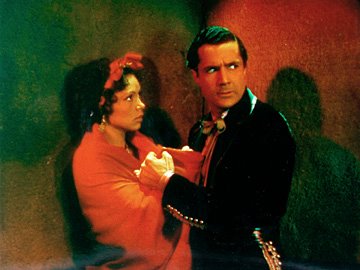
colourThe first live-action film in three-strip Technicolor, La Cucaracha shows off the range and intensity of the hues that it reproduces. Both women and men are dressed in gaily-coloured clothing: reds, greens, and bright blues. Choleric with anger, a character visibly becomes red in the face. Overcome with rage, the lead characters are lit in vivid scarlet and green.

(Technicolor's official site includes a history of the company and the process, and also a Quicktime clip from La Cucaracha, which they describe as a "dumb" movie.)

The film's plot concerns the revenge of Chatita, a singer spurned by her dancer boyfriend Pancho because he is too busy wowing a Mexico City impresario who has come to the bar he works scouting for talent. Pancho angrily denounces Chatita as a cucaracha, cockroach. To sabotage his prospects, Chatita therefore ensures that the impresario's salad is laced with lashings of burning Tabasco sauce. And she shows herself too hot to handle by engaging in a musical duel, drowning out Pancho's tune with her own rendition of a song entitled "La Cucaracha" and then dancing out her aggression in a feisty pas à  deux.

Pancho is outraged, but it turns out (of course) that this intensity is precisely what the impresario wants. On the spot, he books the both of them for his capital-city nightclub.

And intensity is clearly what Hollywood is seeking with this film. The Latin context and setting provide it in spades. Now in full colour, cinema demonstrates how rapidly it is becoming a highly efficient mechanism for the production and distribution--expression--of the affects. This is also expression in the sense that its affect is transmitted by first being subjected to intense pressure, to be then squeezed or forced out from the film's pressure cooker furnace.

With the addition of colour, cinema can now become a fully equipped expressive machine. But it is in Latin America that it finds the raw materials on which it works its modulation and intensification: upping the heat, heightening the tension, saturating with colour.

No real surprise that the Cucaracha's song should be about drugs: a cockroach needing marijuana. Though the image it supplies is of lethargy, affectlessness, lack:
La cucaracha, la cucaracha
ya no quiere caminar;
porque le falta, porque no tiene
marijuana que fumar.
By contrast, everything else here in this film is in surplus: too much colour, too much tabasco, too much emotion, all threatening to carry the characters away.

In the end this film is about an audition: and one audition (Pancho's) turns out to be two (Pancho's and Chatita's). But the represented audition is again doubled by the mode of representation that is tried out in front of a new audience. The film itself is an audition. Hollywood and Technicolor want to convince us of the uses to which this new colour process can be put: they're looking to create a need for their machinic expression, to create a sense of lack within the audience, an addiction that only Technicolor can satisfy.

From affective surplus and excess, to habitual desire premised on lack: finally, this is the process achieved through Hollywood's expressivity, tested and refined here as so often in a Latin American context.

Labels: ,

Saturday, November 26, 2005

Dancing Pirate

As noted at The American Widescreen Museum, very many early Technicolor movies had a Hispanic flavour, "perhaps inspired by the bright colors of the costumes" associated with Latin America. After two-strip (limited colour) efforts such as Rio Rita, the very first live-action full colour Technicolor movie, for instance, was the short La Cucaracha.

Dancing Pirate posterAnd then, in 1936, along came Dancing Pirate, set, like the Zorro movies, in the Spanish California of the early nineteenth century.

Like Rio Rita and La Cucaracha, this too is a musical comedy. The dancing pirate of the title is no pirate, though he is mistakenly identified as one. Rather, he is a dance master from Boston named Jonathan Pride who sometime in 1820, while en route to his aunt's house for the weekend, is forced to join the crew of a buccaneer headed for the West Coast.

Once there, Pride slips away from his pirate companions, still clutching his overnight case and the umbrella he had intended to return to his long-suffering aunt. He makes his way to the village of Las Palomas, where the townspeople, under the bumbling leadership of alcalde Don Emilio José María Salazar y Perena, are readied to resist the expected pirate onslaught. Capturing the errant dance master, who is taken to be a pirate ringleader, the mayor declares glorious victory over the barbarian hordes, and prepares to hang his prize in the morning.

On the scaffold, however, Pride is asked to dance at the suggestion of the mayor's beautiful daughter, Serafina, who has an inkling that this pirate may not be all he seems. So dance he does.

scaffold
What's more, Pride lets out that he has dedicated rather more of his life to teaching young women the waltz than to roaming the high seas. At the news that she could learn how to waltz from him, Serafina begs her father for a reprieve. And so the dancing pirate gains a stay of execution while he gives lessons in this daring dance--daring because it involves the man putting his arm around the woman's waist. Naturally enough, and as if to confirm the fears of the scandalized mayor, Serafina and Jonathan fall in love over the course of their lessons.

As if being on death row were not enough, more trouble is brewing in Las Palomas. A contingent of soldiers garrison themselves in the town, rather outstaying the hospitality shown them as they commandeer even the mayor's bath tub and hot water. It soon emerges, moreover, that their captain, Don Balthazar, has designs on both Serafina and the Perena's well-apportioned estate. As the captain threatens to have the dancing pirate killed, the mayor's daughter agrees to marry him on condition that he save her true lover. (Have we heard this story before, I wonder?)

Through all these travails, from impressment to the verge of execution, Pride remains curiously impassive, barely protesting his fate except in the most cautious expressions of polite umbrage. Though the waltz that he teaches instills a daring sensuality (it is, he reminds us, "an intimate dance"), the teacher himself is strangely affectless, detached from his situation. The villagers, though gradually won over to his charms, express increasing frustration at his lack of resolve. "It's too bad you haven't got any Spanish blood in you," an exasperated friendly innkeeper tells him, "You would die fighting for your woman." Even the ineffectual alcalde, giving his daughter away, rather hopes that her defeated suitor might hit the army captain over the head with his ever-present umbrella.

But Pride does have a plan up his sleeve. Exiled from Las Palomas, he recruits a group of indigenous warriors to fight for his cause. Unfortunately, they are rather too pacific, and still have to master a war dance. So the dancing pirate steps in, and teaches them a dance that will whip them up to martial frenzy, so that soon they are headed back to the village to take on the Spanish army. Then, with the footsoldiers (literally) tied up, Pride takes on Don Balthazar, and what he doesn't know about fencing he more than makes up for with his balletic twists and turns. Finally, even the umbrella comes in handy as a foil for the captain's blade. With Balthazar defeated and sent packing, once again the wedding arranged by and for the dastardly usurper is transformed into the occasion to unite Anglo and Latina in a happy celebration of bicultural resolution.

bride and groom
Moreover, through the dance master's stay in the village, the melding of West Coast Latin and East Coast WASP (and, one should add, indigenous remnant) has effected also an affective modulation. Serafina has learned to revel in the fashionable intimacy that is the modern European waltz. Jonathan has leaned to live up to his surname and take hot-blooded Latin pride in himself and so master his fate. (And the Indians have been roused from their domesticated slumber, to be converted into effective fighters for American self-determination.)

In short, it is as though the ideal affective subject had to break from stifling tradition (habit) without losing fiery authenticity. That subjectivity can only be achieved through a combination of Anglo modernization and Latin spirit. On their own, each is ineffectual, and prey to tyranny: the first because it degenerates into lifeless courtesy; the second because it is all enthusiastic bluster without rational direction.

Labels: ,

Saturday, November 12, 2005

Salvador

Salvador posterAs he is dragged off a Greyhound bus while his Salvadoran girlfriend and her children are taken away by the US Immigration Service, the last we hear from lead character Richard Boyle in Oliver Stone's Salvador is him screaming:
If you send her back they will kill her, they will rape her, and they will mutilate her [. . .] You don't know what it's like in El Salvador! You have no idea what it's like there. You have no idea! . . . Maria!
Then, as the final credits start to roll, this movie whose tagline is simply "Based on a true story" breaks the sense of cinematic illusion, emphasizing rather its documentary claims, by informing us that "Maria and her children survived and were last rumored to be in a refugee camp in Guatemala" and that Richard Boyle is still looking for them.

At the same time, however, we are also told of Boyle's fellow photojournalist, who we have just seen portrayed as he dies taking a picture of a aeroplane strafing the streets of a rebel-held town, that "John Cassady's photos were published."

Hoagland's last framesYet, unlike Boyle, Cassady is not a real person. Rather, he is a character somewhat loosely based on the life of John Hoagland--a US photographer in Salvador who did indeed most likely document his own death with the last six photos he shot, but not at all in the circumstances depicted in Stone's film. (If anything, what's so horrifying about his death scene is how banal it is: a lonely stretch of road and two soldiers on foot.)

Such, of course, are the risks run by any film "based on a true story," above all a film that, as in Salvador's case, also wants to raise political consciousness and galvanize action.

Are we to take the stories of the fictional characters that humanize and mediate political realities at the same level as those realities themselves? If we have reason to doubt what we are told about "John Cassady," don't we also have just as much reason to doubt the final credit's assertion that "To date [as of 1986] the murderers of Archbishop Romero have not been found and the same military leaders continue in power"?

We might find it somewhat unlikely that one person--here, Boyle--should be present both when the Salvadoran archbishop is killed (and just feet away from his assassin) and also in the country's second largest town, Santa Ana, when it's taken by the rebels during the "final offensive" of January 1981; that he should not only happen to be friends with the US lay worker killed with the Maryknoll nuns in December 1980, but also should have been with her the night before her death; that he should know both the US Ambassador to the country and a prominent army colonel.

And if this narrative device of placing the film's lead character at the centre of every twist and turn of Salvador's early 1980s history is unconvincing, might we not also doubt other aspects of the way in which these events are depicted? And what then are we to think of the film's overt political message, that the FMLN's guerrilla uprising was basically justified and that the US military were in league with government death squads?

Oliver Stone's films--and this is arguably the first "proper" Stone film, after a couple of squibs including The Hand--are particularly subject to this tension. Stone characteristically combines melodramatic bombast with his desire to document and proselytize. But the same contradiction afflicts any docudrama, and indeed just about any project of political film-making.

Indeed, more generally, we see here cinema's constitutive split between (to borrow a phrase) the "magical" and the "real." The seventh art is both the most realistic of forms (combining image, sound, and movement) and also, for the same reasons, the most powerfully illusionistic (able to deploy the most special of "special effects"). From its very outset, in the distinction between the Lumière brothers' documentary impulses and George Méliès's preference for magic, these have been the twin, indissociable poles of cinematic representation.

Stone, perhaps more than anyone, wants to combine these two aspects of film both to convince and to shock his audience, to reveal and to dazzle.

Salvador was intended as an intervention into the geopolitics of the late Cold War era. Made at the height of national debate over US policy in Central America, the film aimed both at the minds and the solar plexus of its American audience. Stone himself saw El Salvador as a potential re-run of Vietnam (and would almost immediately go on to film Platoon). But then so did the Reagan Hawks whom he so despised.

Not that this is the only similarity between Stone and those he criticises. More importantly still, the question is whether his own politics of spectacular critique merely mirror, or perhaps play into, a dominant political mode in which image is all, affect trumps persuasion, and "shock and awe" are enshrined as foreign policy and strategy.

Stone is aware of this danger (what else is Natural Born Killers about if not the ambivalent power of the media?), but he wants us to believe him because his is the voice of suffering, and so the real. He has suffered personally (in Vietnam) and for his art (in the numerous obstacles he had to overcome to make Salvador above all). No wonder that the controlling voice of this film should be that of the gonzo journalist Boyle, who repeatedly finds himself beaten up, able to save himself only by his gift of the gab.

James Woods as Richard Boyle
But the problem is that this gonzo affect that is meant to ground Stone's message is, of course, simply another cinematic effect, another of the tall tales that endlessly contribute to Stone's (and Hollywood's) own mystique and mystification.

[Update: on the twenty-fifth anniversary of the killing of the Maryknoll nuns, an article "In His Sister's Name", from northjersey.com. Via Tim's El Salvador blog.]

Labels: ,

Tuesday, November 01, 2005

malleability

What, if anything, unites Hollywood movies that portray Latin America? Is there some shared element beyond the contingent commonality of theme? Hollywood's Latin movies don't constitute a genre--they follow many different generic conventions. But perhaps they make up a mood, a style?

DeeDee Halleck suggests that there is one over-riding narrative to these stories set south of the border. By contrast, what's most striking is the variety of excuses or reasons for invoking latinidad. Latins can play (or be played as) sexy lovers, tragic heroes, ridiculous clowns, noble savages... their "expressive faces" are multivalent.

Is this one possible key: that there is some resonance between Latin America and the movie industry. Both are defined by the self-reflexivity and variability of their performative affect. It is in its (re)production of the Latin that Hollywood sees its chance to incarnate, make real, the other; to think through an other's body.

Labels: ,

Sunday, October 09, 2005

Herbie Goes Bananas

Herbie poster"I love your country," says Harvey Korman as Captain Blythe at one point in this automotive caper. "It's very colourful, and the children have such expressive faces."

And Disney seems to have needed no more excuse than this to set its third (and until this year's revival, Herbie: Fully Loaded, also final) sequel to The Love Bug in what becomes an increasingly dislocated Latin America.

Herbie Goes Bananas is loaded down with colour and cliché, from Inca gold to a bizarre car-as-toreador bullfight. Its leading character is the Mexican child pickpocket, Paco, whose face mostly expresses first fear as he is pursued by his various victims seeking revenge or restitution, and then joy as he is repeatedly rescued by his friend Herbie, the VW Bug with a mind of its own. And the Latin America that this road/cruise movie traverses is dislocated as any sense of geography disappears in a puff of the VW's exhaust.

But let's try to trace the film's route nonetheless. It opens in Puerto Vallarta, to which our notional heroes, DJ and Pete, have travelled by bus to pick up the old racing car, Herbie. Here Paco steals their wallet, as well as that of one of the criminal combo who are looking to unearth Inca gold. Inadvertently, Paco transfers the negatives that are somehow key to the Inca gold discovery to DJ and Pete's possession. So the bad guys are also on his trail as he stows away on a cruise ship headed down to Rio, where Herbie is to race in the Brazilian grand prix.

At sea, the car is tossed overboard for various misdemeanours committed on deck, and DJ and Pete (along with newfound companions PhD student Melissa and her lascivious Aunt Louise) are told to leave the ship when it docks en route at Panama. Herbie (whom, incidentally, Paco calls "Ocho") has meanwhile managed to swim his way to Panama also, where the various characters, including now the stranded captain Blythe, take to the road again.

Here's where the geography goes to pot. Unremarked, the Beetle and its pursuers would seem to traverse the Darien Gap by road, somehow achieving the feat despite the fact that this is where the Panamerican Highway peters out. Paco tells Blythe shortly before the bullfight scene that "Panama's long gone, capitán." Which, as they are heading south, places them already in Colombia. Not long thereafter, from the middle of the jungle, the captain tries to get a message to his ship to wait for him in Tobago, while the bad guys are busy digging up an enormous gold disk of Inca gold, and DJ informs the assembled company that they are only twelve miles from an airport in Chiclayo--which would put them in the Peruvian coastal desert. A little later, as the party are presumably drawing towards Tobago (i.e. in northeastern Venezuela), we're told that they have driven (only!) 700 miles with their car blanketed in bananas. Oh, and Herbie's powers are ascribed to (Haitian) vodú.

OK, so verisimilitude is hardly a high priority for a film whose star is a car that can think, communicate, and act on its own.

What we have is an imaginary geography that pretty much respects the map from Mexico to Panama, but that consists in an extraordinary contraction once south of the canal. In South America itself, the South Pacific, Amazonia, and the Caribbean are all essentially contiguous territories. Remains of Inca civilization can be found right next to banana plantations, the nation state and the inconvenient obstacles of border posts disappear, as also do "customs" in the sense of localizing cultural traits.

"Why are we going in circles?" asks one of the criminal gang as they try vainly to escape in a light plane. Because, well because this is a topography of affective intensity (colour and childlike expressivity) rather than geometric extension. Unlike most road movies, whose aim is to chart a territory, to mark out its boundaries and investigate the spatial coordination of its customs and cultures, Herbie Goes Bananas describes endless circles to give a dizzying sensation of "south of the border disorder."

But there's no necessary value to be attached to affective intensity. And frankly, in this instance the car should have been left at the bottom of the ocean.

Herbie on the plank

Labels: ,