Saturday, June 23, 2018

Back From Eternity

Seventeen years earlier, John Farrow directed what was probably one of the first airplane crash thrillers. Despite the fact that Five Came Back remained known as an adventure B movie, its fame helped most of its characters to move forward to Hollywood A production industry. It is in 1956 that Farrow directs Back From Eternity, a remake of the low-budget 1939 hit, but know 'correcting' aspects of the plot that failed to make it more recognized, from characters to extensions of the dialogue.

The general plot is basically the same: eleven passengers on a commercial aircraft flying towards Latin America crashes in the middle of the jungle and only five of them come back in the partially repaired airplane. However, to make this a mainstream movie, Farrow's movie starred a highly popular cast for promotion purposes. This was made very clear on the movie's poster which emphasizes the participation of the renowned superstar Anita Ekberg with the phrase "Ooh that Ekberg!".

Among the changes made to the movie (of course thanks to bigger budget expenses) there are some that concern to the quality of the production such as more filming locations and characters that allow to expand the story, better accessories, and an evidently more modern plane; there are other changes that might reflect the audience input after seeing the first movie, and also the good neighbour policy of the previous decades which influenced in the portrayal of Latin America in a different way than in the original movie. Certainly, Back From Eternity shows a friendlier approach regarding Latin America and its people. In the 1939 movie, the only occasion in which the United States and Latin America are contrasted is in the airport in Mexico, but this contrast, ironically, shows that there is no such thing because American culture and language predominate in the only Latin American city depicted in the movie. In this new delivery, in contrast, we visit El Paso and Panama City before the crash. The difference is evident. In addition to people finally speaking in Spanish and passengers excited to try local foods, at the entrance of the Mexican airport the first image we see is a humble Mexican woman selling ponchos, in contrast to the convicted Panamanian criminal who is the first Latino we see in the previous movie.

The character of the Latino criminal has been modified too. Now he is not even Latino, but a European that nationalized in the fictional South American destination called Boca Bravo. In this movie, he is not considered an anarchist or a dangerous person. Instead, Vasquel's (a variation of Vasquez, name used for the character in the original movie) friendly personality makes the rest of the group consider him trustworthy which also affects the end of the movie. In this occasion, Vasquel does not steal the gun but the group entrusts it to him. Interestingly, Farrow's choices on Vasquel's character and dialogue reflect the transition from the Good Neighbour Policy era to a returning period of US intervention during the Cold War which amounted to Soviet influences on Latin America. Though neither the non-intervention principle's nor the US-Soviet conflict is mentioned, Vasquel portrays just those two with his friendship with the old American couple, plus the rightfulness of his cause. He killed a politician but because he was aiming to kill a dictator that was as oppressive as the ones in Europe.

Thus, we are implicitly introduced to a Latin America struggling to get help to overthrow its dictatorial governments. We see its humble and friendly people who are deserving of that help. But still, Latin America is again in this remake a place of adventure that offers promising vacations or new beginnings but also it is the home of dangerous tribes where civilization has not reached yet. This movie is all about what the audience wants to see: more emotions, bigger planes, and more references to the reality, or what it should be like.

Labels:

Five Came Back

John Farrow’s Five Came Back (1939) is a black and white thriller about an airplane crash in the middle of the dense Amazon jungle. Though it is remembered as a ‘B’ production, it is probably the first movie of its kind and inspired later airplane disaster movies from the remake Back from Eternity (1956) to the Airport series in the 1970s. Travelling from Los Angeles to Panama City, a commercial flight with twelve people on board suffers an engine problem because of a tropical storm and ends up landing in the Amazon rainforest. In the wait to get rescued or repairing the damaged plane to fly back home, the passengers will rediscover themselves after living and cooperating with each other to survive for twenty-four days.

The movie starts with a quick introduction of the characters in the airport before they get on the plane. From then we know that every passenger has a different motivation to travel to Latin America, but they will agree on the reasons to come back.

Judson (Patric Knowles) and Alice (Wendy Berrie) are a rich couple going to Panama to get married against their family wishes. An old couple, Prof. Henry Spengler (C. Aubrey Smith) and his wife look for a tropical adventure that can revive their love. Pete (Allen Jenkins) is a gangster’s right hand escaping with his child away from American justice. The seventh person is Peggy Nolan (Lucille Ball) who is trying to forget about her failing romances in a place where can start over. And finally, extradited to his home country by the US government for having killed a high-rank politician, Vasquez (Joseph Calleia), a Panamanian anarchist travels to face justice accompanied by Crimp (John Carradine) as his custodian. Of course, we also see the pilots Bill and Joe (Chester Morris and Kent Taylor) and the flight steward Larry, but it is not after the crash that we get to know more about them.

First the plane lands in Mexico for a layover. As soon as the passages know they have crossed the border, the general assumption is that the food will be too spicy and the people Spanish speakers. Ironically, however, the America versus Latin America contrasting imagination fades away when the group realizes that the airport restaurant is run by a Chinese-American chef who speaks English.

The characters, dialogues and landscapes are used by Farrow to portray the different realities that one might experience when travelling to Latin America. The Mexican airport, for example, is the Latin America for the tourists, made by Americans and for Americans. Such is the influence that the passengers do not have to worry about speaking a foreign language or eating foreign food. That is a controlled and secure place, but then we are taken to a totally different Latin America after the crash. The Amazon jungle is nothing like what everyone was expecting when arriving in Panama City. The closest city can only be reached by flying out; the jungle provides enough food and water to survive, but the Amazon Indians will soon come to torture or kill everyone.

The Amazon jungle in its anarchical and isolated state forces the group to commit to an organization based on reason, but also power, similar to Hobbes’ hypothetical state of nature. The Amazon jungle then is the place where theories of pre-civilization stage, where political fiction can be experimented with. To survive, Hobbes argued, a leader with coercive power is designated to protect the whole from the fear of brutish dead. Farrows movie likewise is about the survival of the whole, and the fear of being attacked by an uncivilized tribe motives them to chose one leader, and the power that leader has for ensuring control is a gun. Whoever has the gun, has power too. This unexpected experience and the designation of roles (women cook and take care of the child, men repair the plain, look for resources, and protect the settlement) profoundly transforms each person’s perception of life. The most important change is produced in the anarchical criminal mind of Vasquez. Seeing that the group has been able to organize itself, Vasquez accepts that figures of authority for politics and justice are necessary and that the problem is corrupt people and anarchists like him.

After two people get killed by the Indians, there is no other option than trying to fly out or die in their hands, but only 5 people can get on the plane. Vasquez takes the gun and thus the power to decide. He kills the rich Judson who became an alcoholic and offered money to get a spot. The kid, the two young women and the two pilots who are now romantically involved go back, and the old couple who revived their love and got to explore Latin America decide to stay with Vasquez.

Latin America is shown with its many faces. It is a safe touristic destination highly influenced by the United States, in language and in food, as well as in social and political practices; it is the “civilized” Latin America. But in places beyond the reach of American influence, such as the Amazon forest, it remains an exotic, uncivilized, and dangerous place, like in pre-colonial periods. This second face of Latin America is fictional. Indeed, Farrow had constructed the jungle in a studio with plants brought from the jungle but arranged as his imagination about the place took him. Remote places or societies restricted from American culture, technology, language, politics, etc., are stigmatized, but at the same time, that “untouched” nature of the jungle is romanticized since it becomes an opportunity to find the real self and experience, from zero, the beginning of civilizations when governed by reason.

Moreover, the movie shows an implicit support for gun use as a mean to enforce justice. So the question is: had the gun not been present, would the five survivors still be able to get on the plane? Perhaps without it, the corrupt and alcoholic Judson could have taken one of the pilots’ seats or left a woman behind. The gun is as well the door for a better death for those staying than being tortured by savage Indians. And the Indians, aren’t they also beings of reason which make them able to create norms and rules in the same “state of nature” circumstance? Certainly, in this movie the answer might be negative since Farrow shows only the fear those Indians provoke, we do not see their faces, but we know they are coming to hunt foreigners.

Labels:

Wednesday, June 06, 2018

Strange Wilderness

Strange Wilderness (2008) is a comedy directed by Fred Wolf about an animal TV show. A son takes over his dead father’s TV show which has become a failure at risk of cancellation as it lacks inspiration, budget and audience. The program is widely criticized because of the inaccuracy between its themes and what is presented on the screen; the show has passed from being an educational natural wilderness-themed program to a sensationalist and ridiculous representation of human wilderness (sex, blood, and drugs). To honour his father’s memory, the son, Peter (Steve Zahn), forms a group of four men and a woman to look for the legendary “Bigfoot” creature in the Ecuadorian forest. A trip to Latin America could help the group increase the show’s ratings, and it is also an opportunity to go on a real and wild adventure. It is a parody of animal-life shows like National Geographic or Animal Planet and questions the concept of “wilderness.”

By the time they get to the jungle, we know that any representation of animal wilderness will have a sexual undertone, a tragic death, or some footage of animal life accompanied by a nonsensical description. When they arrive at the Ecuadorean jungle, for example, the first wild animal to be portrayed in the TV show is a monkey, shown with the comment that “monkeys make up over 80% of the monkey population.” Immediately thereafter, Peter randomly talks about lions, zebras, giraffes, and gazelles, all iconic animals from Africa, not South America. The movie is full of generally mistaken and mismatching information like this one that let us assume that the group has no idea of what they are doing or talking about, which contributes to the simplistic humour of the plot.

Clearly each member of the group has a problem with drugs, alcohol, or/and a perverted mind which relates everything to sex. Men are presented like some kind of prehistoric troglodytes trying to show off their masculinity to the rest of the group Their uncontrollable and desperate need for women, and their failing efforts to prove themselves superior to animals, make their silliness extremely obvious. The only woman in the group (also basically the only woman in the movie) adds the brain to the group. She seems very aware of the ridiculousness of the trip and of the teenage-perversion of the group, but she is doing her job, so her opinion does not really count.

The trip to Ecuador is not only an adventure to find Bigfoot; it also represents hope to find their better selves. For Pete, keeping the show on screen is saving a legacy and part of his pursuit to become more like his dad. For Whitaker (Kevin Heffernan), going to a recondite place in the middle of the jungle is a chance to force himself out of alcoholism and to experience real life (sober). For the group as a whole, this journey forms not only a group of colleagues but a group of new friends.

In the movie, travelling to the South American wilderness (and finding Bigfoot) is the craziest idea one could have. And to everyone's surprise, since the plot is full of failures, in the end they do indeed find the creature. However, their hopes vanish after they “accidentally” kill Bigfoot and go back to the United States.

How is Latin America being portrayed? One of the reasons the group travels South the Border is to fulfill their expectations of presenting “real wilderness” in the TV show so it stays on the screen. Through the journey across the jungle to find Bigfoot, we are introduced to a dangerous place (funny, exotic, but dangerous): a lot of monkeys, snakes, carnivorous piranhas, tribes that cut scrotums and kill with arrows, explorers who will take advantage of you and steal your belongings, and of course the enormous Bigfoot.

Yet the portrayal of Latin American nature is not really important to the plot (we know that all the information given is intentionally mistaken or exaggerated because of the genre). The main reason for going on the trip is to seek out new material that will increase the TV show’s ratings. Animal life, whether it is a Latin American beast or an insect from the tree outside a building, is taken and exploited as a commodity. In the movie, those kinds of TV shows will not portray wilderness as it is, but as the audience wants it. Nature has been fetishized with sensationalist images; sex, blood, or comedy itself are more important than the facts. This is very clear at the end of the movie after the Bigfoot report is not accepted since Pete decides to film an episode about shark attacks, which saves the TV show. "People love shark attacks, you are back again," says the TV director. And what is wilderness? Who or what is "the wild"? Even though the TV show is called Strange Wilderness (referring to wild animals) and the Latin America jungle is the wildest place they could go to, ridiculing aspects of American pop culture like views on the use of drugs and guns, the sexual portrayal of women on TV (even worse of women of tropical places like Latin America and Africa), and sensationalism to create profit, suggest that animal-life or Latin America is not the only wild ideas portrayed in this film (they are scarcely important at all in the movie, to be honest).

Certainly, what is being portrayed about the Latin American jungle might appear quite wild, but these imaginaries of wilderness (like violent indigenous tribes and creatures living in caves) are only the space to which Western Society compares itself to argue it is superior, and a more civilized society. Wilderness is a word used to emphasize the most uncivilized, least human, least Western aspects of life. It is a word used to create a division and to reject certain truths that make "civilized" society uncomfortable. What could be wilder than killing animals for no reason, seeing women as a sexual object, becoming desperate for food or sex, doing crazy things under the influence of alcohol and drugs, feeling entertained when there is a shark attack or someone dies, and then using all these things to have more ratings on screen?

Labels: , ,

Sunday, June 03, 2018

The Green Inferno

Inspired by the well-known cannibal film, Cannibal Holocaust, Eli Roth directs The Green Inferno (2013), a horror and adventure movie that portrays the controversial practice that was allegedly once part (or perhaps still is part) of the cultural rituals of some indigenous tribes living in the Amazon forest, human cannibalism. A group of young American humanitarian activists travel to the Peruvian Amazon to oppose the establishment of a multinational corporation helped by the local government which will destroy “untouched” areas of the jungle and kill indigenous tribes living there.

On their way to the Amazon, the group can see from the window of their plane the beautiful landscape of the rainforest: the predominant colour on the screen is the green of the jungle with some rivers crossing in between. Those images, and later the long trip by boat to the construction site, make the activists think that indeed the Amazon is an untouched environment in danger. They use as a strategy the exposition the corporation and the military supporting it (ready to kill the natives) on social media. Their plan seemed to have worked, so get on a plane on their way home after having saved the Amazon. Unfortunately, the plane crash in the middle of the jungle where they get kidnapped by a Cannibal tribe that tortures them one by one and prepare them as food for the whole tribe. Like Cannibal Holocaust, Roth makes the bloody killings look very realistic and transmits the feelings of the horrified activists. Nevertheless, the movie does not portray the cannibal tribe as evil or inhumane, on the other hand, Roth discusses different controversial traditions (including genital mutilation and cannibalism) and the difficulties on trying to eliminate or condemn certain practices that are deeply rooted in some cultures. The “human” side of the tribe is represented with the little girl that helps the protagonist Justine (Lorenza Izzo) to escape.

Justine finds her way out of a genital mutilation ceremony and runs into an armed conflict between another private corporation and the tribe. She uses this moment to get rescued and appeal for some real action to stop the destruction of the Amazon and the persecution of the tribe. Once she goes back to the U.S. she uses the influence of her father (lawyer in the UN) to denounce the private corporation’s abuse of human rights. At this point, Justine does not mention anything about her experience or how her group was assassinated by the tribe which will protect the tribe and strengthen the argument for the Amazon preservation.

In addition to displaying bloody and shocking scenes of cannibalism, this movie communicates a sarcastic opinion about activism and about efforts to protect the Amazon rainforest. Before the protest, all the activist group is seen excited about promoting meaningful changes in society and politics, but their efforts remain useless. By the end of the movie, we are taken to some point at the beginning of the movie when Justine was still at the university campus; she wakes up from a horrifying nightmare and the little group of activists that convinced her to travel to the Amazon are still protesting for some campus-related issue. Protecting the Amazon forest and its people is solely a fantasy. Even if there are people protesting for a good cause like preserving indigenous communities with centuries of history, there are numerous layers that make the issue more difficult to tackle such as the flow of money involved, corruption, or the fact that Amazon is not really “untouched” nature. Even those aspects of the tribes like cannibalism could change the way one thinks about them (Are cannibals worth fighting for?).

Various aspects of the Amazon forest are portrayed in the movie, but throughout it is suggested that it would be better not to venture too far in the jungle. The Amazon's dangers (be they human or natural) win out over the beauty of its green richness. Interestingly, there is nothing said about the protection of plants or animals of the Amazon like it is usually done in other Amazon or jungle movies. On the contrary, the plot shows little consideration to the animal life (a machete and a gun are given to the young Americans in case they find any animal in the jungle). Travelling to the Amazon for activism or tourism is portrayed as a worthless cause. Its landscape could seem very green, but its insides are more like an inferno for those who are not aware of how life is there.

Labels: , ,

Thursday, May 31, 2018

The Blue Butterfly

The Blue Butterfly (2004) is a Canadian production inspired by the true story of entomologist George Brossard and David Marenger, but adding a touch of fantasy and mystery to the plot. Its director Léa Pool takes us to the middle of the rainforest in some unnamed part of Latin America (in fact, the movie is filmed in Costa Rica) on a magical journey to fulfill the dream of a little kid who has a terminal brain tumour: catching a very rare blue butterfly, the Blue Morpho. The story is related by the young boy, Pete Carlton (Marc Donato), who in the course of the movie shares with us his memories, personal thoughts, feelings, and what he learns. The entomologist Alan Osborne (William Hurt) agrees to be a guide for Pete and his mother Teresa (Pascale Bussieres), however, the task of finding the butterfly turns out to be more difficult than expected due to the changing seasons and dangerous incidents while exploring the jungle.

For Mr. Osborne and little Pete, seeing a blue butterfly is one of the most beautiful and miraculous events. Once in the rainforest, their passion for insects and their desire to catch this exotic creature make them ignore the beauty of their surroundings: the many other living beings, landscapes and moments that could make the rest of Pete’s life more happy and meaningful than simply adding one more insect to his collection. Influenced by the people of a small village in the middle of the rainforest and their stories (beliefs passed on by their ancestors and myths about the jungle), Pete starts to appreciate these other things than just the Blue Morpho, which eventually becomes less relevant. Nevertheless, Pete keeps those thoughts for himself since Osborne and his mother have already spent time and resources to find the butterfly in very unfavourable conditions, so he continues with the search.

Pool presents the rainforest as a beautiful and exotic place; such beauty makes it a place with an atmosphere full of magic and spontaneous mysticism by which one can achieve an understanding of nature. There are many close-up shots framing diverse animals and plants and complete shots that accompanied by peaceful background sounds and intense colours captivate our attention. All the emphasis is given to the flora, fauna, and landscapes of the jungle creating a romantic portrayal of the Latin American rainforest. Even though there are people living in the village, the plot shares with the viewers a general perception is of an ideal environment free of human intervention when the three Canadians leave the village to explore the jungle; for Pete, there is a division between nature (represented by the butterfly) and himself as a human. On the other hand, Pool also questions this romanticization of nature by exposing another side of the exploration and problematizing the concept of nature.

Meeting Yana, a girl from the local village, Pete reflects on her questions about his desire to catch the Morpho. When Pete says that the butterfly is a miracle, Yana replies "I am blue butterfly, you are blue butterfly, everything is blue butterfly." This line changes Pete's perception of nature and its apparent separation from humans. He understands that what he had considered a miracle of the Latin American rainforest, is in fact only an alibi for his desire to escape his own reality, to stop thinking about his illness. In the end, finding the butterfly does not satisfy Pete's desires, but the journey does help him to understand that Latin America and its natural "miracles" have nothing magical or mystic on them other than what society constructs. The way in which the rainforest is romanticized can misrepresent the reality, whether this omitted information or attributes are positive or negative, like the beauty of its people's culture and traditions, or the dangers of its wild places and species, as presented in the movie.

Labels: ,

Friday, May 18, 2018

The Rundown

During the colonial period, European explorers were convinced that the legendary gold city called El Dorado was real. Desires of finding that promising place full of gold inspired numerous movies such as “Aguirre, Wrath of God” (1972) and the animated movie “El Dorado” (2000), among others. These fantasy stories recounted adventures of imperialist explorers looking for hidden gold mines in the Amazon rainforest. But how would life look like if the legend of El Dorado was not a tale, but a reality? It is that possibility that Peter Berg presents in The Rundown (2003). Berg creates another treasure-hunting adventure in the dystopic reality of a village called “Hell Dorado” (indigenous from the Amazon replace El by Hell expressing their opposition to the gold mining companies looking for their village).

Beck (Dwayne Johnson) goes to the Brazilian Amazon looking for an American guy (Travis) that should take back to the United States. The huge Amazon rainforest is shown in a wide shot accompanied by the lyrics of a soundtrack shouting “don’t bring guns home”. This shot establishes a romantic view of nature, a beautiful place that has not been touched yet. However, on the way to El Dorado, there are a lot of contradictions that make the idealization of nature fall apart. Beck is warned to stay away from the jungle and from a group of rebels that will otherwise kill him. Once in El Dorado, Beck is introduced to the owner of the biggest gold mine in the area, which is also a source of political and economic power over all the Brazilian people, especially over the poor families living from their work in the mines. For foreign mining investors, the once celebrated source of gold is still a promising way to become rich, however, for the Amazon communities that gold was only the source of an eternal slavery and destruction of nature.

In the middle of the mission, Beck and Travis are caught in traps of the rebel group. After some time coexisting with the group, Beck realizes that the foreign company has influenced him and many visitors in the are with a wrong perception about the intentions of the so-called “rebels”. Indeed, they are rebelling but against oppression. This group of native Amazonians fight against the mining company that even though has provided with some infrastructure and “modern” lifestyle, it has also brought instability, poverty and ways to keep the village under dependency. Both the company personnel and the “rebel” group start a search for a golden statue shaped like a cat that is hidden in the Amazon. Such object will provide the local community with freedom from the monopoly of gold mines, and reform the economic system with practices such as agriculture, among other ones that would go in accordance with their ancestral traditions.

The movie ends with the successful searching of the golden item, and the expulsion of the mining company from the Amazon. The dystopia is eliminated from the plot and the Brazilian Amazon becomes a land ruled by Brazilians. Nevertheless, the fight was not to come back to the previous indigenous lifestyle but to improve the conditions in which modernity is imposed. Because of coloniality people's culture and beliefs are shaped and it is almost impossible to decolonize them. For example, the mine owner insults the natives for being unthankful since he gave shoes for the barefoot indigenous and hired them to buy things they want. Even though natives reject everything that comes from the mining business, they will not stop using clothes or shoes, instead, this is adapted to their own lifestyle.

The visual dichotomies proposed throughout the plot between the beauty of the jungle and the social injustices of people taking advantage of its resources are shocking. The ways in which Latin America, its people, and the people looking for its treasures (natural resources) are portrayed make a call to reflection, especially in the negative environmental and social impacts that resource-extraction monopolies could cause.=

Labels: , ,

Thursday, May 17, 2018

Dragonfly

A mystery is presented in different manners in Tom Shadyac’s Dragronfly (2002) which confuses the audience about the main genre of the movie. It starts with the sudden death of a loved one and its denial, then it turns into an almost scary ghost film, and finally closes with a dangerous adventure in the Venezuelan jungle, all driven by the conviction that love goes beyond death. The story is full of clues and analogies suggesting a truth that Dr. Joe Darrow (Kevin Costner) will discover after immersing himself into the mysterious Amazon forest.

The story starts with a chaotic scene in which Joe’s pregnant wife, doctor Emily Darrow (Susana Thompson), is taken on a bus from a rural community in Venezuela to another location as part of a Red Cross mission. Waters from a heavy rain soften the soils of a poorly constructed and unsafe road causing a landfall and pushing the bus to an end down the cliff. Some people were rescued, other died, but Emily’s body was never found, which raises doubts in Joe’s mind on whether his wife really died or not. Joe becomes frustrated trying to find answers to what did his wife see in Latin America that she rather put herself and their baby in danger than building a career in a U.S hospital, as he did. “I am needed there”, said Emily before going in the mission which tells us about the interest on helping as one of the reason. But there are some symbols suggesting that Emily was also attracted by exotic nature such as her pet and her favourite animal, a talking parrot and dragonflies which are found in tropical places like the Amazon rainforest.

Meanwhile, the mystery increases more and more reaching a stage of mental breakdown. Joe chooses to work in the pediatric department of the hospital where his wife used to work. Emily starts to appear in the dreams of children at the edge of death and like a ghost hunts Joe’s house attempting to communicate a message. Dragonflies, rainbows, waterfalls and pictures of his wife with an indigenous community in the Amazon forest are the hints Emily provides Joe with to force a trip to Venezuela.

Once in Venezuela, there is a lot of distrust of the alien. Joe is skeptic about the abilities of Venezuelans to handle technology like flying a small plane or indigenous holding guns. On the other hand, Venezuelans are also skeptic about leaving Joe getting into the Amazon and to their villages by himself. Though Venezuela is portrayed as a poor country that lacks knowledge about technologies or medicine, the travel guide and indigenous people of the area own another type of knowledge that Joe lacks: they know the forest and its dangers. The little importance Joe gives to this local knowledge is the cause of a misfortune that almost costs his own life. By the end of the movie, Joe finally finds the place from his wife’s pictures, a village of indigenous people next to a waterfall from where a rainbow usually emerges, and a small mark of a dragonfly on a baby’s foot, the baby the people from village saved before Emily passed away. “I do not know what Emily saw [….] and I do not know how the baby survived so small and fragile in the middle of the jungle”; that is Joe’s reflection on how the plot unfolded and then comes back to its routine in Chicago.

In this movie, the Amazon rainforest is depicted as a dangerous place, especially because of imaginaries of "wilderness" with landscapes free of human intervention. This romanticization of nature takes two forms in the movie. On one hand, Emily's desire to go on the Red Cross mission shows a paternalistic perspective from which arises a feeling of humanitarian responsibility. Taking care of those living in a stage of intellectual immaturity and provide them with the "advancements" of modernity including technology and medicine is a goal to reach. On the other hand, Shadyac presents the survival of Joe's daughter as a miracle. Even though it is very explicit that she was taken care of by the indigenous tribe, Joe talks about the jungle disregarding the people living there and their knowledge, like if the baby was left alone for the whole time.

When the plot moves to Venezuela, the visual hierarchy of the different societies being represented is clear (like in the image). On the top is Joe coming from the United States, a well-educated man who wears clean clothes. Then we have the guide, a Venezuelan who speaks Spanish, the tribe's language, and even more important for the plot, English; he knows how to drive and fly aircraft (though without a license) and wears average clothes, but a bit old and dirty. And at the bottom, there is the tribe. Even under the developing Venezuelan society portrayed in the character of the guide, these people speak only their language, live in the jungle, use primitive tools to defend themselves, and wear almost no clothes. How could the tribe live without medicine, without technology and many other things that are indispensable for modern societies? There is no answer to this question in the movie because whatever they knew or did to maintain their lifestyle is not considered as something important, and on the contrary, indigenous people are happy and thankful to be introduced to Western knowledge. That is what an old indigenous lady tells Joe about what Emily did for them. For the director of this movie the reality of the Amazon tribes and people of Latin America more generally, could change if people like Emily and Joe reach those "wild" communities.

Labels: ,

Friday, December 09, 2005

The Naked Jungle

The Naked Jungle posterIn Italy, apparently, the Charlton Heston / Eleanor Parker vehicle The Naked Jungle goes under the title "Furia Bianca," or "White Rage." The discrepancy between the two titles--one of which highlights the main characters and their affect; the other of which points to the environment in which they are set--indicates the tension that lies at the heart of this movie. There is the story of "man against nature," which was the focus of the Carl Stephenson short story "Leiningen vs the Ants," on which this movie is based; and then there is the melodramatic confrontation between the sexes, played out in the face of natural adversity.

Of course, the point is in part that the main characters--pioneer settler Christopher Leiningen, played by Heston, and his mail-order bride Joanna, played by Parker--are themselves forces of nature. The movie suggests that the circumstances of their relative isolation from "civilized" norms, which have to be imposed upon an unforgiving Amazon terrain, reveal a basic difference between man and woman. But it also implies that at the limit, as the reclaimed land upon which Leiningen's cocoa plantation sits is sacrificed back to the river, a more fundamental synergy can be achieved: in the end, gender difference between husband and wife is subordinate to their common humanity when their greatest struggle is simply to stay alive.

The jungle, then, is the great leveller.

And The Naked Jungle is something like a melodramatic Heart of Darkness. Indeed, the movie recalls Conrad's book in its opening scenes, in which we follow Joanna up the river as she comes closer to meeting her husband for the first time. We are led to believe that Leiningen is fearsome and somehow unknowable. Even his best friend, the Brazilian government official who had played the part of Joanna in the ceremony formalizing their proxy marriage, indicates that finally this proudly independent foreigner is a mystery to him. Leiningen has claimed the jungle, but the jungle has also claimed him as one of its own; it is up to the white woman to come and claim him back for humanity.

Yet Leiningen has also established a simulacrum of Enlightenment order in his remote terrain. His sumptuously-outfitted mansion includes a grand piano just waiting for someone to play it; and he prides himself on his humane treatment of his native workers. His is a civilizing mission. Left to their own devices, he claims, the locals would return to their head-hunting ways. But he is not, in the end, so different from his neighbour and rival, the German, Gruber, who whips his charges into submission: Leiningen, too, secures order through force rather than consent, as is indicated when he burns the workers' boats to ensure that they do not flee the plantation when they discover it's in the path of a column of voracious soldier ants, who will destroy everything they come across.

antThere's no doubt that there's a political allegory here, as DeeDee Halleck implies: the menacing ants are "red" soldier ants, anthropomorphized when Leiningen captures one and holds it up to inspection, and enemies of private property, capitalist enterprise, and individual liberty. What's at stake is the one against the many. But it is not as though capitalism really wins the day.

For in the end, Leiningen is forced to burn his furniture and floods his own fields. In the end it is not capital that survives but the human couple, reduced close to what Giorgio Agamben would term "bare life." Their poverty is absolute.

And it is not the state or the modern biopolitical machine that reduces Leiningen and his wife to bare life. The state here is hardly present, incarnated only in the roving Commissioner who advocates only resignation in the face of the "Marabunta," the ant onslaught, who can at best inform his superiors down-river of what's going on in the heartland. Bare life, here, results at the interface of savage capitalism--accumulation at its most primitive, which is also its most immediately colonial, civilizing--and a natural multitude that springs from nothing and is headed no-one knows where.

The Amazon is imagined as the setting for this grand encounter. But also the setting, simultaneously, for humanity's discovery of its most basic affect: love. A love that dispenses with purity, that accepts that it is use, rather than exchange, that determines value.

In this sense, and no doubt against its intentions, conscious or otherwise, there is something strangely revolutionary about The Naked Jungle.

[Update: Or perhaps not so unintentionally, as I learn that blacklisted writer Ben Maddow was involved with the script. Via Dan Webster's Movies & More.]

Labels: ,

Sunday, November 20, 2005

Men with Guns

The virtues of a road movie are that it can easily combine both realism and fantasy. On the one hand, as in a classic nineteenth-century novel, the episodic nature of road movies effortlessly shows us all the different estates and occupations that constitute society as a whole. On the other hand, few cinematic journeys are ever fully innocent: they soon acquire the character of a fable or mythical quest.

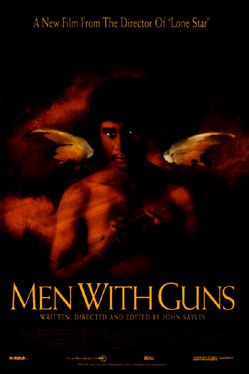
Men with Guns posterIn Men with Guns, then, John Sayles takes on the road movie genre to show us a cross-section of an un-named contemporary Latin American country and to spin a fable of fantasies both utopian and touristic.

Physical geography reveals also human variation. As the film moves from the capital to the countryside, from the plains to the highlands, we also move from a world of bourgeois civility to campesinos eking out an increasingly precarious existence from salt-selling, cane-cutting, or coffee-picking.

The movie's protagonist is Dr Humberto Fuentes, a recently-widowed doctor and medical professor from the capital who is searching for his former students, whom he had sent out three years earlier on a health program to work with the country's indigenous peoples.

En route, he is joined by an orphaned campesino boy, an army deserter, a defrocked priest, and a young woman struck mute since her horrendous rape at the hands of the military.

For everywhere Fuentes goes he finds that the "men with guns" have been there before him. From the army officer in his well-appointed surgery at the film's outset, to the company of soldiers guarding a "model village" of displaced people in the highlands, to the guerrillas in the cloud forest, their influence is all-pervasive.

The quest, then, becomes the search for a place where there will be no more violence, a utopian space "where men with guns don't go" represented by the semi-mythical village "Cerca del Cielo" ("Close to Heaven") that people describe as somewhere "más adelante," "further on," and almost magically hidden from both the army and the guerrillas.

But the words that Fuentes uses to invoke Cerca del Cielo (as he convinces the young mute not to take her own life, not to give up on the quest) are taken straight from a tourist brochure advertising a resort somewhere near Bali: it's a place "where the air is like a caress, where gentle waters flow, where wings of peace lift the burdens from your shoulders."

For this utopian quest comes to overlap with the travels and travails of a pair of US tourists who are out searching for archaeological sites. The two journeys, the search for political refuge and the backpackers' trail, constantly intertwine: early on Fuentes meets the US couple in a roadside restaurant, where (still ignorant about his country) he tells them that accounts of army atrocities are fabrications of the foreign press; later we discover that the tourists are obsessed by a conception of a Latin American culture blood-soaked from an epoch of pre-Columbian sacrifice.

While both natives and foreigners are in some senses looking to turn back time, the tourists are overly fascinated with death, but Fuentes is trying to move past the violence that he's inadvertently uncovering to reach the oasis of peace that, ironically, the Western tourist industry has given him the language to describe.

Finally, this complex and perhaps almost unique film (made by a US director but mostly in Spanish and indigenous languages) maintains a delicate balance between the opposed conceptions of Latin America as utopia and as heart of darkness, between indigenous authenticity and globalized hybridity.

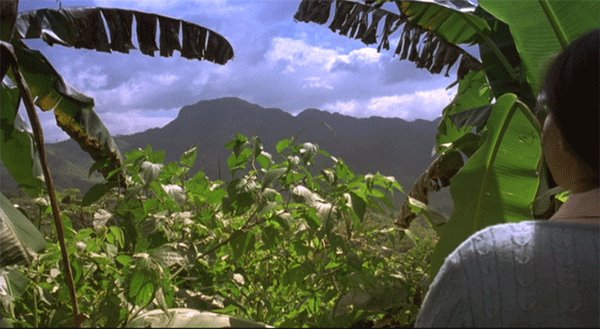
It ends ambivalently and uncertainly: Fuentes fails to find his students, but he does encounter both death and repose; Cerca del Cielo exists, but is no paradise, rather a place of what Sayles himself terms "quiet desperation." It's "where rumors go to die." Still, in its final shot, the film holds out the possibility of yet another más adelante, a continued dream of something better further on.

final scene

Labels: ,