Saturday, April 04, 2009

A Date with Judy

A Date with Judy posterA voice-over begins A Date with Judy (1948) by commenting on the characteristic features of the ordinary town of Santa Barbara, California. The voice mainly focuses on two men: Mr. Pringle, a successful tycoon who has very little time for family life; and Mr. Foster, who may not have as nice a house as Mr. Pringle, but who always finds time for his family. The scene then shifts to a performance rehearsal where Judy Foster (Jane Powel) is practicing a song to sing at her parents’ wedding anniversary. Her boyfriend Ogden Pringle (Scotty Becket) is leading the orchestra and staring adoringly at Judy, until his sister Carol (a stunning, young Elizabeth Taylor), who is also Judy’s best friend, interrupts to say that Judy is singing the song a little too joyfully and should be more seductive. Judy agrees, as Carol is her idol, but Ogden thinks the song is good as is, innocence and all. Judy then heads home to get ready for the high school prom that night. Carol’s power over Judy is again illustrated when Judy changes from her new blue dress to an old pink one upon Carol’s insistence (seeing as Carol was already wearing a blue dress). Carol then privately tells Ogden (or ‘Oogie’ for short) that he should play hard-to-get with Judy by sending another friend to collect her for the dance. Judy is devastated when Oogie doesn’t show. She decides to phone him to give her a piece of her mind, but must do it from the local soda shop because her younger brother is occupying the phone at the house. After telling Oogie off, Judy sits dejectedly on a stool until the owner of the soda shop, Pop Scully, offers to have his handsome nephew, Stephen Andrews (Robert Stack) take her, as he is just starting his shift at the shop. Judy is elated and attempts to act as mature as possible (but to no avail) because Andrew is considerably older than herself. At the dance, Stephen is embarrassed to be among high school kids until he spies Carol in the corner while Judy is on stage singing a song. The two are then introduced by Judy, who is immediately ushered away by Carol to go greet the guest performer Xavier Cugat (played by himself). Xavier hits it off with Judy’s parents, who are also at the dance, and takes her mother on the dance floor to rumba when her father good-naturedly refuses. Carol and Stephen also begin to dance as Judy and Oogie have a spat over why Oogie did not pick Judy up himself. Judy is determined to stick with Stephen through the night, even if he’s not interested in her, if only to spite Oogie. When Stephen walks her to her door after the dance, she unabashedly kisses him; much to Oogie’s disappointment, who was watching from the bushes. Oogie tells this news to Carol, who promises to take care of everything for Oogie, if only to get Stephen for herself. The brother and sister then sadly remember their deceased mother and pine for a father like Judy’s who is there for the family, instead of their own Mr. Pringle.

The next morning, both girls are swooning over Stephen and go to the soda shop to see him. Carol tells Judy that she has landed her a radio program at her father’s station and asks her to go see her father about sponsorship. When Judy leaves hurriedly, Carol invites Stephen to dinner at her house; which he accepts. Stephen thinks that Carol is beautiful, but also sees that she is spoiled and egotistical. Meanwhile, at Mr. Foster’s work, he has enlisted the help of Rosita Cochellas (Carmen Miranda) to teach him the rumba so he can surprise his wife at their wedding anniversary; however, when Judy arrives to speak to him, he must hide Rosita in a closet to keep the dance lessons secret. The dancing is rather sensual for Mr. Foster, but he perseveres. That night, at the dinner Carol has planned, Stephen shows up with Judy, in hopes to get her back together with Ogden. When Ogden shows up, Stephen requests that they do a performance together, to which Judy reluctantly complies. Oogie and Judy prove sensational as a duo and they plan to do the radio show together, but only as business partners, as Judy stresses. Oogie then reveals to Judy that he would like to marry her one day, to which she replies that she is far too mature to consider marrying him; while Stephen tells Carol that she tries too hard to impress him which makes her furious. Carol later tells Judy to never trust men because, like her father, they will one day forget about you. Judy is still swooning over Stephen later that evening and tells her father that she wants to marry him, to which Mr. Foster quickly replies that he will sponsor her radio program, if only to keep her from eloping (even though he doesn’t realize that Stephen isn’t interested in marriage).

Carol wakes up early the next day to tell her father about Stephen, but he barely listens between phone calls. The butler later tells him about the love situation his daughter is in, and Mr. Pringle immediately enlists the butler to investigate Stephen. Meanwhile, Judy and Oogie go to get Mr. Foster to sign a contract for the radio program, and happen to arrive during the dance lesson. Rosita quickly hides, but Judy spies her dress in the closet door, leading her to suspect that her father is having an affair. At the radio rehearsal, Judy is despondent and then reveals to Carol the ‘tragedy’ that she had ‘witnessed’. Carol accidentally reveals that she’s in love with Stephen, to which Judy replies that she’d be very angry if she wasn’t already through with men. Judy decides to make her home as pleasing as possible for her father, but when Mr. Foster hints to his family that he has a surprise for them at the anniversary party the next night, Judy fears the worst.

Carol’s butler attempts to covertly interview Stephen but is immediately exposed as an investigator, causing Stephen to storm into Mr. Pringle’s office and berate him for being a terrible father. Mr. Pringle takes this to heart and immediately attempts to reconcile a history of neglect between him and his children. Oogie then goes to serenade a miserable Judy, but is rejected. And so Oogie turns the tables by declaring that he is too old for her games and promptly leaving. The next day, Rosita gives Mr. Foster his last lesson before the two of them go to the hotel in preparation for the night; unknowingly being watched by Carol and Judy who agree that they can’t say anything of the affair until after the celebration. But when Rosita sings a song that night with Cugat’s band and focuses her attention on Mr. Foster, Judy is outraged. She confronts Rosita afterwards and demands to know why she is fooling around with a married man who has children. Rosita herself becomes furious as she confuses the allegations with her fiancé, Xavier Cugat, whom she pulls from the stage to answer questions as to why Judy is claiming he is married with children. The dance lessons are finally revealed and apologies are made once Mr. Foster takes the dance floor with Mrs. Foster to show off his rumba moves. After much arguing, Judy finally forgives Oogie and Stephen arrives with Mr. Pringle to tell Carol that he wants to be with her. A happy ending is finally achieved as the guests at the party all join in a sing-along to celebrate Mr. and Mrs. Foster’s happy marriage.

A Date with Judy
is another one of the many Hollywood films which showcase America’s fascination with Carmen Miranda. Her ticket into these pictures has always been her passionate way of song and dance, but the comparison between her Brazilian rhythm and the plain, childlike ways of Judy in this film present a stark contrast between American and Latin styles of performance. Mr. Foster comments that the rumba appears to be a vulgar dance; that is, until he learns it and begins dancing around the house and wearing colorful new ties, demonstrating exactly how Americans want to be caught up in the Latin craze, but are at most times too conservative to try.

In the film, Rosita is engaged to Cuban Xavier Cugat, but the interesting aspect of this couple is that Carmen Miranda plays the unknown singer while Xavier is celebrated in the film as a celebrity band leader. Rather than this being seen as a machismo view of Latino male performers, it should be noted that at the time of the film’s release, the casting of Carmen Miranda as an unheard of entertainer would only be considered an act of irony, as the Brazilian star could be recognized in any role due to her swaying hips, flashy attire, and brilliant smile. During one song, she sings “I’m the zootiest chick this side of Brazil”, a line which strangely emphasizes her immigrant status during the time of the notorious Zoot Suit Riots. It must be suggested that perhaps such a statement was meant to bring a sense of class and prestige back to a term which had recently taken on a somewhat threatening connotation in the United States.

Labels: , ,

Friday, February 27, 2009

One Night in the Tropics

One Night in the Tropics posterOne Night in the Tropics (1940) is a musical comedy about a topsy-turvy love triangle and is best known as the film debut of radio duo Bud Abbott and Lou Costello, who, although they steal the show with witty dialogues, play only minor roles in the main plot. The movie begins with the klutzy Steve Harper (Robert Cummings), who is unlucky with love in the way that he always has too many women at once. He’s falling head-over-heels (almost literally) for the beautiful Cynthia Merrick (Nancy Kelly) and the two plan to marry within the week; until Steve has several unfortunate run-ins with an elderly lady who ends up being Cynthia’s Aunt Kitty (Mary Boland). She forbids Cynthia to marry such a screw-up and Cynthia finally agrees when Steve inadvertently rips her wedding dress. While Steve tries to win Cynthia back over the phone, Mickey Fitzgerald (Peggy Moran) shows up and declares that no one will marry Steve except for herself. Steve is at odds until his best friend Jim “Lucky” Moore (Allan Jones) arrives with the proposition of offering Steve a million dollar ‘love insurance’ policy against his marrying Cynthia by Saturday. Seeing as Jim is about as lucky as they come for an insurance salesman, Steve accepts with the wisdom that he’ll obviously lose in his love insurance policy and thus marry Cynthia. All appears to be going to plan, as Cynthia has agreed to forgive Steve, until one evening when, while out at a restaurant, Cynthia, Steve, and Jim run into Mickey who sings a swooning love song to Steve. Cynthia becomes suspicious and her fears are soon confirmed after she discovers Mickey cornering a reluctant Steve into a kiss. Jim, who had met Cynthia only that night and immediately was bewitched, becomes fearful that he may owe Steve one million dollars if there’s no marriage that Saturday, not to mention a hefty bet that he laid with the intimidating restaurant manager, Roscoe. Cynthia storms off and is followed by Steve, who is followed by Mickey, who is followed by Jim, who is followed by Abbott and Costello, Roscoe’s unlikely henchmen, who are ordered to make sure Jim seals the deal between Cynthia and Steve.

Cynthia plans to board the S.S. Pan America with her aunt and head for the South American town of San Marcos. She is secretly pursued by Jim, Abbott, and Costello. When Steve fails to arrive at the boarding dock for the scheduled time of departure in order to win back Cynthia, Jim sends Abbott and Costello to investigate. Instead, the two nit wits become absorbed in their famous ‘baseball dialogue’ and when they finally arrive at Steve’s apartment they realize that he was being stalled by the conniving Mickey, who conveniently stole the ‘love insurance’ policy when Steve wasn’t looking. Steve takes the next boat to San Marcos while Mickey, flanked by a watchful Abbott and Costello, also manages her way to the South American city.

Meanwhile, on the steamer, Jim and Cynthia discover that they are interested in one another, but Jim keeps his distance, more to honour the insurance policy than his best friend. Aunt Kitty also takes a liking to Jim and upon arriving in San Marcos she insists that the young pair spend more time together. When night falls, the two lean in for their first moonlit kiss, accompanied by the hotel orchestra, but are interrupted by Steve who bounds up and tries to discreetly tell Jim that Mickey is also at the resort. This is all for naught when Mickey appears in Cynthia’s room that night and divulges the entire story to her. Cynthia joins forces with Mickey in order to beat the boys at their own game, thus making more of a love-square than a love-triangle. Mickey is all for it, as long as she is able to have Steve in the end.

The girls plan comes into action the next day when they attend a bull fight with the men and immediately send them into a state of jealousy with Mickey fawning over Jim to distract Steve, and Cynthia swooning over the bull fighter, Rudolfo, in order to distract Jim. They return to the hotel that night and spend the evening serenading their pretend partners while yearning to be with the ones they love, which leaves everyone pacing their verandas in anticipation of the wedding. The following day, Cynthia arrives at the ceremony to announce that the wedding is off, but is stopped when Roscoe appears and forces the minister to marry Steve and Cynthia so that he can win his bet. Jim spoils Roscoe’s plan by throwing grapes at him and then runs away with Cynthia; leaving Mickey behind who threatens the minister with the dropped gun to marry her and Steve, much to Steve’s delight. In the meantime, Cynthia and Jim race away from Roscoe through a maze of dancers in the square who are performing the country’s national dance, the Farandola, in honour of the wedding ceremony. The pair try to blend in, but to no avail. When Roscoe has them cornered, Cynthia pleads to Roscoe not to hurt Jim. Roscoe begins to laugh and says that the insurance policy has been fulfilled on account of Steve marrying Mickey and no one is going to get hurt. Jim doesn’t even hear this as he’s only focusing on how Cynthia tried to save him. He pulls her in close for a kiss as the final curtain falls.

In New York, the characters are constantly at odds with one another, and while the situation doesn’t appear to improve much after shifting locations to San Marcos, the trip’s intention of ending confusion and liberating love lives eventually transpires. San Marcos, in all its wonderful geographic ambiguity, is a site of escape and a refuge for stressed city-folk. Along with the oddness of its street vendors selling hot dogs under the name of ‘tamales’, even the ‘national dance’ of San Marcos appears out of place as it is actually a dance native to several regions in France. The bullfight brings the characters closer to the culture of Spanish heritage, but the tell-tale ignorance of foreigners in Latin America is flaunted when Aunt Kitty exclaims, “Oh, what a pretty bull!” as the beast appears in the ring, which clearly demonstrates that she is unaware of the expected outcome of a bull fight. The resources of this Latin setting are constantly being utilized to set-up passion for the complicated Americans, from the ever-present orchestra and rich moonlight, to the bullfighter Rudolfo who is used as an object to create jealousy. From the plot’s point of view, one night in the tropics, where “the chief import is love and the chief export is happiness”, is all that is needed to untangle a muddled love-triangle.

Labels: , ,

Tuesday, February 03, 2009

You Were Never Lovelier

You Were Never Lovelier posterYou Were Never Lovelier (1942) has charm, rhythm, and leaves you wanting to take a spin in Fred Astaire’s tap shoes. . . What more could one ask from a musical comedy?

The first character to appear is Robert "Bob" Davis (Fred Astaire), a gambling, grinning, tap-dancing New Yorker down in Buenos Aires, Argentina, to try his luck at getting a contract to perform at the prestigious Hotel Acuña. The only thing standing in his way is the grumpy hotel owner, Mr. Eduardo Acuña (Adolphe Menjou), who speaks his mind and lets you know when you’re not wanted or, in this case, when Bob’s not wanted. Fortunately, at the hotel Bob runs into his old friend and bandleader Xavier Cugat (played by himself) and the two conspire for Bob to sing at Mr. Acuña’s oldest daughter’s wedding the following night. Now, the fact that this is the wedding of the eldest daughter is quite significant, as the Acuña family tradition states that the four daughters must marry in order of age, eldest to youngest. This leaves the two youngest, Ceci and Lita, who already have suitors, in a bind because their second eldest sister, Maria (Rita Hayworth), has no interest whatsoever in marriage--to the extent that when she catches her elder sister’s bouquet at the reception and is immediately surrounded by admirers, she promptly shows them all the cold shoulder.

Bob puts on a pleasant show at the wedding and then on the veranda he runs into Maria, whom he immediately tries to charm but all his (disappointing) attempts fall through. We later learn from Mr. Acuña that Maria has been waiting for her ideal "knight in shining armour" since she was fifteen; he and her sisters are by now quite worried that this knight will never show. So Mr. Acuña takes matters into his own hands and begins writing anonymous love letters to his indifferent daughter, who eventually becomes unabashedly captivated by her secret admirer.

Bob arrives at Mr. Acuña’s office to demand a contract, but instead takes up pretending to be the bellboy and has to deliver the latest love letter to Maria. She misinterprets this by thinking that Bob is her secret admirer and falls head-over-heels for the aloof American. When Mr. Acuña realizes what has happened he immediately explains the situation to Bob and enlists him to let Maria down gently in exchange for a contract at the hotel. But that night at dinner, things do not go as smoothly as Mr. Acuña had planned, as Bob and Maria discover they have more in common than they bargained for. They spend the night singing to one another and twirling around the veranda in unison, and continue to act this way even behind Mr. Acuña’s back. A few days later, when Bob arrives at the Acuñas’ 25th wedding anniversary, Mr. Acuña is almost furious, which prompts him to blackmail Bob into leaving or he’ll tell Maria that her sweetheart never wrote her the mysterious letters. The plot is then revealed to all when Mrs. Acuña catches Mr. Acuña writing a final love letter and Bob quickly explains the situation to avoid any rumours that Mr. Acuña is cheating on his wife. This puts Bob in the father’s good books, but the daughter goes back to her old self and the cold shoulder. With the help of the rest of the Acuña family, Bob tries everything to get Maria back: love letters, orchids, singing telegrams. But nothing works until he rides up to the Acuña’s house (and into Maria’s fantasy) as the "knight in shining armour." He thinks she has rejected him when he makes a fool of himself dismounting, but this seems to warm her heart even more, and they carry on pirouetting around the garden in front of two happy Acuña parents and the two younger, and even happier, Acuña daughters.

This film highlights Buenos Aires as a cosmopolitan and sophisticated city, with all its characters being from the upper class/aristocratic society, a subjective view all on its own. The city itself is visually absent from the movie, with the exception of a few shots of national monuments, such as the famous Plaza de Mayo, in the opening scene; rather, the focus is on locations such as Mr. Acuña’s office and home. This lack of connection to the actual culture of Argentina allows the movie to indulge in immigrant characters (Mr. Acuña’s parents left Brittany to come to Buenos Aires) and the music, dance, and dress of American culture. This, not surprisingly, almost transplants the audience from South to North America, instead of the other way around which was, interestingly, what happened in Bob's case.

There is no overt mention of World War II in You Were Never Lovelier, but this doesn’t relieve the glaring observation of copious amounts of US propaganda coinciding with an attempt for an increase in inter-continental relations, such as Maria's comment to Bob that "We love your North American music and dances down here," and Bob's stated admiration for both the city of Buenos Aires and its people. At the time of the film’s release, it was not clear as to whether Argentina was allying with the Axis countries in the war or with the US; although it often the country’s ports would open to American ships and stay closed to ships belonging to the Axis. The clandestine theme of the US encroaching upon Argentina is a stamp of the North American superpower’s desire for more influence in the Southern continent, and a possible demonstration of the filmmakers' intention. On this note, perhaps the best subliminal message passed on from the film is when Maria asserts that her new American lover is “not leaving South America if [she] can help it”; and in the end Bob, of course, continues his stay in Buenos Aires.

Labels: , ,

Monday, December 05, 2005

La Cucaracha

Though less than 21 minutes long, La Cucaracha is full to bursting: with song, music, dance, passion, hot food, hot women, drugs, love, jealousy, anger, conflict, and above all colour. Deep, saturated colour.

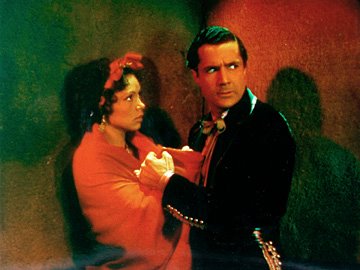
colourThe first live-action film in three-strip Technicolor, La Cucaracha shows off the range and intensity of the hues that it reproduces. Both women and men are dressed in gaily-coloured clothing: reds, greens, and bright blues. Choleric with anger, a character visibly becomes red in the face. Overcome with rage, the lead characters are lit in vivid scarlet and green.

(Technicolor's official site includes a history of the company and the process, and also a Quicktime clip from La Cucaracha, which they describe as a "dumb" movie.)

The film's plot concerns the revenge of Chatita, a singer spurned by her dancer boyfriend Pancho because he is too busy wowing a Mexico City impresario who has come to the bar he works scouting for talent. Pancho angrily denounces Chatita as a cucaracha, cockroach. To sabotage his prospects, Chatita therefore ensures that the impresario's salad is laced with lashings of burning Tabasco sauce. And she shows herself too hot to handle by engaging in a musical duel, drowning out Pancho's tune with her own rendition of a song entitled "La Cucaracha" and then dancing out her aggression in a feisty pas à  deux.

Pancho is outraged, but it turns out (of course) that this intensity is precisely what the impresario wants. On the spot, he books the both of them for his capital-city nightclub.

And intensity is clearly what Hollywood is seeking with this film. The Latin context and setting provide it in spades. Now in full colour, cinema demonstrates how rapidly it is becoming a highly efficient mechanism for the production and distribution--expression--of the affects. This is also expression in the sense that its affect is transmitted by first being subjected to intense pressure, to be then squeezed or forced out from the film's pressure cooker furnace.

With the addition of colour, cinema can now become a fully equipped expressive machine. But it is in Latin America that it finds the raw materials on which it works its modulation and intensification: upping the heat, heightening the tension, saturating with colour.

No real surprise that the Cucaracha's song should be about drugs: a cockroach needing marijuana. Though the image it supplies is of lethargy, affectlessness, lack:
La cucaracha, la cucaracha
ya no quiere caminar;
porque le falta, porque no tiene
marijuana que fumar.
By contrast, everything else here in this film is in surplus: too much colour, too much tabasco, too much emotion, all threatening to carry the characters away.

In the end this film is about an audition: and one audition (Pancho's) turns out to be two (Pancho's and Chatita's). But the represented audition is again doubled by the mode of representation that is tried out in front of a new audience. The film itself is an audition. Hollywood and Technicolor want to convince us of the uses to which this new colour process can be put: they're looking to create a need for their machinic expression, to create a sense of lack within the audience, an addiction that only Technicolor can satisfy.

From affective surplus and excess, to habitual desire premised on lack: finally, this is the process achieved through Hollywood's expressivity, tested and refined here as so often in a Latin American context.

Labels: ,

Saturday, November 26, 2005

Dancing Pirate

As noted at The American Widescreen Museum, very many early Technicolor movies had a Hispanic flavour, "perhaps inspired by the bright colors of the costumes" associated with Latin America. After two-strip (limited colour) efforts such as Rio Rita, the very first live-action full colour Technicolor movie, for instance, was the short La Cucaracha.

Dancing Pirate posterAnd then, in 1936, along came Dancing Pirate, set, like the Zorro movies, in the Spanish California of the early nineteenth century.

Like Rio Rita and La Cucaracha, this too is a musical comedy. The dancing pirate of the title is no pirate, though he is mistakenly identified as one. Rather, he is a dance master from Boston named Jonathan Pride who sometime in 1820, while en route to his aunt's house for the weekend, is forced to join the crew of a buccaneer headed for the West Coast.

Once there, Pride slips away from his pirate companions, still clutching his overnight case and the umbrella he had intended to return to his long-suffering aunt. He makes his way to the village of Las Palomas, where the townspeople, under the bumbling leadership of alcalde Don Emilio José María Salazar y Perena, are readied to resist the expected pirate onslaught. Capturing the errant dance master, who is taken to be a pirate ringleader, the mayor declares glorious victory over the barbarian hordes, and prepares to hang his prize in the morning.

On the scaffold, however, Pride is asked to dance at the suggestion of the mayor's beautiful daughter, Serafina, who has an inkling that this pirate may not be all he seems. So dance he does.

scaffold
What's more, Pride lets out that he has dedicated rather more of his life to teaching young women the waltz than to roaming the high seas. At the news that she could learn how to waltz from him, Serafina begs her father for a reprieve. And so the dancing pirate gains a stay of execution while he gives lessons in this daring dance--daring because it involves the man putting his arm around the woman's waist. Naturally enough, and as if to confirm the fears of the scandalized mayor, Serafina and Jonathan fall in love over the course of their lessons.

As if being on death row were not enough, more trouble is brewing in Las Palomas. A contingent of soldiers garrison themselves in the town, rather outstaying the hospitality shown them as they commandeer even the mayor's bath tub and hot water. It soon emerges, moreover, that their captain, Don Balthazar, has designs on both Serafina and the Perena's well-apportioned estate. As the captain threatens to have the dancing pirate killed, the mayor's daughter agrees to marry him on condition that he save her true lover. (Have we heard this story before, I wonder?)

Through all these travails, from impressment to the verge of execution, Pride remains curiously impassive, barely protesting his fate except in the most cautious expressions of polite umbrage. Though the waltz that he teaches instills a daring sensuality (it is, he reminds us, "an intimate dance"), the teacher himself is strangely affectless, detached from his situation. The villagers, though gradually won over to his charms, express increasing frustration at his lack of resolve. "It's too bad you haven't got any Spanish blood in you," an exasperated friendly innkeeper tells him, "You would die fighting for your woman." Even the ineffectual alcalde, giving his daughter away, rather hopes that her defeated suitor might hit the army captain over the head with his ever-present umbrella.

But Pride does have a plan up his sleeve. Exiled from Las Palomas, he recruits a group of indigenous warriors to fight for his cause. Unfortunately, they are rather too pacific, and still have to master a war dance. So the dancing pirate steps in, and teaches them a dance that will whip them up to martial frenzy, so that soon they are headed back to the village to take on the Spanish army. Then, with the footsoldiers (literally) tied up, Pride takes on Don Balthazar, and what he doesn't know about fencing he more than makes up for with his balletic twists and turns. Finally, even the umbrella comes in handy as a foil for the captain's blade. With Balthazar defeated and sent packing, once again the wedding arranged by and for the dastardly usurper is transformed into the occasion to unite Anglo and Latina in a happy celebration of bicultural resolution.

bride and groom
Moreover, through the dance master's stay in the village, the melding of West Coast Latin and East Coast WASP (and, one should add, indigenous remnant) has effected also an affective modulation. Serafina has learned to revel in the fashionable intimacy that is the modern European waltz. Jonathan has leaned to live up to his surname and take hot-blooded Latin pride in himself and so master his fate. (And the Indians have been roused from their domesticated slumber, to be converted into effective fighters for American self-determination.)

In short, it is as though the ideal affective subject had to break from stifling tradition (habit) without losing fiery authenticity. That subjectivity can only be achieved through a combination of Anglo modernization and Latin spirit. On their own, each is ineffectual, and prey to tyranny: the first because it degenerates into lifeless courtesy; the second because it is all enthusiastic bluster without rational direction.

Labels: ,

Friday, November 25, 2005

Rio Rita

Rio Rita poster?Nothing better illustrates the fact that Hollywood's Latin movies can't be restricted to a single genre than Rio Rita.

This movie is a rather bizarre hybrid on many levels. It's the film version of an immensely successful stage show, that had racked up almost 500 performances on Broadway. Though mostly black and white, the last half hour is a rare example of early Technicolor. And, generically, it combines musical (a very early example of the genre), western, and comedy, with two parallel (scarcely overlapping) plots both set just south of the Rio Grande.

The main plot concerns the search for outlaw "Kinkajou" who is terrorizing both sides of the US/Mexican border. (The film claims that "kinkajou is Mexican for wild cat," but in fact these little "honey bears" are closer to raccoons, which is not to say they can't be dangerous.) On his trail is the Texas Ranger Captain Jim Stewart, who has crossed the border incognito to find his man. Suspicion soon falls on a shady-looking character, one Roberto Ferguson, but things become complicated as Jim falls for Roberto's sister, the eponymous Rita. Meanwhile, a Russian aristocrat named General Ravinoff, his presence in these parts unexplained, is also after Rita's affections. Ravinoff captures Ferguson and tries to kill Stewart, and so to save both brother and lover Rita agrees to marry the dastardly general.

At the same time, we also see the story of small-time bootlegger and man-about-town Chick Bean, his lawyer Ned Lovett, and his two wives, Katie Bean and Dolly Bean. Lovett had fixed for Bean to get a Mexican divorce from his first wife, Katie, only to discover belatedly that Mexican divorces aren't legal in the USA. So Bean is an inadvertent bigamist, a fact he tries to keep from new wife Dolly. Meanwhile, when Katie turns up from New York and announces that she has just inherited $3 million, Lovett does his very best to make her his. Somewhat predictable hilarity ensues, in which Bert Wheeler and Robert Woolsey (playing Bean and Lovett) revive their vaudeville success, and with Dorothy Lee (Dolly) lay the basis for what would be a rather successful cinematic career as a comedy trio.

Both plots are interrupted not only by set-piece musical numbers, but also by elaborate choreographed dance sequences, some of which are reminiscent of Busby Berkeley numbers, complete with an innovative overhead shot of dancing girls geometrically arranged.

The film's climax is a sumptuous reception on a pirate barge (!) moored in the Rio Grande, just on the Mexican side of the border that runs through the river. It is here that the various Beans play out their comedic excess with Lovett. And it is here that Ravinoff plans to wed Rita. His plans are thwarted, however, by Jim's reappearance: the Ranger cuts the tether holding the barge to the Mexican bank, allowing it to drift over to US territory where he arrests the Russian, now revealed to be the elusive bandit. Rita's brother Roberto, therefore, is found to be not the Kinkajou as originally feared, but also an agent of law enforcement, working undercover with the Mexican secret service. And so a wedding takes place, but it is the American who weds the fiery young Rita, not the Russian.

So what's interesting is the way in which the film portrays the fluidity and permeability of the US/Mexican border as ultimately something to be celebrated. If it weren't for the current that sweeps the barge northwards, the Rangers wouldn't have caught the bandit. And the film's most significant romance is that between the straight-laced US lawman and the Latina temptress, who is rather more unbuttoned (especially in her opening scene). Jim disguises himself by throwing a serape over his shoulder. But his investment in latinidad proves to be outcome of a long-standing fascination. "But you've never seen me before," says Rita to Jim. "Oh yes, I have," he replies. "From down there across the Rio Grande I've watched you."

Jim and Rita
Finally, then, though Rio Rita flirts with the notion of a threat from south of the border, instead its emphasis is on the border as mirror. For far from being the criminal other, Roberto proves to be the Texas Ranger's counterpart and opposite number, similarly disguised, similarly motivated, and similarly attached to "Rio Rita." The exchange of women between the two men cements their relationship, as also the partnership between South and North, at the same time that they successfully expel the foreign interloper, the displaced European who brings Bolshevik resonances to his aristocratic demeanour. It is by handing Ravinoff over to the Mexicans that Jim wins the right to wed Roberto's sister.

This is the Monroe doctrine as happy synthesis: (literally) the marriage of two equal partners, each determined to rid themselves of European influence in favour of a fluid pan-Americanism, lubricated by desire, and by song.

Labels: ,