Wednesday, July 18, 2018

Zorro-Disney Series (Season 1)
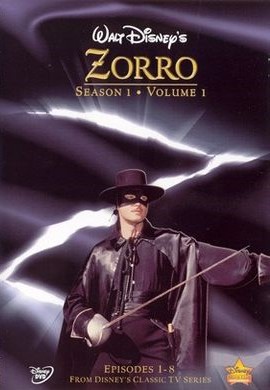
Zorro (1958) is a series created by the Walt Disney Company based on the stories of Johnson McCulley. Disney decides to continue the Zorro tradition that by the time has been going on for more than 30 years. Most of its direction is credited to Norman Foster, however, the series is a collaboration with other directors such as Lewis. R. Foster, Robert Stevenson, John Meredith Lucas, Charles Barton and Charles Lamont, who put together two seasons of about fifteen to twenty hours each, making this series the longest Zorro storyline in the tradition, and also the most popular one (at least before Bandera's interpretation of Zorro in 1998). Though of its popularity, this series continued to be cataloged among commercial B-movies, together with previous serial versions such as Republic Pictures' series. Though this series length requires creating more stories and additional characters which differ from the first Zorro movie, this incarnation of Zorro might be one of the most traditional ones and the closest to the original version since Johnston McCulley himself was involved in the development of the serial.

Norman Foster take us to the traditional time and location of McCulley's "The Curse of Capistrano". It is 1820 in the old Spanish California and Don Diego de la Vega (Guy Williams) has just arrived from his temporary stay in Spain to Los Angeles. Even before the ship gets to the pier, he and his mute assistant Bernardo (Gene Sheldon) are informed about the tyrannical government that Capitan Monastario has imposed to oppress the poor, the Indians, and the just blue-blooded aristocrats of the region. Don Diego believes that his duty as a loyal subject is to defeat all of the Crown's enemies, and to do so he will hide his intentions behind the mask of Zorro, while pretending to be a coward man interested only in literature and music in front of everyone else, even in front of his father Alejandro de la Vega (George J. Lewis). But he is not fighting alone. Bernardo who is also highly skilled at sword and whip fighting adopts a second identity to help his master (Bernardo pretends to be a silly deaf-mute instead of only mute but smart) and his fast and well-trained horse called Tornado will make of Zorro an invincible legend.

California is presented as a beautiful place to live in and to take advantage of for people around the world. Its location, resources, but also its instability as a colony of the Spanish empire after the Mexican emancipatory revolutions have attracted the most ambitious men who will try to use their influence to destroy anyone who steps on their way. Spanish occupying positions in the highest power hierarchies because of their names and appearance reflecting aristocratic or even royal ancestry become Don Diego/Zorro's nemeses. Don Diego, however, does not condemn the special privileges of being aristocrat or Spanish, neither he critiques colonialism. The problem arises when those are corrupted or lead to unacceptable treatment. What is acceptable or what is not is obviously determined by the elites, thus things like increasing taxes for the poor and the rich is considered unjust, but making indigenous work without any pay for the church's missions or as servants in the aristocrat's houses are seen as not only as just, but they are the necessary means to guide the Indians towards civilization.

A plot in support of European elitism is a characteristic of the traditional Zorro movies because of the period in which it takes place when Spain had legitimate control over California. However, in this series, the underlining "good" social constructions imposed on Californians by the Crown are challenged as the storyline goes on, and the elites (like the De la Vega family) will use their powerful influence to protect and differentiate their Californian from Spain.

Don Diego opposes the enemies of the Crown, but on top of it, as Zorro, he fights in the name of California, even if this means breaking the conventions of his aristocratic class and of his Spanish roots. During the first quarter of season one, Zorro fights the corrupted Captain Monasterio, but after defeating him, new threats appear to destroy the beauty and wealth of California, and the tranquillity of its people. These new enemies are each time people closer in the hierarchy to the Crown and those conflicting loyalties develop in Zorro and in all people of the village a stronger feeling of patriotism but not towards Spain, but towards California. The Californio identity rises as Zorro also become part of California's cultures through legends and songs. While children dress up like Zorro fighting with swords made out of wood, Zorro, the De la Vega family and many other Californian aristocrats get ready to go on a civil war against those trying to destabilize the peace of Los Angeles and the rest of California. Soon they will realize that the enemy is the appointees of the Crown themselves.

The last part of the first season tells us a lot about the construction of the Californio identity which becomes more visible because of the tensions of a possible civil war. The Californio identity and patriotism appear as the civil war creates a sense of "otherness" towards the foreigner. Interestingly, the dual identity of Don Diego/Zorro seems to fade away under these circumstances making Don Diego act as Zorro without the need of wearing the mask to cover his face. He starts to get more involved in the matters of California's governance, he tricks and fights his enemies, and he opposes injustice, whether this comes from criminals or if this part of the Spanish law. The Californio identity is also defined in relation to other identities. Though that in many aspects such as in culture and traditions California is a mix of Spain and Mexico, Californians consider themselves totally different from both. This is especially true after we start hearing about the Mexican independence war. From here Disney made clear that California is not part of those newly independent Mexican states mentioned in the series. And despite the fact that people know they are subjects of the Spanish King, the attempts to control and exploit the people and resources by every Spanish that arrives in Los Angeles will soon make all Californians remove the "Spanish" from Spanish Californio when referring to themselves. One thing can be clear, California might separate itself from the Mexicanidad, but it cannot escape its own Latin American essence.

One of the additions Norman Foster made to the original Zorro storyline is introducing the character of "The Eagle". Like Zorro, the Eagle has a second identity. During the day he is Jose Sebastian Varga, the new California's Magistrado, but at night he becomes the Eagle, a far-right wing Galindo that wants to re-built Spain's lost grandeur. For that, the Eagle will try to take control of California and sell it to other countries such as England, France, and Russia. England and France retire their offers when they realize that Varga lied about the state of California, but the Russian count retires only after he knows the people cannot be contained even with force.

This first part of the Disney Zorro portrays California in interesting ways. For the language and the culture, it perfectly fits under the Latin American umbrella, but at the same time, Californians have developed a totally different identity. Zorro is the personification of that identity and its evolution. We see that as the threats against California become sounder with the civil war, the courage and mobility characteristic of Zorro (performance of Latino personality) show up not only in the unmasked Don Diego but in all the patriotic people trying to defend California, from the richest to the poorest. California/Latin America is as well the scenario in which different countries expose their weaknesses and strengths. We see a Europe in decay trying to take control of California because of its gold, its haciendas, its wine, and everything that makes it seem like a paradise. We are also exposed to the idea of a growing Mexico approaching with its revolutionary ideas, the fear of the little left from Spain in California.

Like other Zorro incarnations, the plot of Disney Zorro implicitly projects events in history and its effect on Hollywood. Douglas Fairbanks' Zorro provided Latin America and California with a hero right after the Great War. This renewed Zorro appears after the Second World War after which European countries became dependant on The U.S wealth, just like it happens in this series, though California is not considered part of the United States yet.

Labels: , , ,

Wednesday, May 23, 2018

The Debt

The Debt (2015) is a drama that delivers a multi-narrative plot to explore how far (or over how many people) someone will go to obtain what they want, whether the reasons are satisfying an appetite for wealth and self-pride or ensuring the well-being of loved ones. The plot details the lives of two Peruvian families (one indigenous and one low-income) and a group of investors from a New York finance corporation.

In the beginning, we are introduced to each group individually. Oliver and Miguel both work for the American finance corporation buying huge proportions of Peruvian agrarian bonds (land debts) for a lot less than the actual price, then to obtain revenue from the actual amount of the debts by negotiating directly with the Peruvian government. Then we have Maria, a low-income nurse whose mother is suffering a treatable, but a painful medical condition. Maria’s economic condition does not allow her to help her mother, especially since treatment is given to those who can pay or to those who have great influence on the system. Finally (but probably the most important), we meet the indigenous farmer Florentino and his family. Florentino has been pressed to agree to sell his land to a Peruvian investor that has promised an agricultural project with stable jobs and possible healthcare to him and the rest of the agrarian community of the Peruvian highlands. Florentino, however, has rejected every single time since giving up his land will mean going back to a serfdom status of the colonial times under the rule of rich landowners.

This Barney Elliott drama movie is also a historical and political work about the agrarian bonds of the twentieth century in Peru which remain unpaid until today. Ancestral land ownership is currently a contested right in many Latin American countries for which agriculture and resource extraction as their main national income source. Historical facts like this one provide this production with a high sense of realism which denounces social injustices and the impact of neo-liberal politics in the lives of the indigenous and the poor, two of the most vulnerable groups in Peruvian/Latin American society. Indigenous people, like Florentino, remember vehemently the huasipungo period when they were slaves of the landowner and see any attempt to take their lands as an attempt to enslave them again. Nevertheless, the history of struggle and resistance of those groups to stop neo-liberal influence (that under their eyes is an imperialist project) is of little importance when American investors (in alliance with local elites) look to profit out of it, as portrayed in the movie. Indeed, Latin American politics, politics that look to decrease social inequality and injustice that come from a shared history of colonialism, are perceived by those US investors as “hearth bleeding politics”, too dramatic, too unrealistic for the free-market politics and interests of the neoliberal project.

Eventually, each of the three sides of this story the characters is challenged to choose a life or death decision that opposes their initial convictions. The farmer Florentino unwillingly gives up his land to Oliver (representing the private corporations) to save his little son's life. After long waiting hours and under the circumstances, the nurse Maria decides to put her mom's life before Florentino's son in her only chance to get medical attention (which will cost the kid his leg).  Finally, the only person left that has the actual power to change repetition of injust enforcements is Oliver. After he finds out that his Peruvian partner and friend died on the highlands looking for the real motivations for taking away the land from the agrarian indigenous community (exploiting the gold mines and not giving them stability and healthcare as promised), Oliver decides to break the chain that could result on a profitable scamming on land prices. "You think they want to help us? We are only cholos indios for them. Do you want to be slaves again?" said once Florentino in Quechua warning his community about selling their land.

Comparing Oliver's thinking at the beginning of the movie to how the plot developed at the end, this movie questions neoliberalism. Oliver talks about free-trade benefits and how the system and social problems of a country are the faults of its people and not the market, thus everyone should follow the project. Politics and economy for the US finance company are black and white, take it or leave it, but as the plot goes on Oliver starts to understand the difficulties of the process and the lives that are getting affected. Undoubtedly this movie has a critical socialist view on the neoliberal ideology. Latin America in that system does not benefit, only serves to the interests of those setting the rules, even though the proposals might seem more promising. Interestingly, however, the Peruvian government is portrayed as highly manipulable. American private corporations have more power and influence than government officials and, of course, the people. Neoliberalism for Latin America is not more than another form of social, political, and economic control, it is neoimperialism. In this case, the vicious change was stopped, but it required the involvement of someone within the power elite, otherwise, Latin America seems too weak to effectively block economic and social issues by itself.

Labels: , , ,

Friday, April 03, 2009

Mi Vida Loca

Mi Vida Loca posterMi Vida Loca (My Crazy Life, 1994) shows a series of events from the different perspectives of several Chicano teenagers belonging to the gangs in the Echo Park neighbourhood of Los Angeles. This compilation is split into three chapters: "Sad Girls Y-Que," "Don't Let No One Get You Down," and "Sauvecito."

Sad Girls Y-Que

Sad Girl (Angel Aviles) begins by describing the Echo Park barrio as a place that has slowly evolved into a from English to a Hispanic neighbourhood and has everything you need. The residents live in a karma-like environment where they know that ‘what goes around, comes around’ and you just have to take the good with the bad. This explains the shocking scenes of teenage mothers having profane catfights; oblivious to how this is affecting their young children witnessing the scene from nearby strollers. Sad Girl and Mousie (Seidy Lopez) have been best friends since they could remember. They even joined the ‘homegirl’ gang the Locas (and thus the bizarre pseudonyms). Mousie soon becomes interested in Ernesto, aka Bullet (Jacob Vargas), who is part of Echo Park’s male counterpart gang, the Locos. Things soon get serious between the adolescents resulting in Mousie becoming pregnant and then giving birth to a son. As Mousie becomes reclusive with her child, Ernesto begins to take an interest in Sad Girl and their affair results in more offspring for Ernesto and an insurmountable barrier of hatred between Mousie and Sad Girl. Mousie then continues the story explaining how after being thrown out by her father, she had moved from house to house with her son until one day she has a confrontation in the park with Sad Girl (displaying their utter immaturity in spite of their attempts to be ‘bad ass’), which results in a plan for the two to settle their differences in the hills later that evening. The plot then turns to Ernesto who has turned to drug dealing in order to make enough money to support his progeny and to buy a new truck, Sauvecito, which he keeps secret from both Sad Girl and Mousie. But the truck is no secret to El Duran, the playboy leader of the River Valley gang, who stalks the Echo Park neighbourhood in his 1950s collectible cruisers, searching for the Sauvecito because he claims it should be his. Ernesto has pledged to both Sad Girl and Mousie that he will keep them safe the night of the fight, but as the girls hesitate while facing each other down, they are startled by two gun shots, echoing through the valley. It turns out that Ernesto had been dealing to a ‘white chick’ with his new female associate Whisper, a member of the Locas, when all of a sudden the client had pulled a gun, killing Ernesto and injuring Whisper in the leg. Mousie and Sad Girl turn despondent after the death, but are then drawn closer as they find strength through the similarity of their new situation which finds them without the father of their children.

Don’t Let No One Get You Down

Whisper then tells about when the Locas took a road trip to the nearby women’s prison to collect Giggles, an older generation Loca who was sent to jail for a crime that her deceased husband had committed. Giggles tells the group about Sauvecito, which she learned about from Big Sleepy, a veteran Loco who had down some work on the truck. The news causes the Locas to consider selling Sauvecito to make money for the families Ernesto had left behind. Mousie and Sad Girl take a covert peak at the truck, which is under the watchful eye of Ernesto’s younger brother Shadow; but he refuses to give the girls the truck because the River Valley gang is after it. The Locas at first look-up to Giggles because she was the first Loca to go to prison, but they soon change their minds when Giggles talks about getting a jobs with computers and starting a future where they don’t need men to take care of them. Giggles then tries to connect with her neighbourhood friends such as Big Sleepy. The two end up spending the night together which is when Big Sleepy offers for Giggles and her daughter to live with him, but Giggles refuses his kind offer on the grounds that she wants to be independent.

Sauvecito

A side-story then introduced about Sad Girl’s sister, Alicia La Blue Eyes, which tells of the bizarre love affair that Blue Eyes has with a prison inmate named Juan Temido, whom she has only met through his poetry in a magazine and then weekly letters. The two end up pledging their love to one another, but then much to Blue Eyes’ disappointment, the correspondence stops. Next is El Duran’s perspective which describes the gang conflict between the Locos and River Valley which has been present for more than 60 years; as such, the issue of attaining Sauvecito is more a matter of honour for El Duran than his actual desire for the truck. Back in Echo Park, one of the Locas reveals that Juan Temido is actually the real name of El Duran and the group brings the heart-broken and naïve Blue Eyes to a River Valley party where she will unknowingly meet El Duran. Meanwhile, Shadow discovers that Sauvecito has been stolen and the Locos go on a blood mission to kill El Duran, who they assume is the culprit. At the party, Blue Eyes is captivated by El Duran’s way with women and the two begin dancing, but she is soon mortified when it is announced that El Duran and Juan are one and the same, causing Blue Eyes to flee from the building and into the comforting embrace of her sister. Suddenly the Locos arrive and immediately shoot El Duran, no questions asked, before escaping into the night. The next day it is revealed that a younger Loco had actually stolen and crashed the truck and that El Duran had been murdered without cause. But the killing continues as a group of River Valley girls attempt to shoot a Loco while outside a local store, but end up accidentally shooting Big Sleepy’s young daughter who was caught in the cross-fire. The film ends at the girl’s funeral, with Giggles slowly walking away from the grave with Big Sleepy and the Locas also walking away together, but on a separate path.

The ending of Mi Vida Loca displays the madness which saturates the lives of these Chicanos, but it also shows the wisdom which develops from living through such experiences. The veteran gang members observe the dead-end lives that result from the constant drug-dealing, fighting, and promiscuity. In this sense, the plot is similar to that of American Me, which also depicts a community of Chicanos stuck in the vicious cycle of younger generations picking up habits inspired by the older generations; even though the veterans of the ‘crazy life’ realize how illogical such a path is in attempting to find happiness.

Although Ernesto often criticizes his white, junkie clients as a class of ‘weak’ humans who get greedy when faced with the ‘stress’ of their perfect lives; the issue of gender in this film appears to take precedence over any concern about race. Even though the women still take on the role of care-givers to the children, they also identify with the machismo attitude of pride and the bond which develops from their inclusion in the gangs; so much so that some members tattoo their aliases onto their knuckles. These girls worry about being killed in gang fights, but still fuss over daily chores such as doing the laundry and getting groceries. Their lives suggest a new perspective on the Chicano community, one where the citizens accept their plight of life in American society and even acknowledge it by naming their gangs the 'Locos' and the 'Locas' (meaning ‘crazy’). Giggles remarks that “women need skills because their men are in prison, disabled, or killed by the time they are twenty-one.” These Chicanas have taken the matter of raising the next generation into their own hands, where they use weapons out of love instead of to prove a point. In the final scene, Giggles embodies the notion of moving away from the ‘gang life’ to start over as she walks away with Big Sleepy; but the cycle continues as the rest of the Locas choose a different path to walk with their children.

Labels: ,

Wednesday, April 01, 2009

American Me

American Me posterEdward James Olmos directs and acts in the film American Me (1992), which is inspired by true events and examines the life of a Chicano mobster as he comes to understand how his life choices have affected those closest to him. First we are introduced to the poetic reminiscence of Montoya Santana (Edward James Olmos), who is in prison sifting through a box of old photographs. His musings take the plot back to the Los Angeles in the year June 1943, when his parents, Pedro and Esperanza, two proud ‘zoot suitors’ had first started to date. Their love for one another is strong, but it is overshadowed by the racial tension between Latinos and US sailors which leads to a night of sickening chaos as the couple is caught up in one of the famous Zoot Suit Riots. Sailors beat Pedro to a pulp and rape Esperanza with absolutely no remorse. Montoya then shifts to the year 1959, when he was 16 years old and starting a Latino neighbourhood gang called La Primera. The gang allows Montoya (nicknamed Santana) a reprieve from his father’s chronic anger. Members are initiated via a small tattooed symbol on the back of their hand at the bottom of their thumb. The group consists of Santana; his best friend JD (William Forsythe), who is Caucasian but walks and talks like a Latino; and the newly-initiated Mundo. The group decides to take a shortcut one night after Mundo’s initiation which brings them through the Hazard gang’s territory, provoking a chase. La Primera breaks into a shop and manages to lose their pursuers, only to encounter an enraged storeowner who shoots JD and almost kills him. The breaking-and-entering gets Mundo and Santana time in Juvenile Hall. His first night there, Santana is raped by a fellow juvenile, but then refuses further submission and stabs his rapist in the throat. That killing earned Santana a jail sentence once out of Juvenile Hall, but also the respect of every adolescent in his surroundings. Santana knows that a clica is built upon respect and so he begins to assemble a Latino gang by the name of La Ema (for the Mexican Mafia) which unconditionally welcomes JD once he is out of the hospital and also serving his sentence.

The film progresses to Folsom State Prison where the original gang has grown and the choices they have made to survive have earned them 10-25 years; but the power that they now possess by way of extortion, gambling, prostitution, drugs sales, and even charging rent to inmates, has made them the ultimate force in the prison hierarchy, with the only other gangs in the yard being the Black Gorilla Family and the Aryan Brotherhood. Santana still receives visits from his mother and much younger brother, Paulito. Other visitors secretly supply La Ema with drugs through a method of hiding the package in a series of body cavities. A riot is almost imminent between the Black Guerilla Family and La Ema when a black inmate contaminates some of the cocaine and is then set on fire and killed by Latinos as punishment; but the excitement is set back to just a solemn threat from the African American gang to Santana once the guards begin to arrive. This event causes Santana to be sent to the Hole for solitary confinement; which he only laughs at because he can still run his business from such an isolated location. But the business is beginning to fail as the prison system attempts to break-up La Ema by sending its members to different prisons. Soon Folsom sees new Latino gangs surfacing, such as Nuestra Familia headed by El Chucko. To halt this threat, Santana enlists La Ema’s newest and youngest member, Little Puppet, to kill El Chucko and restore power to La Ema. Life for Santana then begins to change as he receives news of his mother’s death and soon after JD is released. Then, after an astonishing 18 years of prison time and many years to think about his actions and their effects, Santana is finally released into a world that he has difficulty adjusting to. He is welcomed by his friends and family, all except his father, at an intimate celebration and begins to take a liking to Julie (Evelina Fernández), Little Puppet’s cousin. Julie attempts to make light of his struggle in the outside world; but Santana is unable to react as he can’t seem to think with his heart instead of his head.

It doesn’t take long for Santana and JD to get back into business by first confronting the Italian Mafia boss with their proposal of running the drug business in East L.A. and all trades with Mexico in exchange for the safety of the son of the Italian boss, who incidentally was just sent to Folsom. The boss laughs at their offer, until he hears the news that his son was raped and killed on account of La Ema. Meanwhile, Santana opens up to Julie as they get to know each other and she shows him many things for the first time such as driving, going to the beach, and making love, which Santana fails to adjust to as he flips Julie over and attempts to have anal sex with her before she runs away from him screaming. Perhaps things would have eventually worked out between them if it hadn’t been for the Italian boss’ retaliation of sending pure, uncut cocaine into the Mexican barrios and immediately causing upwards of 50 deaths, including Julie’s younger brother, Nito. After this, Santana and his father finally bond as they sit by Esperanza’s grave. It is here that Pedro tells his son about his mother’s rape and how he could never truly love Santana because he always knew that it was an indiscriminate sailor who had fathered him, and not Pedro.

The drug business begins becoming a dangerous place as the Black Gorilla Family stays true to its previous threat and kills several young Latinos by making them deeply breathe-in the pure cocaine which they are cutting for Santana. In an attempt at normalcy, Santana acts as best man at the wedding of the recently-released Little Puppet. Santana is able to talk to Julie outside of the reception and he explains that he is simply working with this reality of drugs, but Julie is repulsed and says she once cared about him, but she doesn’t know this monster who he is now. Suddenly, two police officers appear and start interrogating the two as to why they are on the street talking. After searching ‘Santana’s’ jacket (which is actually Little Puppet’s) the officers find Little Puppet’s drug stash and Santana is then sent back to Folsom. JD goes through with a plan to enlist the Aryan Brotherhood to send a message to the Black Gorilla Family, which ends up being utter bloodshed with racial overtones that Santana disapproves of. La Ema begins to quietly talk about Santana’s new weakness while they solicit Puppet (Little Puppet’s older brother) to kill Little Puppet for accidentally putting Santana back in prison. The film ends in a spirit of utter madness as Puppet reluctantly kills his younger brother, imploring him not to look him in the eyes as he does it; Santana voluntarily concedes to his murder by La Ema as they stab him with the same brutality as any other; and on the outside, Paulito follows in Santana’s footsteps as he initiates younger kids into the gang and then gives them a gun to shoot at the other neighbourhoods in the name of La Primera. But which innocent bystander should the new recruits shoot? It doesn’t matter.

Even the title of American Me taps into the identity crisis existing for Chicanos living in America. Santana says that his parents were proud pachucos, but this didn’t stamp out the Zoot Suit Riots in their era which were ignited by racism and fuelled by media coverage which hailed the sailors for ‘purifying’ America during a time of nationalistic frenzy. This prejudice continues when Santana is a teenager, especially in Juvenile Hall where the gangs are no longer segregated by neighbourhood locations, as in the Chicano barrios, but instead by race. The power hierarchy runs on machismo pride and because of its connection to survival, no ethnic groups are excluded. Near the end of the film, it is revealed that both Julie and Pedro have the Mexican gang tattoo on their hands, which Julie tries to hide with make-up and Pedro looks at with disdain. This symbolism drills home the fact that even those people in the Mexican community who don’t approve of the drug trade are still affected by it due to their connections of family and race. Julie condemns Santana’s actions by saying, “There’s no fucking hope for our kids, for our barrios, with people like you around.” And this cycle doesn’t end with Santana’s death. The message is clear: the Chicanos in this community will never be rid of the crime and drugs that pervade their streets. Malleable adolescent minds look up to the drug lords and see only the attractive shell of power which surrounds these ordinary men of flesh and blood. Everything: the racism, the clicas, the death, the drugs; will continue because the thirst for supremacy is now in that blood.

Labels: , ,

Thursday, March 05, 2009

Clear and Present Danger

Clear and Present Danger posterClear and Present Danger is a 1994 film directed by Phillip Noyce, based on the book of the same name by Tom Clancy. It stars Harrison Ford as Dr. Jack Ryan, who is appointed the CIA Deputy Director of Intelligence when the existing Director falls ill with pancreatic cancer. The situation Ryan must diffuse begins when a U.S. Coast Guard patrol boat finds that an American businessman and his family have been murdered on their yacht off of the Colombian Coast. The murdered man, Peter Hardin, happens to have been a close friend of the President of the United States. It is discovered that Hardin was murdered because of his ties to the Cali Cartel, having skimmed $650 million for his own use. The President tells his National Security Advisor James Cutter that the Colombian drug cartels present a "clear and present danger" to United States national security, and authorizes him to execute a covert operation taking down the men responsible for his friend's death. Meanwhile, Jack Ryan's first job as Deputy Director is to go before United States Congress requesting $70 million in funding for an ongoing CIA investigation of drug activity in Colombia. The Congress agrees on the condition that no military operations will be conducted in the country. James Cutter must keep the military operation authorized by the President a secret from Ryan, so he turns to CIA Deputy Director of Operations Robert Ritter, who helps him assemble a black-ops team under John Clark (Willem Defoe), a secret field operative. Clark and his team travel to Colombia and begin destroying assets of the Cali Cartel, including safehouses, drug lab facilities, and equipment. Meanwhile, Jack Ryan is sent down to Colombia to establish the connection between Hardin and the Cali Cartel so that the President can seize Hardin's money; but behind Ryan's back, the President has already seized Hardin's assets.

The head of the Cali Cartel, Ernesto Escobedo, is enraged when the United States government seizes the $650 million dollars Hardin stole from him. He asks his main operative Feliz Cortez to take care of the problem. Cortez is a former Cuban intelligence officer who is dating an unwitting secretary at the FBI, Moira Wolfson, as a way to get information. He feigns romantic interest in her to find out that the director of the FBI Emil Jacobs is travelling to Colombia to negotiate with the country's attorney-general concerning the seized funds. Without Escobedo's knowledge, Cortez plans an assassination attempt on Jacobs when he arrives to Colombia. As Jacobs, Jack Ryan and some other U.S. officials travel through Bogota, their motorcade is attacked by men on rooftops with rocket launchers. Everyone is killed except for Jack Ryan and two other officials. It is revealed that Cortez' real motivation is to cause distrust among the leaders of the Cali Cartel including Escobedo, none of whom know who ordered the ambush on the FBI Director. This way he can assume control of the cartel himself after the inevitable gang war he presumes will follow. After this, Cortez travels to Washington, D.C. and kills Moira to tie up the last loose end. Back in the White House, James Cutter orders the aerial bombing of a villa where a meeting between the Cartel bosses will occur in order to retaliate for Jacobs' death. The bombing kills everyone in the house, including women and children; Escobedo and Cortez have not yet arrived, and so they are spared. The media is told it is a car bomb set by a rival gang lord. Both Ryan and Cortez suspect something fishy about the "car bomb", and after some investigation, they independently discover it was a U.S. military operation. Cortez uses this knowledge to broker a deal with James Cutter in Washington. Cortez will agree to assassinate Escobedo and lead the Cartel, allowing the FBI to periodically arrest Cartel members to create the illusion that the US administration is winning the war on drugs; Cutter must shut down all operations in Colombia and allow Cortez to destroy John Clark's black ops. The deal is agreed to, and Ritter is told to destroy all the evidence of the deal, but Jack Ryan has recorded the entire meeting without their knowing. Ryan does some further investigations, hacking into Ritter computer account and discovering the details of Cutter and Ritter's work in Colombia. This leads to a confrontation between Ryan and Ritter, in which Ritter informs Ryan that he and Cutter have written permission from the President to conduct the operations in Colombia, and that Ryan will be the scapegoat who is blamed for it all, since he was the one who unknowingly asked for the funding from Congress which made the military operation possible.

The black-ops team is cut off and left for dead in Colombia, and they are ambushed by Cortez' men, much to John Clark's bewilderment. Jack Ryan travels alone to Colombia to find John Clark and save his men. Cutter and Ritter have told Clark that Ryan was responsible for cutting his men off, but Ryan manages to convince Clark of the truth. Together, they mobilize themselves to save the lost soldiers. They buy an aging helicopter using a CIA company check and fly to where the soldiers were attacked, in the jungle. They find the squad's sniper, Domingo Chavez, who informs them that two of his unit members have been taken prisoner by the Cartel's men, and that the rest are dead. Ryan decides to visit Escobedo and inform him of Cortez' deal with Cutter, using a tape-recorder to play him the conversation. Enraged, Escobedo arranges a meeting with Cortez at the Lindo Coffee Factory, where he confronts him. Escobedo is about to kill Cortez when Cortez' henchman kills Escobedo and his men. Ryan, Clark, and Chavez escape the shootout and rescue the two soldiers who are imprisoned downstairs. The helicopter comes to the coffee factory to pick them up, and as they escape, Chavez kills the pursuing Cortez with his sniper. Back in Washington, Ryan angrily confronts the President, who is responsible for the illegal war in Colombia and the deaths of innocent people there. He tells the President that he intends to blow the whistle at a Congressional Oversight Committee session despite the damage that it could do to his career. He walks out of the Oval Office, and the final scene shows Ryan beginning his testimony to Congress.

Colombia is a lush, green country crawling with wealthy drug lords and soldiers. It is very different from what the American government officials who visit the country are used to. Jack Ryan is shocked to see the number of armed soldiers at the airport in Bogota. In the car on the way from the airport, an FBI man asks Ryan, "How's the food down here?", and Ryan replies, "It's like Mexican food. I hate Mexican food". Ryan proceeds to warn the man, "You shouldn't drink the water; you'll be in the can the entire time you're here". These sober Americans are somewhat uncomfortable in the exotic, dangerous, and hot atmosphere of Colombia; they are used to the gray and organized life of Washington D.C.. Even the "bad guys", the drug lords, are portrayed colourfully. They are fabulously wealthy, with vast colonial-style villas set in green hills, and they are always surrounded by their families, with little girls in bright dresses and little boys playing with toys running around, their wives and mothers in the background, keeping everything under control. One scene showing the birthday party of Escobedo's daughter is reminiscent of party scenes in the Godfather movies, where a lavish celebration takes place under the watchful eye of numerous armed men, the danger present even in the midst of a happy family event. For this reason, there is so much outrage after the aerial bombing kills numerous members of the drug lords' families. Family is an essential element of Colombian life, and is mixed even with dangerous business.

This film also portrays the ever-present association of Colombia and drugs. The "War on Drugs" has been an essential policy issue in the United States since the 1960s, and it has largely attacked the supply side of the drug trade. This film depicts the American sentiment that the drug trade is the fault of the drug-producing countries and organizations. In order to appear that the Americans are winning the War on Drugs, Cortez must allow FBI men to arrest Colombians, because this is what make people believe it. Only Escobedo mentions briefly they massive amount of demand for drugs in America that drives their production and trade in South American countries. Scenes showing bricks upon bricks of cocaine being produced by the Cali Cartel create an image of the exaggerated abundance of the substance in Colombia, and its seemingly uncontrolled production as a threat to U.S. national security.

Labels: ,

Sunday, March 01, 2009

Walker

Walker posterWalker (1987) is set in the 1850s, yet a 1980s Mercedes drives through one scene; in another, mercenaries in Nicaragua smoke Marlboro cigarettes and drink Coca-Cola from bottles. The final scene contains a Saigon-style evacuation, complete with helicopter and fatigue-clad soldiers with machine guns. Obviously, these are not simply goofs on the part of director Alex Cox, but deliberate details which contribute to the film’s bizarre, blood-soaked, and chaotic portrayal of Latin America. Their intent becomes clear as the credits roll and a television screen appears showing journalistic footage of Ronald Reagan defending America’s actions in Vietnam, of American soldiers in training camps in Nicaragua and Honduras talking about “helping Nicaragua defend its own country”, of naked bodies of dead Nicaraguans and their weeping relatives. Although not entirely adherent to history, the film is based on the invasion of Nicaragua by American filibuster and adventurer William Walker, who took the “liberation” of the country into his own hands and ruled as president from 1855 to 1857.

The opening scene shows William Walker, played by Ed Harris, and a number of scruffy, tough-looking soldiers fighting a bloody gun-battle in dusty Sonora, Mexico. He and his men suffer heavy losses and just manage to retreat across the border. Back in California, Walker is put on trail for conducting an illegal war in Mexico, but his fervent defense speech, littered with references to the popular notion of Manifest Destiny and the preservation of the American way of life “at any cost”, manages to get him acquitted by the jury in eight minutes. After all the excitement, Walker is ready to settle down with his fiancée Ellen, but soon enough he is summoned by tycoon Cornelius Vanderbilt, who owns all the infrastructure in the Central American country of Nicaragua, and is asked to invade Nicaragua and establish stability in the country so that Vanderbilt’s business can flourish. Walker declines. Upon returning from his trip to see Vanderbilt, Walker discovers that his fiancée has died of cholera, and so with nothing keeping him in America, he agrees to Vanderbilt’s proposal. With a rough and raggedy group of mercenary soldiers, he travels by sea to Nicaragua, where a civil war between Conservatives and Liberals is wreaking havoc on Vanderbilt’s business opportunities. As he trains his army on the coast, Walker shows his rigid rule as a colonel and his value for a firm hand on the moral conduct of his men. He proclaims the goal of establishing democracy in Nicaragua a righteous cause. He and his men become Nicaraguan citizens.

When the men are armed and trained, the army travels to inland town of Rivas, where they are ambushed by wild gun-wielding Nicaraguan Liberals, who kill many of Walker’s men. As the Nicaraguans shoot at the army from the rooftops and his soldiers are dying by the bucket load, blood splashing everywhere, Walker walks unscathed, expressionless, undeterred, through the carnage until he reaches a safe house. As his remaining men defend the house, shooting Nicaraguans through the windows, Walker plays the piano and sings, as if the combat were not happening. His men are bewildered by his actions, but manage to stop the attack. Despite the huge number of injured men, Walker makes the unpopular decision to escape the town, dragging the injured along to San Juan del Sur, where the men set up camp and try to recover from their losses. A few days later they are found by a large German army, who has just arrived from Rivas and report the retreat of the Liberals and the victory of Walker’s army. Encouraged, Walker and his army march to Granada, the default capital, where they meet with the remaining members of the Nicaraguan government. Walker appoints a President, a Senor Corrales, and appoints himself the Commander-In-Chief of the Nicaraguan Armed Forces. He and his soldiers spend the next while making “reforms”, which include executing any soldier or local who displeases or opposes the Americans and creating violent havoc in the streets regularly. Walker’s taste for power pushes him to accuse Presidente Corrales of treason and have him executed by firing squad, despite the outrage of the leading Nicaraguan aristocrats. Walker claims himself as the new president, claiming he was elected, although no elections are ever held. He begins to act crazy, killing people at will, firing upon his soldiers, doing little or nothing to govern the country. Granada is in chaos, ruled by “crazy gringos”.

Two men from a transportation company rivalling Vanderbilt’s ask Walker to revoke Vanderbilt’s license to do business in Nicaragua and seize all his assets in the country, giving them the monopoly of transport. Walker agrees to do so in the name of the country’s sovereignty, but this leaves him without financial support and supplies from America. Desperate for resources, Walker establishes slavery in Nicaragua. This results in an uprising of a brutally violent nature, to which Walker reacts by decreeing that the town of Granada be burnt to the ground. The ten-minute scene that follows depicts the town, engulfed in flames, as a background to a seemingly anarchic shootout, in which Walker’s men, wearing ridiculous costumes and army outfits, stalk through the streets and shoot randomly at people, blood gushing, people screaming, children crying. Many of Walker’s soldiers are killed by seemingly invisible Nicaraguans, but Walker emerges unscathed, with that same expressionless face and determined walk as before. He appears invincible. He makes his way to the cathedral in Granada, which has been turned into a hospital and torture chamber, with dead and dying people everywhere. Upon the blood-covered altar, one of Walker’s soldiers performs a gruesome torture upon a screaming man. Walker takes part in removing an organ from this man’s body and eating it. Suddenly, a loud sound is heard outside; as the small group of American soldiers walks out of the cathedral’s door and down the body- and blood-covered steps, a military helicopter lands in front of them, full of American soldiers with machine guns. They say they have been instructed to take Walker’s men back to the States, as orchestrated by an outraged Vanderbilt. The helicopter lifts off, leaving a bewildered and wide-eyed Walker standing alone on the front steps of the cathedral. The final scene shows his death by firing squad in Honduras, his body left to be taken away by the waves.

The film is clearly an attack of American interference in other countries, especially of the Iran-Contra affair of a year before its release, in which Reagan illegally financed CIA training of Nicaraguan paramilitaries with money earned from illegal arms sales to Iran. It shows the ruthlessness with which the United States pursues its geopolitical goals in the Western Hemisphere. Latin America - Mexico and Nicaragua, in this case - is just America’s playground, a place for tycoons to monopolize transportation systems and adventure-seeking criminals can go and wreak havoc among innocent local people. Every American in the film, with the single exception of Walker’s wife, is a money- and power- hungry hooligan with a propensity for insanity and destruction. Walker himself, who is portrayed early on as an idealistic man of strong morals and strict discipline, turns out to be the most crazy, the most destructive. The locals are the ones who suffer; most of the Nicaraguans in the film die brutally or are shown already dead, in piles. To the Americans, they have no faces or names, and their lives have no value. The Americans go to Nicaragua to "improve their civilization and their economy"; once they get there, they destroy the civilization and the economy and take the chaos for themselves. It is only when messing around in Nicaragua is no longer profitable that the Americans will leave; as soon as Vanderbilt stops profiting, he convinces the government to remove its American representatives from the region. In the film, Latin America is a place where Americans go to escape the societal norms of their own land and be the destructive immoral animals that they really are inside, all at the cost of the land's seemingly helpless citizens.

Labels: ,

Monday, February 23, 2009

The Americano

The Americano posterThe 1916 version of The Americano is a silent film put to Vaudeville background music and set before the "Great War" (World War I), “when little wars were still important”, on the unfamiliar island of the Republic of Paragonia in the Caribbean Sea. The island is described as one of sunshine, music, adventure, and romance, but another perspective is soon revealed. The Paragonia Cabinet is set to discuss if the contract for the American Mining Company to continue operation on the island should be re-newed. It appears as though all parties are in favor of the partnership as it would boost Paragonia’s economy; all except for the vindictive Minister of War, Salsa Espada (Carl Stockdale), who refers to the company as those “American pigs”. But Espada stands alone and so the renewal goes through. President de Castalar (Spottiswoode Aitken) chooses the Premier of the Republic, Alberto Castille (Tote Du Crow), to travel with the Premier’s wife and the President’s daughter, Juana (Alma Rubens), the “Rose of Paragonia”, to the mining company’s home office in New York in order to finalize the contract. The School of Mining has sent the reference of engineer and “regular American” Blaze Derringer (Douglas Fairbanks) for the tough job of assisting Paragonia in the mining contract, but when Blaze sees that Paragonia doesn’t even fit on the same map as NewYork, he quickly declines the offer. Castille enters just after the refusal, and Blaze leaves the office only to be confronted with the beautiful face of Juana which quickly changes his decision and he accepts the position in Paragonia.

That very day, Castille receives bad news from home and must catch the next boat back. Juana manages to write a note to Blaze telling him not to go to an unhappy country. This warning piques Blaze’s curiousity and he makes sure to be on the next boat to the island. Upon arriving, he is treated as an outsider when no one offers him directions to the President’s house, until a strange, bearded, old man reveals the location and asks Blaze to tell the señorita that there’s hope. Slightly confused, Blaze continues on, unbeknownst to him that the President has been overthrown by Espada and his sidekick Colonel Gargaras, one of Juana’s many eager suitors. When Blaze isn’t let into the mansion through the front door, he boldly climbs a side wall into the garden where Juana throws down a message telling him to return at midnight, only adding to the ominous mystery. Blaze then heads to the company office which appears to have been ransacked and only Harold Armitage White, a black man in the position of attaché in the mining company, is there to greet him. Blaze declares to a hesitant Harold that the Americans must stick together and they both leave the looted building.

Later, when Blaze is eating dinner at a posh restaurant, the same bearded, old man approaches and hands him a note which asks Blaze to follow him. It turns out that the old man is actually Castille in disguise from Espada and he informs Blaze that Gargaras is forcing Juana into marriage or he will murder her father. Castille and Blaze plot to break the President out of prison when it appears that Espada has been siphoning money out of the soldiers’ pay because he is unable to operate the mines without a good engineer. Meanwhile, the President has discovered that his cell in San Mateo prison attaches to an old, escape tunnel, but the entrance has been filled-in with concrete. He decides to write “23 noviembre 1899” on tiny pieces of paper which float down to the rocky coast below his cell when the maid deposits them out the window with the rest of the rubbish. Blaze and Castille discover the notes while scouting the prison and Juana deciphers the code with the help of her father’s diary which notes the prison cell’s unique structure on that specific entry date. They prepare to break the President out that night, but the plans are delayed when Espada has Blaze arrested so as to coerce him with a bribe of ‘soldier money’ to run the mines. Blaze agrees in order to avoid confrontation and then races to the prison and digs through the tunnel’s wall to free the President. Blaze, Castille, Harold, and the President race back into town when they realize that they don’t have much time until Juana is forced to marry Gargaras. They arrive with seconds to spare, and Blaze throws some weight around as he fights several soldiers at once. He then appears on the balcony to the delight of the crowd of people below all chanting “Americano” in admiration of this man who is going to start up the mine for them once again. Without losing any time, he denounces Espada in front of the crowd for stealing money from the army and reveals that the president has been freed. The film ends by stating in shock that after all this, Juana still marries the Head of the Army. A happy ending blooms when it is learned that the brave Blaze has been appointed Head of the Army in place of Gargaras.

The title of The Americano commences a linguistic hybridity which continues the entire way through this silent film, with even the on-screen translations lacking in a basic knowledge of Spanish. The indistinct island of Paragonia adds to this vagueness of culture, but also complements the dependence that this small Republic invests in the mighty and familiar country of America. With a name as equally ambiguous as Paragonia, the American Mining Company, represented by the adventurous and charming persona of Blaze, swoops in to not only save the economic crisis of the populace, but to rescue the beloved President from his usurper. In light of such events as the US securing Cuba as a territory in 1903 and the possession of a completed Panama Canal in 1914, it seems only natural that America is portrayed in the film as a giant power capable of single-handedly liberating a floundering Caribbean country, while leaving no trace of the traditional American desire for foreign resources. It’s baffling that such a pretext remains even after a situation which occurred during the preliminary filming of The Americano in Tijuana, Mexico, where Fairbanks and the film crew were arrested by corrupt Mexican soldiers, who turned out to be militia short on cash; thus causing those involved with the film to retreat north shortly after, with their tails between their legs, to resume filming in San Diego. After such an incident, perhaps it could be argued that the adventurous and triumphant American spirit displayed so openly in The Americano only exists in the context of narratives.

Labels: ,

Thursday, February 12, 2009

Missing

Missing posterMissing is a 1982 film based on the true story of American journalist Charles Horman, who disappeared in the bloody aftermath of the U.S.-backed Chilean military coup of 1973 that deposed President Salvador Allende. The film was banned in Chile during General Pinochet's regime. Both the film and the book on which it is based, Thomas Hauser's The Execution of Charles Horman: An American Sacrifice, were removed from the market. Former Chilean Ambassador Nathanial Lewis and two other American officials filed a lawsuit against director Costa Gavras and Universal's parent company MCA, which they lost. After the lawsuit, the film was re-released by Universal in 1996.

The film begins with a statement by Costa Gavras that the events depicted in the film are true. It ends with a disclaimer from the U.S. State department stating that they are fictional. In the first scene, Charles 'Charlie' Horman and an American friend Terry Simon are returning from the seaside town of Viña del Mar in the car of a U.S. Navy Captain Ray Tower, whom they met there. When they get to Santiago, they are hit by the chaos and bloodshed taking place in the streets. People are being interrogated and shot indiscriminately, tanks are rolling through the main streets, soldiers stand at every few metres, bodies crumpled at every corner. Tower drops them off, and they are forced to spend the night in a hotel because of the curfew. Charlie is worried because his wife, Beth (Sissy Spacek), with whom he is living in Santiago, is at home alone and he hasn't been able to contact her. The next morning, he and Terry make it to their home and find Beth alive and well, but worried. Beth and Charlie decide to leave and go back to America in the next few days because of the danger of the situation. That night, Beth doesn't make it home from a friend's house because she is caught out past curfew, which means being shot by roaming soldiers. She hides in a corner until morning. When she gets home, she finds the house ransacked, and Charlie gone.

Thus begins the search for Charlie Horman. His father Edmund (Jack Lemmon), a New York businessman, comes to Chile to look for his son. He finds Beth desperate and frustrated with her fruitless attempts at locating Charlie in the chaos of the coup. In the beginning, he does not understand why she is frustrated; in his bewilderment, he resorts to blaming Beth and Charlie for their unstructured lifestyle in South America, their "sloppy idealism", and their rejection of the capitalist ideals which he embodies as the reason for Charlie's disappearance. But as he begins to deal with the American Embassy, he realizes that Beth's frustration is justified; the Ambassador and his men are seemingly leading Edmund and Beth on a wild-goose chase, insisting that Charlie must be in hiding and that they are doing their best to find him. Assuming that Charlie would have at least contacted either Beth or his parents if he were in hiding, Beth and Edmund begin to realize that he may be dead. But the Chileans wouldn't kill an American citizen...if he had been executed, an American government official must given consent. With this in mind, they search for Charlie everywhere, in hospitals, in morgues, in prisons, in Santiago's main stadium where all the interrogations occur and political prisoners are held, in buildings piled high with the bodies of men and women killed by soldiers. They find no trace of him.

As Beth and Edmund dig deeper, they begin to discover a terrifying and enormously significant secret. Suddenly answers begin to materialize. After talking to Terry Simon, who went to Viña with Charlie, they find out the Charlie had been talking to some U.S. officials who claimed to be Navy men and admitted to being part of the coup. In fact, the coup was planned in Viña by Chilean and American military leaders, together. Automatically considering Charlie an ally because of his nationality, the U.S. officers had divulged everything. Upon his return to Santiago, these same officers had discovered he was journalist who contributed to a leftist newspaper and translated articles for American newspapers. When they realized the danger of the information he held, they had to eliminate him. The horrible truth becomes increasingly clear, however hard Beth and Edmund try to put it from their minds. One day, an American working for the Ford Foundation contacts Edmund Horman and tells him that Charlie was executed three days after the coup, in Santiago's main stadium. Edmund is heartbroken. He storms into the American Embassy and reveals this new information. The Ambassador and his attachés deny any knowledge of this and try to convince Edmund that Charlie has left the country, but Edmund refuses to accept this and demands the truth. The Ambassador admits implicitly that in order to protect American interests and the 'American way of life', the U.S. government has had to do what is necessary. With this, it is time to leave Chile. Beth and Edmund, who have become quite dependent on each other, tie up some last loose ends with the remorseless and petty American Embassy officials and return to New York. Before they leave, Edmund Horman warns them that he will sue them, if it's the last thing he does. Charlie's body is supposed to follow his father and wife a few days later, but a voice-over in the closing scene informs the viewers that his body returned home seven months later, in a condition which made autopsy impossible. It also informs us that Edmund Horman did file a lawsuit against 11 U.S.officials, including Henry Kissinger. The evidence for the lawsuit was labelled 'Secrets of State', and so the suit was dismissed.

Although Chile is never actually named in the film, Viña del Mar and Santiago are, and so it is clear that Chile is the location of the film. And Chile is depicted as hell, as a place of unparalleled violence and bloodshed, as a place brutally and totally ruined by a ruthless quest for power. One mournful Chilean says, "The junta has destroyed in a few weeks everything that was beautiful about this country". In one scene, a beautiful white horse gallops through the burning city streets, chased by a jeep full of shooting soldiers trying to kill it; this scene is a perfect symbol of this destruction. Chile is no longer a place for men. Edmund Horman asks desperately, as gunshots ring out in the streets, "What kind of world is this?". Later he admits that this place has "torn his heart out of him". The Chilean soldiers are the ubiquitous and terrible demons in this hell, murdering innocents in the streets, cold-hearted and cruel behind their hard faces. They are true South American military villains, capable of the utmost destruction. Their victims were once ordinary Latin American citizens; they have become nameless piles of bodies. Shots and explosions punctuate every hour; in the end, they no longer surprise anyone. The Chile in the film is Hell itself.

This hell is partly created by the seemingly eternal U.S. quest for power. The Cold War rhetoric of the film centres mainly around the Ambassador's speech to Edmund Horman. "There are 3000 American firms in Chile," he says, "and we need to protect their interests. We are protecting your interests, too, Mr. Horman. We are preserving the American way of life." He goes on to remind Edmund that were it not for his son's disappearance, he would be sitting at home, oblivious of the events in Chile. The theme of American political manipulation is pervasive throughout the film, and is Gavras' main criticism. Although the Chilean military officers are those shown directly committing the acts of violence, they remain flat and numerous, while the American officials are prominent characters whose shameless lies and remorseless disregard for human life evoke the most shock and disgust from the viewers. In all the chaos and suffering, the Americans seem unruffled and slightly amused. And so Latin America is depicted as a place where the United States wants to have the ultimate power, at any cost. The United States can sink to any level, to the level of Pinochet's brutal military government. No problem, as long as American interests are protected. The cost of American manipulation is borne solely by Latin America, whose people die by the masses, whose living citizens live a life of debilitating fear, whose streets are riddled with bullet holes. The U.S. doesn't care if Latin America is completely decimated, as long as they control it.

Labels: , ,

Tuesday, February 03, 2009

You Were Never Lovelier

You Were Never Lovelier posterYou Were Never Lovelier (1942) has charm, rhythm, and leaves you wanting to take a spin in Fred Astaire’s tap shoes. . . What more could one ask from a musical comedy?

The first character to appear is Robert "Bob" Davis (Fred Astaire), a gambling, grinning, tap-dancing New Yorker down in Buenos Aires, Argentina, to try his luck at getting a contract to perform at the prestigious Hotel Acuña. The only thing standing in his way is the grumpy hotel owner, Mr. Eduardo Acuña (Adolphe Menjou), who speaks his mind and lets you know when you’re not wanted or, in this case, when Bob’s not wanted. Fortunately, at the hotel Bob runs into his old friend and bandleader Xavier Cugat (played by himself) and the two conspire for Bob to sing at Mr. Acuña’s oldest daughter’s wedding the following night. Now, the fact that this is the wedding of the eldest daughter is quite significant, as the Acuña family tradition states that the four daughters must marry in order of age, eldest to youngest. This leaves the two youngest, Ceci and Lita, who already have suitors, in a bind because their second eldest sister, Maria (Rita Hayworth), has no interest whatsoever in marriage--to the extent that when she catches her elder sister’s bouquet at the reception and is immediately surrounded by admirers, she promptly shows them all the cold shoulder.

Bob puts on a pleasant show at the wedding and then on the veranda he runs into Maria, whom he immediately tries to charm but all his (disappointing) attempts fall through. We later learn from Mr. Acuña that Maria has been waiting for her ideal "knight in shining armour" since she was fifteen; he and her sisters are by now quite worried that this knight will never show. So Mr. Acuña takes matters into his own hands and begins writing anonymous love letters to his indifferent daughter, who eventually becomes unabashedly captivated by her secret admirer.

Bob arrives at Mr. Acuña’s office to demand a contract, but instead takes up pretending to be the bellboy and has to deliver the latest love letter to Maria. She misinterprets this by thinking that Bob is her secret admirer and falls head-over-heels for the aloof American. When Mr. Acuña realizes what has happened he immediately explains the situation to Bob and enlists him to let Maria down gently in exchange for a contract at the hotel. But that night at dinner, things do not go as smoothly as Mr. Acuña had planned, as Bob and Maria discover they have more in common than they bargained for. They spend the night singing to one another and twirling around the veranda in unison, and continue to act this way even behind Mr. Acuña’s back. A few days later, when Bob arrives at the Acuñas’ 25th wedding anniversary, Mr. Acuña is almost furious, which prompts him to blackmail Bob into leaving or he’ll tell Maria that her sweetheart never wrote her the mysterious letters. The plot is then revealed to all when Mrs. Acuña catches Mr. Acuña writing a final love letter and Bob quickly explains the situation to avoid any rumours that Mr. Acuña is cheating on his wife. This puts Bob in the father’s good books, but the daughter goes back to her old self and the cold shoulder. With the help of the rest of the Acuña family, Bob tries everything to get Maria back: love letters, orchids, singing telegrams. But nothing works until he rides up to the Acuña’s house (and into Maria’s fantasy) as the "knight in shining armour." He thinks she has rejected him when he makes a fool of himself dismounting, but this seems to warm her heart even more, and they carry on pirouetting around the garden in front of two happy Acuña parents and the two younger, and even happier, Acuña daughters.

This film highlights Buenos Aires as a cosmopolitan and sophisticated city, with all its characters being from the upper class/aristocratic society, a subjective view all on its own. The city itself is visually absent from the movie, with the exception of a few shots of national monuments, such as the famous Plaza de Mayo, in the opening scene; rather, the focus is on locations such as Mr. Acuña’s office and home. This lack of connection to the actual culture of Argentina allows the movie to indulge in immigrant characters (Mr. Acuña’s parents left Brittany to come to Buenos Aires) and the music, dance, and dress of American culture. This, not surprisingly, almost transplants the audience from South to North America, instead of the other way around which was, interestingly, what happened in Bob's case.

There is no overt mention of World War II in You Were Never Lovelier, but this doesn’t relieve the glaring observation of copious amounts of US propaganda coinciding with an attempt for an increase in inter-continental relations, such as Maria's comment to Bob that "We love your North American music and dances down here," and Bob's stated admiration for both the city of Buenos Aires and its people. At the time of the film’s release, it was not clear as to whether Argentina was allying with the Axis countries in the war or with the US; although it often the country’s ports would open to American ships and stay closed to ships belonging to the Axis. The clandestine theme of the US encroaching upon Argentina is a stamp of the North American superpower’s desire for more influence in the Southern continent, and a possible demonstration of the filmmakers' intention. On this note, perhaps the best subliminal message passed on from the film is when Maria asserts that her new American lover is “not leaving South America if [she] can help it”; and in the end Bob, of course, continues his stay in Buenos Aires.

Labels: , ,

Saturday, January 31, 2009

Dr. No

Dr. No posterDr. No (1962) is British secret agent James Bond's explosive debut into the world of film, in the form of the smooth-talking Sean Connery. His first mission is to investigate the murder of a fellow agent, John Strangways, and his secretary stationed in Jamaica. The dead agent was working on a case with the American CIA involving the disruption of Cape Canaveral rocket launches by radio jamming. Upon arrival in Kingston, Bond proceeds to Government House, where he meets Principal Secretary Pleydell-Smith, who sets him up with a local Police liaison and arranges an interview with other members of Strangways' bridge four (who were the last to see him alive). He meets with them at the Queen's club and is pointed in the direction of a local fishing guide, who apparently had taken Strangways on numerous boat-trips before his death. When Bond goes to the port to find the guide, named Quarrel, he discovers that he and the Felix Leiter of the CIA were observing a certain offshore island called Crab Key with Strangways. Rocks collected from this island have turned out to be radioactive; furthermore, locals are afraid to go near there because of the existence of a "dragon", keeping the island completely private. The owner of the island is a mysterious Chinese man, Dr. No.

Bond pursues a lead and goes to see Professor Dent, a local metallurgist and member of Strangways' bridge four. Dent refuses to cooperate with Bond's inquiries, and immediately thereafter takes a boat to Crab Key, where he goes into a large complex and is instructed by an unseen voice to kill Bond with a black widow spider. That night, Dent releases the spider into Bond's room, but Bond keeps his cool and kills it with a shoe. The next morning, he goes to Government House to report, and catches the sexy Asian secretary, Miss Taro, listening at the keyhole. He makes a date with her for that afternoon. When he is driving up to her house in the mountains, Dr. No's henchmen chase him in a hearse, but thanks to Bond's excellent maneuvering, they drive off a cliff. Miss Taro is surprised when he arrives to her house, expecting him to be dead. He seduces her, calls the police to take her to prison. Then he waits in the dark at her house, knowing that someone will show up to kill him. This unlucky someone is Dent, whom Bond kills.

Late that night, he meets with Leiter and Quarrel to reconnoitre Crab Key in Quarrel's boat. Bond and Quarrel sleep on the island, waiting for day. The next morning, Bond finds the beautiful Honey Ryder (Ursula Andress), who is diving for shells off the beach. Suddenly a patrol boat of security men show up, shooting up the beach with machine guns while Bond, Honey, and Quarrel hide. When they have gone, Honey leads the two men up a stream and into the jungle, where they barely avoid being found by the guards and their dogs. As night falls, they are on an open swamp and encounter Crab Key's famous "dragon," which is a fire-blowing armoured tractor driven by guards in radioactive suits. The dragon's fire kills Quarrel, and the guards capture Bond and Honey. They are taken to Dr. No's lair, a large underground complex full of men in radioactive suits, and soon thereafter are invited to dine with Dr. No. Dr. No is a megalomaniac genius of German and Chinese descent, who is a member of the evil SPECTRE organization, and is working on disrupting a highly publicized Project Mercury space launch (Nasa's first manned program, erroneously described as the first moon-orbital shot) from Cape Canaveral with his atomic powered radio beam. After dinner, he has Bond and Honey put into separate cells, and proceeds to his control room to disrupt the space launch. Bond escapes from his cell and breaks into the control room, disguised as one of No's men. He overloads the nuclear reactor that powers the complex, kills Dr. No, and saves Honey as the whole complex begins to explode. He steals a boat just in time and escapes with Honey while Dr. No's lair blows sky-high in the background.

Dr No was filmed entirely in Jamaica in 1961-62. Jamaica gained its full independence from Britain in 1962, immediately after the filming was finished. In the movie, Jamaica is still a British colony, its power centre at Government House, which is administered by British bureaucrats and military officers in khaki shorts and knee-high socks. The entire film is permeated by the British colonial spirit, with its propriety and organization, its high social circles completely separated from those of the locals. At the Queen's Club, the British ex-pats play bridge and talk about business. The Jamaicans' island, on the other hand, is a laid-back and fun place where American tourists go to party. One scene takes place in a bar on the beach, where whites and black locals mingle and dance together. Jamaican people are portrayed as relaxed, but distrustful of foreigners. They are very superstitious, and Dr. No takes advantage of this by creating the myth of the "dragoon".

Where does James Bond stand in all of this? Bond is undeniably a part of the British power organization, and slips easily into the colonial atmosphere. He acts as if he owns the island, but is it because it's a British colony or because Bond acts this way wherever he goes? He works alongside a black local, Quarrel, as an equal. The island dynamics demonstrate, however, that the local Jamaicans are far below the high-up and high-power politics of the British elite. They are excluded from every important event in the film. There is still very much a small English ball of power within a larger, looser, darker Jamaican world.

See also Jon's account of the film.

Labels: ,

Thursday, January 29, 2009

Christopher Columbus

Christopher Columbus posterChristopher Columbus (1949) is a tale of suffering on the part of its protagonist, who spent long, frustrating years soliciting monarchs to finance his voyage, then after the initial thrill of discovering the New World, spent long, frustrating years governing a colony perpetually on the verge of chaos. The fact that the indigenous people under his notoriously tyrannical rule also suffered is shielded from viewers, lest this distract them from the nuanced personality of the man himself.

It is immediately clear that the film plays fast and loose with the historical details. In the first scene Columbus visits a monastery, hoping to send a letter to Queen Isabella via her confessor, and speaks to a monk about his certainty that a “New World” has yet to be discovered. The viewer is thereby informed that Columbus had a vision of the Americas that primarily motivated his voyage, whereas in real life his goal was to chart a quicker trade route between Iberia and the Indies. When the monk later asks Columbus why he plans to sail to India, he responds “Because there are thousands of heathen in those parts to be converted, and they are rich in gold and spices.” In 1485, talk of the “New World” is a glaring anachronism, and the viewer receives mixed cues whether to imagine India or Latin America as the object of the voyage, especially due to the repeated references to the gold in these unknown lands.

After weaseling his way into Court, Columbus secures a private meeting with the Queen, whose interest is piqued by his vision of an “empire” with “illimitable riches.” Trade-routes to India have now been put firmly on the back-burner; the prime goal is now the colonization of an imagined abundant landscape. Columbus delivers his evidence of the New World before a royal commission, and despite the machinations of one Francisco de Bobadilla, whose Mediterranean trade investments would be threatened by the discovery of an Atlantic trade route, he is given the go-ahead and his fleet of three ships cast off towards the New World. Columbus quickly realizes that he underestimated the length of the voyage and rumblings of discontent culminate in an attempted mutiny. Following this, Columbus swears that if they do not reach land in three days they will turn back. To his profound relief, land is sighted at the eleventh hour. The camera lingers on him, in a shot taken from below, outlining his furrowed brow and windswept hair, for a heroic portrait with orchestral accompaniment.

Columbus kneels and utters a prayer, then reads aloud a proclamation taking possession of the territory for the Spanish monarchs, naming the land San Salvador, and stating the intent to teach its inhabitants the Spanish culture and language. It is uncertain whether the Europeans are aware that a giant ring of these inhabitants is forming behind their backs, or whether they are too caught up in the rituals of conquest to notice. First contact occurs without the mutual surprise and fear one might expect; the Spaniards merely ram their flag into the sand and an indigenous person approaches them, then drops to his knees and releases his spear as a sign of submission. The two cultures are shown fraternizing, the indigenous people helping the Europeans and trading with them. Within a decade, however, the honeymoon is over and King Ferdinand and Queen Isabella are shown fretting about the tales of “disorder and bloodshed” that come back from the colonies. Francisco de Bobadilla is sent to the New World and he brings Columbus back in shackles, arrested on account of his irresponsible and tyrannical governorship. The film closes as he leaves court demoted from colonial viceroy and embittered with life: the conqueror of the New World branded a criminal.

In Christopher Columbus, Latin America appears only as a tropical shoreline and its loincloth-wearing inhabitants are portrayed as friendly, guileless, peaceable, generous and, significantly, entirely mute. These individuals are so passive that they not only drop their weapons at the sight of the Europeans, presumably understanding that they lost their sovereignty when the Spaniards planted their flag, but they do not even have voices. Conversely, the Spaniards exercise the power of language to change everything around them, from the requerimiento, the declaration of sovereignty read before conquered populations, to the practice of (re)naming places. When Latin America is on screen, the viewer learns very little about it; it is merely a landscape in which to showcase Columbus’s ingenuity, fortitude, and benevolence. The devastation caused by the introduction of European diseases and the violence of Columbus’s ruthless governorship is barely alluded to and never shown. It is ironic that in the main scene showing good Indigenous/Spaniard relations, Columbus stops a deckhand from trading broken crockery for a gold necklace, chiding him that “We are here to convert these natives to Christianity, not to exploit them.” In actuality, Columbus's log books reveal his rapacious nature from the moment he set foot in America, containing plans to subjugate the indigenous people and enumerations of the resources to be extracted from their lands.

Labels: , ,

Thursday, November 08, 2007

Bring Me the Head of Alfredo García

Alfredo Garcia posterIn a crucial scene towards the end of Sam Peckinpah's Bring Me the Head of Alfredo García, the movie's protagonist Bennie has finally got hold of the eponymous head of Alfredo García, but is stopped in his tracks by the family of the deceased. Somewhere in the middle of Mexico, in front of a backdrop of dramatic snow-capped peaks, Bennie and the Garcías have an armed stand-off, and the former reluctantly gives up his precious cargo. Then all of a sudden, there is an interruption: a tour bus is for some reason traveling along this lonely country road. It can't get by the two cars that are blocking the way, so a member of the García family jumps into their impossibly battered car to move it off the roadway. As the bus then slowly negotiates its way past, those inside wave to the locals outside. And the combatants briefly lower their weapons and doff their caps in order to wave back, the family matriarch clutching her chest the bag that holds Alfredo's now rotting head.

This is an instance of the grisly black humor that characterizes much of the film. Shortly thereafter most of the García clan are gunned down in a bloody shootout and Bennie recovers the battered body part, and is therefore able to resume his part in this off-kilter buddy movie: by this time he has nobody to talk to, and certainly nobody he can trust, beyond the disembodied noggin rolling around his passenger seat and foot-well. But the tourist bus scene also encapsulates one of the movie's most significant themes: the missed encounters and misrecognitions that plague foreigners south of the border.

For Bennie is a gringo, and while when we first meet him he seems to have found his niche in Mexico City, the rest of the movie charts his dramatic decline and fall, although this descent into something like madness (as he starts talking to Alfredo's head) is also of course the achievement of a kind of knowledge.

But the film starts off by playing with audience expectations and images of Latin America. It opens in some unknown Latin American country with a shot of an idyllic scene by a duckpond, but the mood then quickly turns to menace and violence: a young girl is pregnant and her father demands to know the name of the man who has knocked her up. To do so, he's quite prepared to have her knocked about, and makes his henchmen break one of her fingers so that she gasps the name "Alfredo García." Having first dramatically shifted tone from rural tranquility to callous violence, in a second shift we suddenly realize that this is no historical drama, but a parable shot decisively in the present day. As the jefe's men fan out from the hacienda to seek the head of García and so earn a promised $1,000,000 reward, they drive off in sports cars and stationwagons and jump on to planes to land in swank international hotels.

Bennie, meanwhile, is piano man in a fairly seedy bar, but he's well connected (the first person even to have heard of García) and his glass is full of greenback tips. He also has a girlfriend, a singer and prostitute who dreams that they could have a better life together. But the search for Alfredo García, driven by the money he's promised in reward, leads him ever downward such that it's not only his white suit that becomes besmirched, and not only his car that becomes progressively more battered. He loses his woman, who is also his translator (his own Spanish is almost comically bad), and practically loses whatever soul he ever had: desecrating graves, shooting at almost anything that moves.

In the end Peckinpah portrays Mexico as a place in which nineteenth-century codes of honor and shame plus twentieth-century expectations of cash and social mobility together conspire to ensure that the country's heart is rotten, decadent, and corrupt. But Mexico is far from alone in its degradation. In a Mexico City hotel, an impeccably-besuited hired hand is reading a copy of Time with Nixon's impeachment prominently displayed on the cover. Peckinpah's playing out a sense of US decline, the notion that the nation's values come down now to raw power and the profit motive, by means of this dislocated allegory of nihilistic despair. US tourists take bus rides to see the picturesque Mexican villagers, but these images are merely a distraction from the violent money-grubbing that lurks behind every façade. Just before the credits roll, the film's last image is of a smoking gun. And it's pointed right at us.

Everything in the world that this movie depicts is inescapably tainted, grubby, and dirty. The only way out is a kind of suicidal apocalypse, which in turn no doubt only kickstarts once more the cycle of violence.

Alfredo Garcia still
YouTube Link: the movie trailer.

Labels: ,

Sunday, December 04, 2005

Moon Over Parador

I've mentioned before that a detour through Latin America is often a means to approach the question of governance. I've also discussed the way in which performativity seems to be at the core of Hollywood's Latin America.

Moon over Parador posterMoon Over Parador combines these two concerns: it depicts a US actor, Jack Noah (played by Richard Dreyfuss), who finds himself playing the role of his life standing in as dictator of a Latin American banana republic.

Naturally enough, Noah's act turns out to be more convincing than that of the real dictator whose place he takes. Equally predictably, Noah also comes to take his role increasingly seriously, coming up with policies that will materially improve the plight of his oppressed people.

Not that the notion of an actor as president is so very novel: within Hollywood, it can be dated at least as far back as The Magnificent Fraud (which this movie essentially remakes); similar substitutions occur in Mark Twain's The Prince and the Pauper, Anthony Hope's The Prisoner of Zenda, Charlie Chaplin's The Great Dictator, or, more recently, Ivan Reitman's Dave. Outside of Hollywood, and in 1988 when Moon Over Parador came out, there was of course Ronald Reagan.

The film even nods towards Reagan when Noah employs the Gipper's characteristic trick of pretending not to hear press queries by gesturing that their questions are drowned out by the roar of a helicopter's rotors. It also alludes to Reagan's then-current policy towards Latin America in its portrayal of a CIA agent, Ralph, whose mission is to ensure that the Republic of Parador is not engulfed by encroaching Communist guerrillas.

Meanwhile, Sonia Braga's role as the dictator's somewhat disreputable mistress, Madonna, is more than a little reminiscent of Evita Perón. And indeed Noah, as he gets into his role and apparently subverts it by tempering autocracy with liberalism, in fact increasingly comes to resemble a populist leader such as Juan Perón or Getulio Vargas.

This layering of references (and there are others, deliberate or otherwise, such as the echoes of Casablanca and the citations from Man of La Mancha) establish that power is performed effectively only by its imitation of other instances of power. Noah learns to rule not by learning anything about the political or social situation of Parador, but by following models drawn from previous representations of power. It's significant that the dictator's name is "Simms": dictatorship is shown here to consist in the art of (dis)simulation.

SimmsThere is no original. Convincing Noah that he must play the dictator's part, chief of police Roberto Strausmann (Raul Julia) points out that "Noah," too, is no more than an act, a performance: "Isn't your real name Noah Blumberg? And haven't you assumed a totally new identity?"

What's more, the previous dictator, whose place Noah assumes, wore a wig and make-up, and is described as "Parador's greatest actor." Power is an act, a sham, a matter of smoke and mirrors, that is parasitic on previous shamshows that stretch back to infinity.

But the only thing, the movie suggests, that can overturn power's performativity is yet another simulation. Though the guerrillas might otherwise be imagined to be the "real" against which this imaginary dictatorship is posed, in the end it is only Hollywood that can rescue Noah from his predicament as an actor whose acting is unrecognized, taken to be real. For the special effects guy from a visiting film crew arranges the dictator's fake assassination, so that Noah can smuggle himself away, out of the country and back to his former life as jobbing Broadway thespian.

And retelling his story in New York, Noah finds that his fellow actors find his tale simply too unlikely. The problem with power, Moon Over Parador suggests, is that it provokes only either credulousness or incredulity. We should be prepared, rather, to take its unseriousness seriously. Which is also a pretty good rule of thumb with which to approach light-hearted comedies such as this one.

Labels: ,