Friday, May 25, 2018

Tambien la Lluvia (Even the Rain)

También la Lluvia (Even the rain) is a 2010 Spanish movie directed by Icíar Bollaín. It is a history and political drama production that takes place in Bolivia, which includes a dual narrative. The first one is the creation of a movie about the first religious opposition to the enslavement of indigenous people in New Spain during the colonization period. The second one recounts the struggles of poor communities to protect their right to get drinking water opposing a process of national privatization of its supply, carried by an agreement between the city´s municipality and a multinational company. The movie production crew hires locals to perform as extras in the project, while at the same time the political tensions intensify behind cameras. The movie illustrates the events of the Cochabamba water war, as it is known in Bolivia´s history, which took place from 1999 to 2000 and resolved in the expulsion of the multinational and the dissolution of the water privatization law that started the conflict.

The movie director Sebastián (Gael García Bernal) travels to Bolivia with a crew formed of Latin American and Spanish people in search for the place and people that will bring his movie the most accurate amount of realism compared to how the events really happened (but they only get what is within their low-budget). Sebastián chooses Bolivia because of its tropical landscape and the facial features of its people which are alike the Taino tribe that Colón first found in his arrival to the Caribbean. His Spanish executive producer, Costa (Luis Tosar), has arranged a casting call in the heights of a Cochabamba neighbourhood, where more than hundred people wait for even the smallest job opportunity. From this initial part, Bolivia is shown as an impoverished place and its people always act in community, which can turn violent if unheard, especially among those with Quechua ancestry. In both revolutionary stories (one led by the Indians in the movie, the other by the people in Cochabamba), the leadership is in the hands of Daniel, a member of the Cochabamba community and activist. He becomes the main character in the movie performing as Atuey, whose crucifixion starts an Indian revolt against the Catholic Crown rule. However, Daniel´s involvement in the water war complicates the project but also makes all the crew aware of the injustices committed in the region, so much that Costa (who showed very little interest at the beginning) ends up providing support to the “insurgents”.

As we can see in the movie, the Bolivian government and national media labelled the protest as an anti-modernization rebellion that had the objective to destabilize a legitimate democratic state. However, just like Sebastián’s character wants to give a voice to the other side of history, to the Indians, in the same way, Bollaín opens the floor to explain the water war favouring the protesters’ viewpoint. By doing this, the plot sympathies with a socialist ideology highly critical of globalization and neoliberalist practices such as the commodification and privatization of services and natural resources. The story advocates for an understanding of social justice through the eyes of the poor, the worker, the exploited, and thus all those social issues shape our perception of Latin American societies and their essence, at least the one portrayed here.

One of the most impactful scenes shows both narratives merging. The leader Atuey brings about a demonstration of all the oppressed Indians against the armed Spanish conquistadors (apparently more powerful, but very small in number). The crowd of natives get uncontrollable after seen his leader being executed. Right after the scene is over, a group of police officers arrive to take prisoner the revolt leader Daniel (Atuey), but all the local people that were acting in the movie successfully rise to defend him. This merging of the two stories duplicates a narrative of struggle and rebellion that let us with one conclusion: not much has changed since colonization. How is so? What about modernity? The critique of modernity is self-evident. The so-called “modernity” of the neoliberal society is just a name given to new forms of exploitation of the same groups: the indigenous and the poor workers in the Cochabamba case.

What does the portrayal of these events tell us about Latin American society? The coloniality of power relations has become a difficult problem to overcome in Latin America. At the end of the movie, Daniel says that a demonstration with force was the only way to make a meaningful change. That is what is being somehow justified with a socialist perspective. When people go to the streets to protest there is an actual reason, a real discomfort, it is not only a selfish act, especially when those people are influenced by a long history of struggle that comes from colonization. Revolutionary rebellions are what it takes in Latin America to stop the socially careless, and economic driven forces of global neoliberalism.

Labels: , , ,

Saturday, March 14, 2009

The Mission

The Mission posterThe period piece The Mission (1986) is set in the 18th century of what is now southern Brazil, when the struggle for territory surged between the Portuguese and Spanish colonists and an even greater war was waged between Jesuit missionaries and slave traders over the lives of the indigenous people populating the area.

The death of a priest at the hands of the Guarani, an indigenous tribe, is the first event to set in motion the main plot of the film. Due to the guilt of sending the previous priest there to encounter his death, Father Gabriel (Jeremy Irons) treks to the Guarani village above the majestic, but treacherous, waterfalls, deep in the heart of the jungle. There Father Gabriel meets the Gaurani and at first is accepted as an oddity as he quietly plays his flute by a stream and the tribe’s hunters silently surround him to listen. The Guarani then accept him as one of their own as he teaches them about Christianity and begins to build a mission. Alas, this realm of harmony does not last. While out in the jungle, several Guarani hunters are captured by the slave hunter Captain Rodrigo Mendoza (Robert De Niro) and brought to the settlement of Asunción to be traded to the Portuguese. This troubles Father Gabriel because these slave hunters have never before ventured above the falls. Back in Asunción, Rodrigo’s life slowly spirals out of control as finds out that his girlfriend, Carlotta, has fallen in love with Rodrigo’s brother, Felipe, during Rodrigo’s absence. Rodrigo’s jealous rage leads him to slay his brother in a duel. Seeing as the law can not touch him because the death occurred in a consensual duel, Rodrigo retreats to a cell-like room of the church to seek the penance of being his brother’s killer, a penance which he can not achieve through civil law. It is here that Gabriel comes across him and agrees to bring him back to the Guarani village to help him overcome his grief. Rodrigo physically carries the burden of his brother’s death in the form of a sack of metal armour which he laboriously lugs up the mountain. He has now taken upon himself the role of that which he once hunted: a slave. Upon reaching the village, the Guarani hold a knife to the throat of this known slave-trader, but when Gabriel motions for them to let him live, they instead cut the rope to the sack of armour which attached Rodrigo physically and metaphorically to his shame. This act of compassion brings Rodrigo to tears as the tribesman, the priests, and Rodrigo all embrace and join in a bout of joyous laughter.

The power of the indigenous people’s kindness soon permeates Rodrigo and he commits his life to being a Jesuit priest. The priests work side-by-side with the Guarani as they construct the San Carlos Mission, learn the indigenous language, and convert many to Christianity. But again this harmony does not last as His Eminency, Altamirano (Ray McNally) of the European Papacy, arrives in Asunción to try to decide through the power of the Church what is to be done with these indigenous people, causing all the priests in the Guarani village to return to the colony. There they lobby against the transfer of Guarani territory to Portugal as this would invite the Portuguese to enlist all the Guarani people as slaves. The Spanish support this land transfer as, unbeknownst to the Church, they secretly take part in the slave trade. The decision rests with Altamirano and so he decides to visit several of the surrounding Jesuit missions to see how the conversion to Christianity is progressing. His findings are impressive: indigenous people living on the morals of the church and discovering their own unique talents via the arts and music. Yet, the tremendous pressure from greedy Spanish and Portuguese colonists, who desire the Guarani territory and its inhabitants, still weighs heavy on Altamirano, and so Gabriel invites him to journey to the San Carlos Mission to help him clear his head. Here, Altamirano is overwhelmed with the spiritual and cultural ‘advancement’ of the Guarani but, much to Gabriel’s dismay, he still decides to give the territory to Portugal though the historic Treaty of Madrid (1750), which would cast the Guarani out of the protection of the Church. His Eminency asks the Guarani to retreat from the mission back into the jungle, but the Guarani accept the mission as their home now and choose to fight instead.

The decision of the Church ignites a fire of hostility in all the priests as they revoke their vows of obedience; all except Gabriel, who chooses, after much deliberation, to fight this decision with love instead of with brute force. The other priests are led by ex-mercenary Rodrigo in a plan that would attack the advancing Portuguese forces from the river and the jungle. Scenes of the brutal and heartless round-up of indigenous slaves in the colonies prophesize the same cruelty about to befall the Guarani. Although the priests lay several clever traps and catch the Portuguese troops by surprise, they still fail to defeat the advancing threat. Several of the priests are killed among the multitude of Guarani during the preliminary fight scenes. At a crucial moment in the battle when Rodrigo is about to blow up a bridge, he instead turns to help two small Guarani children get to safety. This demonstrates his complete transformation of compassion from mercenary to Jesuit priest, but also allows the Portuguese to invade the village. The Guarani women and children, led by Gabriel holding a gold crucifix, walk slowly through the burning village as arrows fly through the air, piercing bodies randomly. Rodrigo is shot and shortly after an arrow kills Gabriel. Rodrigo’s last vision is of Gabriel collapsing to the ground and the Guarani crowd picking up the crucifix to continue their slow march to certain death; an image which shows the moral accomplishment achieved by the priests, but also their epic failure as both versions of the priests’ resistance prove unsuccessful. The film ends with Altamirano questioning the colony leaders about the slaughter of the Guarani, but still knowing that he had ultimately sanctioned the purpose for their deaths. The few Guarani children left alive are then shown rowing a canoe up-river, away from the lives they had known and the carnage that now remains.

The film portrays two feuding sides: first, the mercenaries against the Jesuit priests, followed by the Jesuit priests disputing the colonists and the Church in the name of protecting indigenous rights; and with the Guarani people constantly wedged in the middle of it all. Rodrigo personifies the transition of these two battles as his character finds its vitality and purpose through his connection to the indigenous tribe. But as was seen in the film, this harmony can not be maintained. Even in real life, South America and its indigenous cultures are seen only as a massive chunk of territory ready for the taking by foreigners and South American governments alike. This is displayed most boldly by the fact that the film-makers had attempted to use the actual Guarani people to perform in the movie, but instead decided on the Waunana, a Colombian tribe, when the Guarani proved to be too assimilated and desolate for any use. How ironic that the cultural propagation presented in the film is sent spiraling by the present situation of the Guarani people. The reality that the culture of the Waunana tribe is also nearing the point of extinction presents the question of when this vicious cycle of assimilation will end.

Labels: , ,

Wednesday, February 25, 2009

The Bridge of San Luis Rey

The Bridge of San Luis Rey posterThis 2004 version of Thornton Wilder's novel The Bridge of San Luis Rey is the only one of three versions that remains true to the original novel's shocking ending. The novel and film are loosely based on the life of Peruvian actress Micaela Villegas (1748-1819), known as "La Perichole", a reference to her mixed Spanish and indigenous blood. She was the mistress of the Peruvian Viceroy Manuel Amat y Juniet from 1761 to 1766. The film, however, focusses little on La Perichole and more on the various other characters whose stories intertwine with hers.

The opening scene depicts Franciscan monk Brother Juniper (Gabriel Byrne) being questioned by the Archbishop of Peru (Robert De Niro) before the Peruvian Viceroy and his court. The questioning regards the book Brother Juniper has written about an event which occurred six years earlier, the collapse of the Bridge of San Luis Rey in the Andes, which sent five seemingly unrelated travellers plunging to their deaths in a deep gorge. The Spanish Inquisition is underway, and Brother Juniper's book has been deemed heretical for its questioning of Fate and God's will. In order to defend himself, Brother Juniper must tell the tale of the Bridge of San Luis Rey, which begins the day that he witnesses the tragedy near his mountainside church. Deeply saddened and intrigued by the seemingly arbitrary nature of these five people's deaths, Brother Juniper takes it upon himself to investigate their stories so that he can find some insight into the workings of God's will. The flashback of Brother Juniper's discoveries begins with the Marquesa Maria de Montemayor, the richest woman in all of Peru. She is a lonely old woman, obsessed with a daughter who has abandoned her for a husband in the court of Spain. She manipulates the Viceroy's court in Peru and participates in the most vicious gossip, all for the sake of her daughter's praise, as she sinks deeper into a lonely, alcohol-numbed existence. In order to alleviate her pain, she asks the Archbishop of Peru to find her a companion. He promptly bribes the Abbess of a convent to provide the Marquesa with a young girl, Pepita, who will live with the Marquesa and help her around the house. One of the Marquesa's favourite pastimes is going to the theatre, where the famous actress La Perrichole is the star attraction. La Perrichole is under the tutelage of the theatre's manager, the nefarious but benign Uncle Pio, who has dedicated himself to making her a star. Part of this process has included his encouragement of her affair with the Viceroy, who in return for her attentions provides the theatre with generous patronage. La Perrichole has a secret lover on the side, a handsome matador to whom she sends letters dictated to her scribe Manuel, a silent young man who shares his silence and his identity with his inseparable twin brother Esteban. One day, Manuel and Esteban are unloading a ship at the harbour for a Spanish captain, Alvarado, when Manuel's leg is gravely injured. Despite Esteban's care, Manuel's leg becomes gangrenous and eventually kills him. Esteban's consequent depression leads him to quit his job as La Perrichole's scribe and try to commit suicide. Captain Alvarado arrives just in time to save Esteban from his death, and takes Esteban under his wing, giving him a job on his ship for his next trip to Spain.

We return to La Perrichole's story, in which she and the Viceroy are attending a bullfight together. The matador, her secret lover, publicly pronounces his passion for La Perrichole, causing the Viceroy to be humiliated. That night, at the theatre, the Marquesa angers La Perrichole by acting shamelessly bored in front of all the Royal Court; La Perrichole responds by publicly making fun of the Marquesa. The Viceroy takes this opportunity to avenge himself for his humiliation by ordering La Perrichole to make a public apology to the Marquesa wearing the rags of shame. When she goes to the Marquesa's palace to apologize the following day, La Perrichole is surprised to discover that the Marquesa has had an epiphany, in which she repents from her scheming ways and apologizes to La Perrichole. La Perrichole's relief is fleeting, however, as she soon discovers she is pregnant with the Viceroy's child. The Viceroy arranges for her to live in a villa high up in the Andes until the child is born. Her absence causes Uncle Pio a great deal of sadness; not only has he lost his beloved protegee, but without her his theatre suffers. Once she has had the child, little Don Jaime, Uncle Pio repeatedly visits her and tries to convince her to return, but La Perrichola has accepted her lonely fate away from the public eye. The situation worsens when an outbreak of smallpox infects her and disfigures her loveliness; she escapes the villa and goes to live alone in the mountains with her son, hoping never to see anyone ever again. A few years later, Uncle Pio finds her and convinces her to let him take young Don Jaime back to Lima, where he can be educated and properly cared for by Uncle Pio.

The final and fateful day of the collapse of the Bridge of San Luis Rey arrives as the destinies of all these characters come together. Uncle Pio is returning from La Perrichola's hideout in the Andes with the little child Jaime on his back. The lonely Esteban, who has spent a few days up at Captain Alvarado's house in the mountains, is returning to Lima to embark upon his journey to Spain. La Marquesa is returning from a pilgrimage to Brother Juniper's church in the mountains, where she has travelled to beg God for forgiveness of her past misdeeds, with Pepita in tow. The Marquesa, Pepita, Esteban, Uncle Pio, and little Jaime step onto the bridge, and before Brother Juniper's eyes, plunge to their deaths as the ropes of the bridge break. The flashback ends, bringing us back to the interrogation of Brother Juniper by the Archbishop. The Archbishop denounces his writings as heretical, as the "work of the devil", because Brother Juniper's close search for a historical, mathematical proof of God demonstrates doubt of God. This absurd accusation is supported by all those in the court, including the Viceroy. La Perrichole is brought in to testify for Brother Juniper, but the smallpox that has disfigured her face causes the Viceroy to refuse to acknowledge her identity, making her testimony useless. The Archbishop condemns Brother Juniper to be burned at the stake, with all the copies of his book, "The Bridge of San Luis Rey".

The film was shot on location in Spain, despite its setting being Peru. The focus is on the elaborate power structure of the Spanish colonial system, on the lavish and exaggerated lifestyles of the power-hungry Spanish elites. These elites are portrayed as ridiculous, pompous, and stupid. The Viceroy and his aides are hedonistic and decadent wig-wearing fools, who care little for the proper governance of the colony and more about entertaining themselves. The Marquesa is a fat, desperate and lonely woman who uses her obscene wealth to gain favour in the court. Uncle Pio and La Perrichole, who are lower on the hierarchical ladder of the colony, will do anything to be accepted by these elites, even betray themselves. The costumes in the film, which were praised by critics (the only thing praised by critics) are luxurious and exaggerated, demonstrating the wealth and decadence of the ruling elites. Only Brother Juniper lies outside this struggle for social status; he lives a frugal life among the natives, tending to his church. His good deeds are denounced by the Church, which opposes his education of the natives and his challenge of the Church's corruption. In the colonial system, climbing the social ladder and gaining prestige is of the utmost importance, and goodness is squashed under the quest for power.

It seems that the deaths of the repentant Marquesa, the kind Pepita, the suffering Esteban, the benevolent Uncle Pio, the innocent little Jaime, and the holy Brother Juniper prove that in colonial Peru, goodness can't survive. The good are taken up to heaven, where they are free from the evils of their fellow men. Colonial Peru is a place for wicked men to play their petty games and pay for them with boredom, desperation, and sickness. Brother Juniper's search for God's will reveals that God rewards those who are good, who repent for their sins and help others, by removing them from the cruel world, while leaving the power-hungry to their wicked lives on earth. The manipulation of religious faith by the Archbishop and the Viceroyalty as a means of achieving political power shows their godlessness, a godlessness that permeates the air of colonial Peru.

Labels: , ,

Saturday, January 31, 2009

Dr. No

Dr. No posterDr. No (1962) is British secret agent James Bond's explosive debut into the world of film, in the form of the smooth-talking Sean Connery. His first mission is to investigate the murder of a fellow agent, John Strangways, and his secretary stationed in Jamaica. The dead agent was working on a case with the American CIA involving the disruption of Cape Canaveral rocket launches by radio jamming. Upon arrival in Kingston, Bond proceeds to Government House, where he meets Principal Secretary Pleydell-Smith, who sets him up with a local Police liaison and arranges an interview with other members of Strangways' bridge four (who were the last to see him alive). He meets with them at the Queen's club and is pointed in the direction of a local fishing guide, who apparently had taken Strangways on numerous boat-trips before his death. When Bond goes to the port to find the guide, named Quarrel, he discovers that he and the Felix Leiter of the CIA were observing a certain offshore island called Crab Key with Strangways. Rocks collected from this island have turned out to be radioactive; furthermore, locals are afraid to go near there because of the existence of a "dragon", keeping the island completely private. The owner of the island is a mysterious Chinese man, Dr. No.

Bond pursues a lead and goes to see Professor Dent, a local metallurgist and member of Strangways' bridge four. Dent refuses to cooperate with Bond's inquiries, and immediately thereafter takes a boat to Crab Key, where he goes into a large complex and is instructed by an unseen voice to kill Bond with a black widow spider. That night, Dent releases the spider into Bond's room, but Bond keeps his cool and kills it with a shoe. The next morning, he goes to Government House to report, and catches the sexy Asian secretary, Miss Taro, listening at the keyhole. He makes a date with her for that afternoon. When he is driving up to her house in the mountains, Dr. No's henchmen chase him in a hearse, but thanks to Bond's excellent maneuvering, they drive off a cliff. Miss Taro is surprised when he arrives to her house, expecting him to be dead. He seduces her, calls the police to take her to prison. Then he waits in the dark at her house, knowing that someone will show up to kill him. This unlucky someone is Dent, whom Bond kills.

Late that night, he meets with Leiter and Quarrel to reconnoitre Crab Key in Quarrel's boat. Bond and Quarrel sleep on the island, waiting for day. The next morning, Bond finds the beautiful Honey Ryder (Ursula Andress), who is diving for shells off the beach. Suddenly a patrol boat of security men show up, shooting up the beach with machine guns while Bond, Honey, and Quarrel hide. When they have gone, Honey leads the two men up a stream and into the jungle, where they barely avoid being found by the guards and their dogs. As night falls, they are on an open swamp and encounter Crab Key's famous "dragon," which is a fire-blowing armoured tractor driven by guards in radioactive suits. The dragon's fire kills Quarrel, and the guards capture Bond and Honey. They are taken to Dr. No's lair, a large underground complex full of men in radioactive suits, and soon thereafter are invited to dine with Dr. No. Dr. No is a megalomaniac genius of German and Chinese descent, who is a member of the evil SPECTRE organization, and is working on disrupting a highly publicized Project Mercury space launch (Nasa's first manned program, erroneously described as the first moon-orbital shot) from Cape Canaveral with his atomic powered radio beam. After dinner, he has Bond and Honey put into separate cells, and proceeds to his control room to disrupt the space launch. Bond escapes from his cell and breaks into the control room, disguised as one of No's men. He overloads the nuclear reactor that powers the complex, kills Dr. No, and saves Honey as the whole complex begins to explode. He steals a boat just in time and escapes with Honey while Dr. No's lair blows sky-high in the background.

Dr No was filmed entirely in Jamaica in 1961-62. Jamaica gained its full independence from Britain in 1962, immediately after the filming was finished. In the movie, Jamaica is still a British colony, its power centre at Government House, which is administered by British bureaucrats and military officers in khaki shorts and knee-high socks. The entire film is permeated by the British colonial spirit, with its propriety and organization, its high social circles completely separated from those of the locals. At the Queen's Club, the British ex-pats play bridge and talk about business. The Jamaicans' island, on the other hand, is a laid-back and fun place where American tourists go to party. One scene takes place in a bar on the beach, where whites and black locals mingle and dance together. Jamaican people are portrayed as relaxed, but distrustful of foreigners. They are very superstitious, and Dr. No takes advantage of this by creating the myth of the "dragoon".

Where does James Bond stand in all of this? Bond is undeniably a part of the British power organization, and slips easily into the colonial atmosphere. He acts as if he owns the island, but is it because it's a British colony or because Bond acts this way wherever he goes? He works alongside a black local, Quarrel, as an equal. The island dynamics demonstrate, however, that the local Jamaicans are far below the high-up and high-power politics of the British elite. They are excluded from every important event in the film. There is still very much a small English ball of power within a larger, looser, darker Jamaican world.

See also Jon's account of the film.

Labels: ,

Thursday, January 29, 2009

Christopher Columbus

Christopher Columbus posterChristopher Columbus (1949) is a tale of suffering on the part of its protagonist, who spent long, frustrating years soliciting monarchs to finance his voyage, then after the initial thrill of discovering the New World, spent long, frustrating years governing a colony perpetually on the verge of chaos. The fact that the indigenous people under his notoriously tyrannical rule also suffered is shielded from viewers, lest this distract them from the nuanced personality of the man himself.

It is immediately clear that the film plays fast and loose with the historical details. In the first scene Columbus visits a monastery, hoping to send a letter to Queen Isabella via her confessor, and speaks to a monk about his certainty that a “New World” has yet to be discovered. The viewer is thereby informed that Columbus had a vision of the Americas that primarily motivated his voyage, whereas in real life his goal was to chart a quicker trade route between Iberia and the Indies. When the monk later asks Columbus why he plans to sail to India, he responds “Because there are thousands of heathen in those parts to be converted, and they are rich in gold and spices.” In 1485, talk of the “New World” is a glaring anachronism, and the viewer receives mixed cues whether to imagine India or Latin America as the object of the voyage, especially due to the repeated references to the gold in these unknown lands.

After weaseling his way into Court, Columbus secures a private meeting with the Queen, whose interest is piqued by his vision of an “empire” with “illimitable riches.” Trade-routes to India have now been put firmly on the back-burner; the prime goal is now the colonization of an imagined abundant landscape. Columbus delivers his evidence of the New World before a royal commission, and despite the machinations of one Francisco de Bobadilla, whose Mediterranean trade investments would be threatened by the discovery of an Atlantic trade route, he is given the go-ahead and his fleet of three ships cast off towards the New World. Columbus quickly realizes that he underestimated the length of the voyage and rumblings of discontent culminate in an attempted mutiny. Following this, Columbus swears that if they do not reach land in three days they will turn back. To his profound relief, land is sighted at the eleventh hour. The camera lingers on him, in a shot taken from below, outlining his furrowed brow and windswept hair, for a heroic portrait with orchestral accompaniment.

Columbus kneels and utters a prayer, then reads aloud a proclamation taking possession of the territory for the Spanish monarchs, naming the land San Salvador, and stating the intent to teach its inhabitants the Spanish culture and language. It is uncertain whether the Europeans are aware that a giant ring of these inhabitants is forming behind their backs, or whether they are too caught up in the rituals of conquest to notice. First contact occurs without the mutual surprise and fear one might expect; the Spaniards merely ram their flag into the sand and an indigenous person approaches them, then drops to his knees and releases his spear as a sign of submission. The two cultures are shown fraternizing, the indigenous people helping the Europeans and trading with them. Within a decade, however, the honeymoon is over and King Ferdinand and Queen Isabella are shown fretting about the tales of “disorder and bloodshed” that come back from the colonies. Francisco de Bobadilla is sent to the New World and he brings Columbus back in shackles, arrested on account of his irresponsible and tyrannical governorship. The film closes as he leaves court demoted from colonial viceroy and embittered with life: the conqueror of the New World branded a criminal.

In Christopher Columbus, Latin America appears only as a tropical shoreline and its loincloth-wearing inhabitants are portrayed as friendly, guileless, peaceable, generous and, significantly, entirely mute. These individuals are so passive that they not only drop their weapons at the sight of the Europeans, presumably understanding that they lost their sovereignty when the Spaniards planted their flag, but they do not even have voices. Conversely, the Spaniards exercise the power of language to change everything around them, from the requerimiento, the declaration of sovereignty read before conquered populations, to the practice of (re)naming places. When Latin America is on screen, the viewer learns very little about it; it is merely a landscape in which to showcase Columbus’s ingenuity, fortitude, and benevolence. The devastation caused by the introduction of European diseases and the violence of Columbus’s ruthless governorship is barely alluded to and never shown. It is ironic that in the main scene showing good Indigenous/Spaniard relations, Columbus stops a deckhand from trading broken crockery for a gold necklace, chiding him that “We are here to convert these natives to Christianity, not to exploit them.” In actuality, Columbus's log books reveal his rapacious nature from the moment he set foot in America, containing plans to subjugate the indigenous people and enumerations of the resources to be extracted from their lands.

Labels: , ,

Monday, January 26, 2009

The Bridge of San Luis Rey

Bridge of San Luis Rey posterThe Bridge of San Luis Rey is loosely based on the life of Micaela Villegas (1748-1819), the famous Peruvian actress nicknamed "La Perichole" or, in Spanish, "La Perrichola," meaning "half-blood bitch." She was the mistress of the Viceroy of Spain from 1761-1776, Manuel de Amat y Juniet. Their son, Manuel de Amat y Villegas, was one of the signers of Peru’s declaration of independence from Spain on July 28, 1821. Her story is the basis for Prosper Mérimée’s comic novella Le Carrosse du Saint-Sacrement.

Benedict Boegaeus's 1944 version of Villegas's story begins with the collapse of a rope bridge in the Peruvian Andes, which sends the five people who were crossing it plunging to their deaths. Franciscan priest Brother Juniper, whose chapel is nearby, sets out to discover the true story of all those who perished. His quest brings him to Lima, where he sits down with the well-loved Uncle Pio, director of the Lima theatre and close friend of the Viceroy, to get the facts.

The flashback begins with Uncle Pio's adoption of a poor, young Micaela as his protegée in the theatre. He trains her meticulously and she becomes a big star and a favourite of the Viceroy. Meanwhile, her jealous childhood sweetheart Manuel has made her promise to wait for him as he leaves on a sea voyage to Spain. As Micaela grows in the people's and the Viceroy's favour, Uncle Pio manipulates the situation so that she is invited to the Viceroy's court. She is criticized and abused by the women of the court, and leaves in a huff. Eventually, however, the Viceroy wins her over and asks her to be a member of his court. She leaves the theatre and the brokenhearted Uncle Pio to live in the luxury of the Viceroy's Palace. Her only friend among the aristocracy in Lima is a rich Marquesa; but in reality, the Marquesa is manipulating her and the Viceroy in order to undermine the Viceroy's power and put her own daughter's husband in power. When Micaela finds out, she denounces the Marquesa in front of the court. Much to her surprise, the Viceroy, who is in love with her, condemns her actions and orders her to publicly beg the Marquesa's forgiveness. It is here that he calls her "Perrichola," which she takes as a deep insult.

When she apologizes to the Marquesa, Micaela is surprised to discover that the Marquesa has repented from her scheming, evil ways after witnessing her servant, a kind girl from the convent named Pepita, praying for her salvation. Following this confrontation, Manuel suddenly returns from Madrid and sneaks into Micaela's royal apartments to beg her to come back to him. The Viceroy catches the two young lovers red-handed, and he and Manuel challenge each other over Micaela. The Viceroy arrests Manuel, then asks Micaela to marry him. She refuses. Afraid that his anger at her refusal endangers Manuel's life, she goes to Uncle Pio and begs him to help Manuel escape from prison, which he does. When the Viceroy questions Pio about the escape, Pio convinces him to sign a pardon in order to prevent the people making a martyr out of Manuel. Pio then takes the pardon to Manuel, who is hiding on the other side of the Bridge of San Luis Rey. Pio and Manuel plan to meet Micaela a few days later at the bridge, where she is accompanying the Viceroy as he visits the hospital at Brother Juniper's Chapel. They travel with the Marquesa, Pepita, and Esteban, the Marquesa's scribe who also happens to be Manuel's twin brother. On the last fateful afternoon, the Viceroy crosses the bridge and steps into the chapel courtyard. As the Marquesa, Pepita, Manuel, and the Viceroy's aide begin to follow him, an Indian steps on as well. The ropes break and the five poor souls fall to their deaths. Micaela, who was just about to step on the bridge, is saved from falling by Manuel and Pio.

This adaptation of Villegas's story portrays colonial Peru in all its lavish grandeur and wealth. The Viceroy and his court are dressed in pompous eighteenth-century garb, with the women in Spanish-style gowns and veils. They entertain themselves by watching flamenco and drinking the King of Spain's wine. The Viceroy seems to concern himself little with the affairs of the colony, refusing his aides' insistence that he address them properly and instead continuing with his frivolous activities. Uncle Pio uses his favour with the Viceroy to influence him in policies that benefit the people, such as giving miners higher wages. The indigenous people are depicted as a "simple, friendly" folk, who are marginalized by society and deal only with the kind Brother Juniper. High Peruvian society is made up of pure Spaniards, who scorn the half-blood Micaela for her humble beginnings.

The film emphasizes the line between good and bad, right and wrong, but allows repentance and forgiveness to save all the characters from their humanity. The Catholic trust in God and his ever-forgiving goodness that characterized the Spanish belief system mingles with a questioning of God's intentions and workings on earth. In the end, it is accepted that God works in mysterious ways, and has His own reasons for allowing representatives of every level of colonial Peruvian society - an Indian, a lowly maid, a scribe, a Marquesa, and the Viceroy's top aide - to perish in a freak accident while saving Micaela and the others. God does not discriminate between races and classes as the Spanish do, explains Brother Juniper. In the end, all men are subject to God's power.

Labels: ,

Wednesday, September 26, 2007

Dr. No

Dr No posterAt the opening of Dr. No, the first official Bond film, the famous shot down a gun barrel and signature tune are followed by silhouettes swaying to a generic salsa beat and then a calypso placing us in the film's Jamaican setting. "See that, Captain?" side-kick Quarrel points out early on: "That there's the Caribbean." For the birth of the most famous film franchise in history, and also the location from which Ian Fleming wrote the original Bond novels, was but a hop, skip, and a stuntman's jump away from where Columbus first encountered the New World.

Moreover, in one of the most iconic images ever recorded on celluloid, pioneer Bond girl Ursula Andress literally arises from the sea, washed up from the waters after a life spent drifting around the globe: "The Philippines, Bali, Hawaii, just about anywhere there were shells."

Dr No Ursula Andress
The Caribbean is a global crossroads, where all kinds of people and creatures end up: fishermen, professors, spies; British, American, Chinese; Black, White; crabs, spiders, even dragons. It's a peripheral place of retreat and relaxed retirement, with bridge at the exclusive Queens Club or a beer at the rundown seaside bar. But it's also central, a hub for the geopolitical machinations of Dr. No's ambitious counter-Empire.

For the film's plot pits one Empire against another, in the shadow of a third. It should be no surprise then that it is set at the site of Europe's original colonial expansion, and in the heart of what has always been a cauldron of rivalry between diverse imperial projects.

Dr No's SPECTRE organization is, as Sean Connery's Bond puts it, a vehicle for "world domination. The same old dream." But Bond should know more about this dream than most. His role, after all, is to continue the illusion of British global reach in the wake of the loss of Empire. For the film came out during the heyday of decolonization, and indeed the year of its release, 1962, was also the year that Jamaica left behind crown control and became an independent republic. Soon all the flunkeys in Government House would be put out to seed, getting slowly sozzled over martinis at the Queens Club.

And the real threat to British influence, perilously maintained by its secret service, a few high-tech gadgets, and lone individuals such as Commander Bond, is less an apocryphal underground organization such as SPECTRE than the new Empire whose shadow looms large over Dr. No, personified in the figure of Felix Leiter, CIA agent around town. The British presence in the Caribbean is but a colonial relic, military attachés in khaki short trousers and all. The real power in the region is now the United States.

Hence the significance of the film's final scene. Having dispatched Dr. No and his nefarious sub-maritime base, Bond and Andress's Honey Ryder find themselves stranded at sea, their fuel exhausted. Along comes Leiter, who seems to have commandeered a British naval vessel, to the rescue. Bond insouciantly enquires "Well, well, what's the matter, do you need help?" But the joke hardly hides the real relations of power here.

Dr No final sceneAnd when subsequently, in a further act of rather futile resistance, Bond releases the line with which Leiter's boat is towing his own, his victory is at best Pyrrhic: he may have the girl, and so salvaged some British pride, but he's still going nowhere fast, stuck in the middle of the Caribbean.

YouTube link: the final scene.

Labels: ,

Saturday, September 17, 2005

Zorro

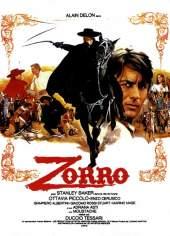
Zorro posterAnother day, another Zorro movie. And Alain Delon's Zorro comes with a cheery theme song, courtesy of Oliver Onions. I defy you to listen to it (and you can find a clip here) and not feel, well, something. And the lyrics...
Here's to you and me
Here's to being free
La la la laaa la la
Zorro's back.
Now, c'mon, what more do you want?

This 1975 version takes the Zorro story from California and transports it to some generic tropical Latin American locale. The skies are blue, the nights are humid, the aristocrats and their servants are baroque and bewigged, the people are enslaved, and, yes, Zorro is back. Indeed, the sequence showing his arrival is splendid: in the middle of a scene taken directly from the 1920 Douglas Fairbanks movie, in which a priest is whipped for allegedly selling underweight goods, parallel edits show the dark figure of the masked avenger gradually coming into focus silhouetted against the azure sky. "Enough!" he declaims. "I want to show you what justice is."

Power is ever more centrally at issue in this version of the story. Power and its disguises. For here Zorro is the outcome of a double disguise: Alain Delon's character, Don Diego, whose real origin and role are murky, first stands in for the governor Miguel de la Serna, murdered at the outset by the dastardly Colonel Huerta, before he subsequently also transforms himself into the bandit with a conscience.

Don Diego therefore impersonates both legitimate power (as his Excellency the Governor) and illegitimate counter-power (as the masked brigand). In both roles, however, he is restrained from violence by his promise to the dying de la Serna, in which he swore to uphold the good governor's ideals. Only in the climactic final scene, in which Huerta cold-bloodedly kills the (same) priest, Brother Francisco, to avert a social revolution, does Zorro feel that he is released from that promise. Huerta is duly despatched, albeit after a protracted fight sequence.

Zorro on his horse in the desertThen, in marked contrast with Tyrone Power's incarnation, Zorro rides off into the distance, leaving behind even his love interest, the fair (if somewhat ornery) Contessina Ortensia Pulido.

This is, in short, a much less territorialized Zorro than either the 1920 or (particularly) the 1940 outings.

The fictional territory in which the action takes place is named either Nueva Aragon or Nuova Aragona: the movie is uncertain even as to its linguistic affiliations, and is dubbed into English from what could quite possibly have been a Babelic confusion of languages used on set. The colonial outpost depicted is an (almost) any-space-whatever of 70s exoticism: it might as well be Mozambique or Tangiers. (The very similar Burn! was in fact shifted during production from the Spanish Empire to the Portuguese.) What's important about the locale is that almost everything is out of place. This is a faux-European society imposed on the barren land of the Third World.

So no surprise that Zorro himself is very much a man of no fixed abode, a nomad who can only impersonate belonging. Here, almost everything is a matter of impersonation.

Don Diego and Colonel HuertaWhat's highlighted is the very ridiculousness of colonial society. In fact, this is a theme that underlies all Zorro films, however much at the same time they attempt to naturalize and legitimate the ideal of a benevolent imperialism.

The films derive their comedy from the antics of Don Diego as fop (here magnificently realized in a scene in which the governor rises from his throne to greet the visiting Pulidos only immediately to trip and fall headfirst on the ground). And Don Diego, in his uselessness, idleness, and futility, is always typical of the ruling colonial class. Which is why, after all, he has to become Zorro, i.e. to step outside that class, in order to reform it.

But whether incarnated in Zorro or Don Diego (here, impersonating governor Miguel de la Serna), what Delon's film more than any other underlines is the performativity of power.

[Meanwhile I note that Isabel Allende has written a Zorro novel. God help us all...]

Labels: ,

Monday, September 12, 2005

The Lost World

In his Seven Theses on the Dinosaur, W. J. T. Mitchell argues that the dinosaur "symbolizes the power of the total state in its modern constitutional form." And Gabriela Nouzeilles has shown how the Argentine state invoked Patagonian dinosaur remains to naturalize its claims of national autonomy and power.

But the creatures in Harry Hoyt's classic silent The Lost World are a little more ambivalent.

Located in the heart of deepest, darkest Latin America, far up the Amazon somewhere at the confluence of Brazil, Colombia, and Peru, they certainly instantiate peripheral under-development.

ape manMoreover, these lumbering beasts occupy what is merely one end of a continuum: they share their plateau homeland with both apes and rather menacing apemen. Down below, in the tropical jungle, are snakes, alligators, sloths, and human "half-breeds," the zambo half black, half Indian. Also left behind in camp, while the main exploring party go on above to search for signs of the previous expedition in the area, is Austin, an English domestic servant. The main party itself is divided between the old and more or less unfit (Professor Summerlee) and the young and nubile, not least the journalist Malone who proves his worth as a husband by braving the South American wilderness, so winning Paula White as female prize from the veteran explorer Sir John Roxton.

But this hierarchy is not entirely stable: Jocko, the pet monkey, is (as Summerlee is reminded) more useful than some of the human members of the group; and Professor Challenger himself often (as Deleuze and Guattari point out) appears half-simian, hirsute and hot-headed, becoming-animal in his enthusiasm and stubbornness, and, not least, his vitriol against the written word.

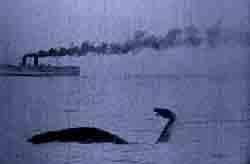
Moreover, if the Conan Doyle novel on which the movie is based frames Challenger's expedition as a civilising mission, concluding with the apemen wiped out or enslaved and a client regime of grateful natives installed on the plateau, the film version differs sharply. Here, the "lost world" is devastated by a sudden volcanic eruption. One brontosaurus, however, escapes and is taken back to London--only there to escape again, cause mayhem in the streets, and collapse the iconic Tower Bridge, before, in the film's final frames, heading back towards Latin America by sea.

brontosaurus at sea
At the head of the tradition of monster movies that it initiates (animator Willis O'Brien would go on to work on King Kong, in many ways a remake of this film), The Lost World introduces a preoccupation with the monster as a genie disturbed, its vengeance a return for modern hubris. In this, of course, Spielberg's own Lost World is a true inheritor.

But if Spielberg's emphasis is on the dangers of science over-reaching itself, is not Harry Hoyt's theme imperial decline, his fear (and the fear radiated in the innumerable close-up reaction shots of Bessie Love playing Paula White) that of the untamed forces of what was once thought natural terrain for colonial intervention?

Labels: ,