Thursday, June 07, 2018

Get the Gringo

Adrian Grunberg directs the crime movie “Get the Gringo” (2012). Following the themes of many other film productions in which Grunberg has had a part (Narcos, Going Back to Cali, among others), Get the Gringo comes with a chaotic portrayal of criminal life in Mexico through the eyes of a criminal, but an American one. The Spanish title for this movie is “Vacaciones en el Infierno” (Vacation in Hell), which better reflects what the film portrays. The Hollywood action superstar Mel Gibson is The Gringo, an American criminal captured by Mexican authorities who send him to a local prison called “El Pueblito” (little town) in Tijuana, a city next to the US-Mexico border. “Is this a prison, or the shittiest mall?” Gibson asks himself while walking around the prison’s patio where convicted criminals have set up their businesses, formed families, educated their children, and even keep committing the same crimes for which they were imprisoned in the first place, like they were living in a little town (but much more dangerous), not within four walls.

A former US soldier steals millions of dollars from the United States and drives towards Mexico where he might hide the money and escape to have a beautiful vacation. Though the persecution started on US soil by its police, he is captured on the Mexican side of the border. The corrupt Mexican police take the robber to the worst prison around, “El Pueblito,” and keep the money for themselves. In the border scene, we can see the wall dividing both countries, an old fence that delimits how far American law enforcement can go to.

Being the only American prisoner, Gibson’s character becomes quickly identified as the Gringo. The place is like hell, entire families of criminals, poverty, drugs, sex, music and gambling are everywhere, every day. The prison guards stand around showing a blind eye to all the madness around them because they are getting bribed by a crime lord called Javi who oversees everything from the top of his prison penthouse, deciding over every living being under him, like the devil itself. To survive, the Gringo starts a friendship with a little kid who gives him information about how the place is run. The kid and his mother live in El Pueblito not because they are criminals, but because the father was one, and he took them to live there. In exchange for his freedom, the Gringo leaves the millions he stole to Javi, but after killing the owner of the money he returns to take it back. He kills the bad guys saving the kid and the mother from being killed, and escapes with them to some beautiful beach in Mexico, the real vacation.

From simple things like music and physical appearance to corruption and crime, Mexico and its people are portrayed in stark conrast contrast to what we see of the United States in the movie. As soon as we are taken south of the border, music is one the clearest features that portray the low standards of culture and life with nostalgic songs about gangsters, love, among others. “Tortured by mariachi!” complains Gibson closing his ears with the ends of two cigarettes. And crime itself is different on either side of the border. El Pueblito is a prison, so of course it looks more chaotic and dangerous than anything else shown in the movie. However, it is almost impossible to know which scenes are happening inside of the prison and which are on the outside. From the littlest kid to the oldest grandma, and from the lowliest guard to the highest ranking prison officer, they are all involved or know about the crimes and protect each other, especially from outsiders like the Gringo, (for being family and for being Mexican). The perception is as if the life within the prison is equal to the life in Mexico as a whole. When the plot moves to the US, however, we know that the only criminal on camera is the Gringo, and that the only reason he could get away with his plan is because he could not get caught on US soil.

When we see a narco film, the biggest fear of the narcotraffickers is ending up in the hands of the gringos. No matter how dangerous South America criminal life could be or how likely to get sent to the most awful and unsafe prison (as in this movie), US law enforcement is worse than that. Perhaps not because of the violence or conditions, but because once caught it is impossible to avoid getting the punishment one deserves. This is the same idea that Grunberg depicts in the movie about Latin America, but most important, about the United States, the terror of the criminals. El Pueblito might be chaotic, and it has the worst living conditions for its prisoners, but neither its walls nor those who are supposed to enforce order within it can stop the Gringo from escaping. Latin American law enforcement is useless compared with the United States (they could not even find the real name of the Gringo) or so the movie seems to claim. And using the name of a real example gives credibility to this idea. El Pueblito was a real prison in Tijuana that was closed because of the corruption that allowed entire families and businesses to develop in its patio.

The ways in which law enforcement and security in Mexico are portrayed in the movie could help to justify arguments to support US intervention south the border. Without the old fence that we see at the beginning of the movie that stops the US officers, perhaps the Gringo might have been caught by responsible and honest officers that would have given the stolen money back. There are a lot of ideas that may support the opening of borders for justice and law enforcement North to South; however, South to North is a different story. We see the Gringo crossing over to the United States with a counterfeit passport. We see a criminal crossing without constraints. At the same time that we see the need to open up the border towards the South, we are introduced to this scene in which it seems necessary to close up the border towards the North, or at least a need to make it stronger.

Labels: , ,

Tuesday, May 22, 2018

Monsters

Gareth Edwards’s 2010 road-movie Monsters recounts the story of an American journalist and an American tourist on their way to cross the border from Mexico to the United States. While the movie’s main theme focuses on the fictional alien invasion and its consequences in Mexico’s and the U.S. security, this is also a border movie in which it is questioned the ways in which “threats” are taken care of before they can cross the border; in other border movies those threats are drugs or violence (usually carried into American territory by immigrants), in this case, monsters (creatures that act independently from human mobility).

The movie starts with an introduction to the current situation: a NASA probe crashed in Mexican land bringing alien forms of life to at least 50% of the country. The United States government has named those areas the “infected zone” and to protect people from the alien infection everyone is requested to wear masks. To avoid the “infection” spread, the Mexican government has paired up with the United States to allow the guarding and bombing of the most dangerous areas. Under these circumstances, Andrew (US photojournalist) is in charge to take back Sam (tourist) to “safe land”, the United States. Throughout their trip to the coast where they will find ferries to take them back home, Sam, again and again, tells Andrew that what is been said about Mexico in the United States is not the reality, that things are much better. In support of Sam’s comments, Andrew recognizes that the media is indeed sensationalist since photos of violence, the alien creatures or dead people are more valuable than photos that show happiness. This leaves him with no other option than look for images that confirm the misconceptions of the sensationalist media. However, as the couple gets closer to their destination, the contrast between what is being portrayed in the media versus Mexico’s reality becomes even stronger.

Once in the coast, crossing the border represents a real problem. Even though Sam and Andrew are American citizens, they are treated in the same way as the Mexican migrants. Before departing, Sam And Andrew go to a night festival in which all people celebrate without any fear of the monsters, however, they do fear and protest against another kind of monsters. The consequences of military intervention in the small coastal village are death and instability. Walls with messages endorsing the military campaign to bombard infected areas have been crossed over and on top Mexican people has written “Que son los Mountros? NO BOMBING” (What are the monsters? No bombing). The indiscriminate bombing to destroy the creatures has also killed hundreds of people, many of them without identification, the unknown dead.

Sam and Andrew lose their passports and have no other option than crossing the border by feet, through the infected zone. After 6 years since the extra-terrestrials arrived in Mexico, the evacuated infected zone became a jungle. Vegetation is growing covering the abandoned buildings and there only sounds that can be heard are those of animals, the creatures, and American aircraft dropping chemical bombs. Thus, the masks are not to protect people from the aliens, but from the chemicals dropped in the zone. “When American planes come, the creatures like animals get mad and become very dangerous… if you don’t bother them they don’t bother you” says one of the people smugglers about the nature of the conflict arising the question of who the real monsters in the story are. These conversations along the road problematize the dichotomy of what is real and what is fantasy within the plot, or in other words, what is being shown in the news (all American news in English, there is no national news reporting the problems) and what Sam, Andrew and the rest of Mexico experience.

The plot recurrently questions the idea and feelings of separation created by the US-Mexico border wall. Though there is a physical wall dividing both countries, several aspects of their societies make them more similar than diverging. One of them, as I have described, is the media present in Mexico. Getting closer to the border all the news on television are American made. Another contradiction to the division of the two North American countries is language, at the beginning of the movie when the main characters are more distant to the border, the language divisions are more tangible. However, as the plot moves up to the border, most of the people in Mexico speak or at least understand English. The last critique is made to the idea of danger/security on each side of the border. Though the general point of view presented by the media is a Mexico full of mystery and danger, especially in the infected zone, people feel quite safe even within that zone (but when the American military is not present). Also, once Sam and Andrew cross the big wall, they think that they are no longer in danger, but at night again they can see two giant creatures, but since this is happening in a US area the media does not report it.

The sci-fi component of this production might turn out attention away from the other aspects of the plot to focus only on the mystery of a typical monster movie. Nevertheless, what this movie tells us about Mexico goes beyond the fictional story. The monsters are introduced to the plot of this movie to question the efforts of building a wall that keeps danger away from the United States. From the movie, we can see that neither the wall not the bombing could stop the entrance of "danger" to American territory, and parallelly, the infected zone and the wall could not stop people from crossing. Additionally, it is very clear the disagreement with the news that is reported in traditional media. Latin America then is more than mystery and violence, is more than the ratings sensationalist media look for.

Labels: , ,

Tuesday, May 15, 2018

Sicario

Sicario, a border film directed by Denis Villeneuve clearly portrays the most popular views, stereotypes, and known realities of southern the U.S.-Mexico border or perhaps only the most acknowledged one: a reality of extreme gun-violence, insecurity, and drug cartels controlling every aspect of the area’s politics and society. The shown illegal and unrestrained drug trade in Ciudad Juarez encourages actions driven by the fear of its possible expansion up to U.S. territory.

One of the most engaging themes present throughout the movie is the constant comparison between North and South which is mainly focused on security. The perception of the United States as a safe place versus a dangerous Mexico appears from beginning to end. It is precisely this deep perception of a generally violence-free America that initiates a war on drugs looking South, where the existence of a Sicario seems to be more possible than one working with or for the United States.

In a collaboration to capture Manuel Diaz, leader of the Sonora Cartel, the FBI agent Kate Macer is sent to El Paso and is forced to participate in an illegitimate operation on Mexican soil. When she tries to oppose the intervention which for her is not part of their jurisdiction, her superior, Matt, accepts the invasive nature of their actions, but simultaneously justifies them for being an attempt to reach a higher end, which is eliminating the Cartel´s leadership once and for all. Additionally, the explanatory discourse of Matt intentionally creates an alarming uncertainty about who should be trusted once Kate crosses the border. Surrounded by an atmosphere of plenty insecurity, Kate explicitly shows her fear towards anyone who is not a U.S. citizen or who does not look like one. The mysterious appearance of the Colombian agent Alejandro is an example of that constructed perception concerning Latin Americans.

Once in Mexico, the warnings that were given by Matt, the sounds of gunfire, and the images of cruel crimes intensify feelings of insecurity, stopping Kate from contributing in the killings of drug trade suspects crossing the border South-to-North. Moreover, numerous visual comparisons appear as the plot moves between the two countries. Crossing the border, an uncountable number of cars and buses full of Mexican people travel north to the U.S, including armed drug traders and gangsters, while the road going South is shown almost empty. At night from the safe and quiet United States, Kate is taken to see the “fireworks”, shooting and bombing flashes that just like fireworks one can fearlessly contemplate from home. As the secret operation continues, Kate realizes that there is actual opportunity to catch the Mexican Cartel leader in Texas, however, her superiors prefer to push the danger to the Mexican side of the border. Arresting the drug dealer or investigating its banking transactions in the U.S. could only create airs of insecurity, so it is better to solve the problem where everyone is used to see violence of that scale.

Although dubious about the credibility of the limited information provided and the legitimacy of the plan to destroy the drug cartel in Mexico, Kate again chooses to continue engaged because of the possibility to prevent future crimes. Surprisingly for her, the paradoxical strategy of using another Latin American Cartel leader to combat the closest one to the U.S. confirms her initial reaction concerning Alejandro. “We cannot trust him, he is not American” Kate had said before discovering that indeed he was equally dangerous than the Mexicans. After discovering the reasons for Alejandro’s participation in the operation, neither Americans nor Latin Americans are to be trusted anymore. But there is one more characteristic that is opposite between the Latino and the American: the motivations driving each one to act and how these are used for the benefit of the collective.

Previously in Robert Rodriguez’s Once Upon A Time in Mexico the craving for revenge after the lives of loved ones are taken was already included as an essential motif of the plot. In the same way, in this movie, the leaders of the U.S operation use the only reliable sentiment among Latin Americans that could make a Cartel assassin collaborate with them, vengeance.

The conservative construction of security at the north of the Rio Bravo dominates most of the plot and wins over any moral questioning. The message of this movie moves towards American exceptionalism and the creation of imaginaries of invasive migration in support of geopolitical strategies to protect national interests. The way Latin America is portrayed in this production implicitly suggest few solutions for the immigration problem including stronger immigration laws, stronger border control, and liberties only for those born within its borders.

Labels: , ,

The Three Burials of Melquiades Estrada

The Three Burials of Melquiades Estrada (2005) presents on the screen an ironic parallelism on the struggles and stories behind those people crossing the U.S.-Mexico border. Parallelism because this time in the attempt to give a proper burial to the Mexican Melquiades for a third and last time, his friend Pete (Lee Jones), who characterizes a Texas cowboy, goes on an unusual journey from North to South the border, to Melquiades's beloved Mexico. Director Tommy Lee Jones questions constructions of identity, justice, the concepts of the legal and the illegal, and finally the idealization of an unknown and promised place, regardless if this is located at the Northern or Southern side of the border.

The main plot relates the story of a Mexican's death and the journey of his American friend to his hometown fulfilling the promise of returning the dead body to his family. The death of Melquiades and its first burial (a quick coverage of the body with sand in the Texas desert) occurs as a result of a mistaken shooting by a US border patrol, Mike, when the Mexican cowboy called Melquiades was in the area as usually required his job. Once the body is found, a brief investigation starts to find the responsible and return the body to the family, but when the Texas police and border patrolmen discover that Melquiades was an undocumented Mexican migrant they decide to finish all efforts to condemn the murder and immediately bury the body for the second time. Outraged for the unjust manner the situation was handled and honouring a promise, Pete decides to take the body out of burial and go to Mexico crossing the desert, through the same path used for “illegal” migrants to follow the American dream.

This adventure is combined with a series of flashbacks that while forming a subplot about Texas people’s daily life (technology, individualism, consumerist culture, purposeless routines), also contribute to the dichotomy of the main plot adding some aspects of Latin American life (landscapes, family values, collective culture, struggles that become part of a purpose) which make the “wild” and beautiful Mexico look like an escape from a society full of deceiving appearances.

By the end of the movie, Pete arrives in Mexico and realizes that Melquiades's stories about his beautiful home and family were lies. The promising but agonizing journey is not but an irony that reveals one reality: whether the migrant comes from the North like Pete in Mexico or from the South like Melquiades in Texas, crossing the border represents the path towards a new life, towards constructing a new identity.

In contrast to other border movies in which the main theme is protecting the U.S from Latin American drug Cartels, murderers, among other negative influences coming upwards, the story presented advocates right-wing opinions on immigration. The idealization of a promising place crossing the border towards the U.S that is endangered by illegal immigrants is undermined. This tries to dissolve the geographical division between the two countries, and instead, it highlights similarities and the fact that a Mexican and an American can be friends, that Mexican people (regardless of their past or by which means they cross the border) can also contribute as part of the society as an American will do if they go to Latin America.

Labels: ,

Tuesday, March 24, 2009

The Way of the Gun

The Way of the Gun posterThe Way of the Gun is a 2000 film from Christopher McQuarrie, director of The Usual Suspects. It begins with the introduction of our two protagonists, let's call them "Parker" (Ryan Phillippe) and "Longbaugh" (Benicio Del Toro), like the real names of Butch Cassidy and the Sundance Kid. They are a criminal duo, looking to make a buck in whatever situation they encounter, stealing their way through life. While at a sperm donation facility trying to make some money, they overhear a telephone conversation concerning a $1 million payment to the surrogate mother of a rich man's unborn child. Their interest is piqued, and they go to the fertility clinic they heard named in the phone call, planning to kidnap the surrogate mother for ransom. Unbeknownst to them, the parents of the unborn child are Hal Chidduck, a crooked millionaire, and his young trophy wife. The surrogate, Robin, is carefully protected by a team of bodyguards whose leaders are Jeffers and Obecks, two cold-blooded associates of Chidduck's. As Robin and her bodyguards are leaving the pregnancy clinic, Parker and Longbaugh attempt to kidnap her, but this proves difficult and results in a shootout. Jeffers tells Robin to go inside and up the elevator, as his priority is protecting the Chidduck's baby at all costs. She begins to do so, but then suddenly determinedly walks out the doors where the shootout is taking place, risking her life. Parker and Longbaugh manage to kill all Robin's bodyguards and snatch Robin, stuffing her into their car and driving off. Jeffers and Obecks have survived the shootout and follow the kidnappers in their car. The following car chase proves futile for Jeffers and Obecks, who are arrested by the police as they pursue the fleeing kidnappers. These scenes show the well-honed skills of Parker and Longbaugh in the art of reckless violence.

As the fugitives head south for Mexico, Jeffers and Obecks are bailed out of jail by Joe Sarno (James Caan), a seasoned operative and close friend of Chidduck's, a man who does all the dirty work necessary to take care of Chidduck's business. Sarno begins to coordinate the rescue of Robin, to whom it seems he is personally attached. Meanwhile, the fugitives are with Robin at a truck stop just before the border; as they rest, Robin starts to suffer nausea and pain, causing the kidnappers to call her gynecologist Allen Painter and order him to confidentially come to the truck stop to treat her. Allen Painter arrives and, at gunpoint, determines that Robin's sickness comes from dehydration and that she should be fine. When he returns from the examination, he heads straight for Chidduck's house, and it is revealed that Painter is Mr. Chidduck's son. At this point, Painter's phone rings and Longbaugh is at the other end, demanding a $15 million ransom for Robin and the baby. Chidduck is enraged because the payment of this ransom will lead a money trail back to the people he does business with, dangerous people who will avenge themselves by killing Chidduck and his family if their business is discovered. He sends Sarno as a "bag man" to try to cut a deal with the kidnappers, who are now at a Mexican roadside motel with Robin. Sarno offers Longbaugh $1 million if he surrenders Robin and walks away, but Longbaugh refuses and returns to the hotel room where Parker and Robin are playing cards. Here, Robin admits that her initial agreement to have the Chidduck's baby because she needed the money has given way to a feeling of maternal possessiveness of the baby. Meanwhile, Jeffers and Obecks are at the Chidducks' house planning a way that they can keep the money by killing everyone and safely returning Robin to the Chidducks while pretending that the ransom payment has gone smoothly. Here, it is also revealed that Jeffers is having an affair with Chidduck's young wife. The time comes for the ransom to be paid, and Jeffers, Obecks, and Painter drive down to the motel; Sarno drives down separately with $15 million in duffel bags. At the motel, Parker is having second thoughts about the kidnapping and tries to convince Longbaugh to walk away, giving Robin the opportunity to barricade herself inside the hotel room with a shotgun, shouting at them to leave. Robin manages to call the police from the room, and when their sirens approach, Parker and Longbaugh escape into the hills. Two Mexican police officers arrive, followed by a car carrying Jeffers, Obecks, and Painter. Painter and the bodyguards try to convince Robin to leave with them, but she is hesitant, causing the Mexicans to draw their guns and make everyone lie down on the ground. Suddenly, Parker and Longbaugh start shooting from a nearby hilltop, resulting in a brutal shootout that kills the two Mexican officers and wounds Obecks. Painter and Jeffers drag Robin into their car and drive south, leaving Obecks behind. The kidnappers run down to the motel and pick up Obecks, taking him into the hills and torturing him until he reveals Jeffers' destination.

The destination is a secluded Mexican brothel, where Robin is confined to a seedy room with Dr. Painter. Robin is in severe pain and bleeding heavily because the placenta has torn away from the uterine wall, and Painter realizes that he must perform a Caesarian section to save the child. At this point, Robin reveals that the child is not the Chidducks', but hers and Dr. Painter's; the baby was conceived because the in vitro fertilization did not take and she was desperate for the money. During the bloody and non-sterile operation, the heavily-armed Parker and Longbaugh invade the brothel and search for Robin, exchanging shots with Jeffers as well as a Sarno and his henchmen, who have also infiltrated the brothel. When the two kidnappers enter the room where Robin is, Jeffers threatens to kill Painter and the baby to stop them from shooting, but Painter shoots Jeffers in the throat with a hidden gun. Now Parker wants to kidnap Robin again, but Longbaugh refuses, saying "She's had enough". Robin is sedated and covered in blood, struggling to survive as Dr. Painter digs his hands into her belly, trying to get the baby out. Outside, Sarno and his men have stacked the $15 million in the brothel's courtyard and await to ambush the kidnappers. As Parker and Longbaugh emerge from the building, there is a violent shootout in which they kill all of Sarno's men except Sarno, who shoots both kidnappers in the legs, maiming them to the point of immobility. He then calls an ambulance, which arrives just as the cries of a baby are heard. Painter and Robin emerge with the paramedics, a newborn baby in Robin's arms. It is implied that Robin is Sarno's daughter. The ambulance takes Robin, Sarno, and Painter with the $15 million away, leaving Parker and Longbaugh dying in the dust. The final scene shows Chidduck's wife, days later and miles away, telling Chidduck that she is pregnant.

Mexico for Parker and Longbaugh is a place to which they can escape, collect their thoughts, and get ready for the money transfer. The ransom payment must occur in a neutral place, and a seedy Mexican motel seems just right, a place where people are unconcerned with their business. It is not, however, a place where they are safe from Chidduck's men; indeed, it seems the Mexican border is a porous, penetrable line through which the men pass at will and without difficulty. The same reckless violence and lawlessness exists on both sides of the border, with no difference between the truck stop north of the border and the motel south of the border. Both places are seedy, dusty, and surrounded by desert. After the shootout in the motel parking lot, a group of Mexican men who were sitting in the bar stand silently outside, observing the scene. They do not get involved, not even to help the screaming, pregnant Robin. When the Americans leave, they turn around, poker-faced, and re-enter the bar. The brothel where the final violent events occur is a bewildering place. It seems deserted and quiet, a dead place; inside there are rooms full of prostitutes, but they make little noise. It seems that the protagonists are the only people there throughout all the action, reinforcing the notion that Mexico is a place of neutrality, where the Mexicans stay out of whatever violent business the Americans choose to negotiate there.

The theme of moral ambiguity is prominent in the film, with no character evoking true sympathy. Everyone is generally bad, but shows evidence of goodness at some points in the film. The evil millionaire Hal Chidduck is still excited to be a father and will do anything to save his unborn child; his vacuous, heartless blonde wife shows a maternal instinct in her desire to have a child. The bodyguards Obecks and Jeffers are just doing their jobs. Sarno is just doing his job as well, but he cares deeply for Robin and the child and makes several merciful and good decisions throughout the film, leading him to save the day and call an ambulance. Painter is a weak man who has worked for his crooked father, but he saves Robin and her baby's lives. Robin lies about her pregnancy to make $1 million, but she cares deeply for her baby's life and is primarily a victim throughout the film. Parker and Longbaugh show mercy and kindness to Robin while she is in their possession, as well as abandoning their efforts to kidnap her in her condition at the end. The Mexicans in the film are also morally ambiguous. They are bystanders, watching indifferently as people kill each other. They are also policemen, who try to save Robin from the dangerous men who pursue her, and lose their lives doing so. They are prostitutes, disinterested in the violence that surrounds them, but they are also ambulance drivers who come and make order of the chaos. The Mexican border is just a line, dividing no one. People are neither good nor evil on both sides of the border, and national lines have no effect on morality.

Labels: , ,

Sunday, February 15, 2009

A Fistful of Dollars

A Fistful of Dollars posterA Fistful of Dollars (1964) has a fascinating lineage; the film was directed by an Italian, who based it on Yojimbo (1961) by Japanese filmmaker Akira Kurosawa, who in turn was influenced by the Westerns of John Ford. The film was shot in Spain and takes place in Mexico, but it is also profoundly American with its choice of hero and thematic preoccupations. Clint Eastwood is this hero, a tough-as-nails mercenary who becomes embroiled in the feud between two families for supremacy over the town of San Miguel. Eastwood plays them against each other until he is the last man standing on a dirt road littered with corpses, and San Miguel is finally purged of its criminal population.

The film opens with Eastwood, who is sparsely referred to as Joe, riding into the sun-parched and seedy San Miguel. He befriends the barman, Silvanito, who describes the local politics: The town is run by two competing families, the family of the town sheriff, John Baxter, and the Rojos brothers which include the prudent Don Miguel, the reckless Esteban, and the intelligent and ruthless Ramon, who is the leader. Silvanito says, “They’ve enlisted all the scum that hangs around on both sides of the frontier and they pay in dollars.” Joe does not mind being employed alongside this scum, so he solicits Don Miguel and Estaban for work and they hire him. Ramon is introduced when, after killing an American cavalry squadron and donning their uniforms, his men lure the Mexican military to trade gold for American guns and instead massacre every last soldier. The massage is clear that Ramon means business.

Joe remains indifferent to San Miguel politics meanwhile he plays the Baxters and the Rojos against each other, and extorts money from both. However, something changes in Joe after he witnesses the Rojos trading a Baxter hostage for Marisol, a woman he has been told that Ramon is madly in love with. During the trade-off, Marisol is spotted by a wailing child, and she runs to him with an agonized, tear-stained face to embrace him and his father, before being torn away by Ramon. Silvanito tells Joe that Marisol was taken for ransom after Ramon accused her husband of cheating at cards, and that he threatened to kill the child should her husband resist. That very night, Joe slaughters the men guarding Marisol, leads her to her husband, thrusts a wad of bills into her hand and directs the thankful trio to the United States. Ramon apprehends Joe and has him brutalized, but despite being too battered to walk upright and having one eye swollen shut, Joe is still sharp enough to engineer his escape.

Ramon is crazed with anger and hell-bent on retribution; he launches a manhunt for Joe with orders to torture Silvanito and torch any building that Joe may be hiding in. A broken and tattered Joe drags himself to the coffin-maker, the only other man in town besides the Baxters and Rojos who makes money, and the kindly man evacuates him from San Miguel in a coffin. As they ride by the Baxter homestead Joe peeks out from under the lid to witness a scene which is the pinnacle of excessive violence in the film; the Rojos engulf the home in flames and as Baxters come stumbling out, choking on smoke and shouting their surrender, the Rojos gun them down with cruel enjoyment. Even Eastwood, with his trademark passive face, is visibly sickened by this spectacle, and in the following days he spends recuperating, one can see his hardened resolve to eliminate the Rojos. Just as the Rojos are torturing Silvanito, Joe emerges from billows of dynamite smoke and proceeds to have a climactic shoot-out with Ramon, who he astounds by hiding a bullet-proof breastplate under his poncho. After the last body hits the ground, Joe bids Silvanito and the coffin-maker farewell, taking no reward with him other than the satisfaction that between him and Ramon, he had the faster draw.

A Fistful of Dollars
is a cynical film in that noble human emotions are glimpsed only a few times in comparison to the selfishness, rage, jealousy, deceitfulness and cruelty portrayed. Yet even the most honorable action, of Joe enabling Marisol to escape, was not based on any moral code. When Marisol asks, “Why do you do this for us?” Joe answers, “Why? I knew someone like you once and there was no one to there to help. Now get moving.” He could just as easily have not done this, like at the beginning of the film when Ramon’s men shoot at Marisol’s child and Joe merely stands by. A Fistful of Dollars is unlike typical Westerns in that the hero does not act upon moral ideology but impulses; he has no complex back-story to help the viewer understand his motivations.

The “frontier” looms large in A Fistful of Dollars. For Marisol, the border is a gateway to a better world in which Ramon has no jurisdiction. However, the border is more generally portrayed as lawless zone where the arm of state power fails to reach, and thus the most degenerate elements of both societies, from Mexican crime-lords to shiftless Texan drunkards, congregate there. Unlike in the Westerns of previous eras, in which the frontier was replete with promise, or at the least kept under control by the hero, frontier lawlessness in A Fistful of Dollars is beyond the scope of any one man. However, after a massive amount of bloodshed, Joe does manage to save San Miguel from the clutches of criminality. The violence in A Fistful of Dollars takes many, often brutal forms, but it is ultimately justifiable because of its cathartic role. In order to become a civilized place, San Miguel must endure its darkest hour of savagery, from the hero as well as from the villains.

Labels: , , ,

Wednesday, November 07, 2007

The Swarm

The Swarm posterThere's some dispute as to how to refer to the bees that feature in the hideously bad disaster flick The Swarm. Though they're generally described as "the Africans," one scientist insists that it's more accurate to call them "Brazilians." For they arrive in the United States by way of South America, and fly to Texas by crossing the Caribbean.

In some ways these killer bees' precise origin doesn't matter: what counts is that they're foreign. The film goes to some lengths to distinguish them from native honey bees. Indeed, the reason why lead scientist Brad Crane (played by Michael Caine) refuses the military's suggestion to drop industrial supplies of pesticide upon the swarm is that the vital US bees would suffer unwanted collateral damage. He screams at the general: "The honey bee is vital to the environment. Every year in America they pollinate six billion dollars' worth of crops. If you kill the bee you're going to kill the crop. And if you kill the plant you kill the people. No! No, general!" And lest we miss the point (for Caine does a remarkable amount of shouting in this movie) and leave the cinema fearing bees of all kinds, the movie's final credit drives the point home:
THE AFRICAN KILLER BEE PORTRAYED IN THIS FILM BEARS ABSOLUTELY NO RELATIONSHIP TO THE INDUSTRIOUS, HARD-WORKING AMERICAN HONEY BEE TO WHICH WE ARE INDEBTED FOR POLLINATING VITAL CROPS THAT FEED OUR NATION.
So the film makes it clear that these foreign bees pose a double threat: to the population at large, but especially perhaps to the industrious American worker.

The potential allegory is patent enough. A brown mass is poised just south of the border, and invades first the Southwest to overcome local residents by sheer force or numbers as well as their lethal but invisible venom, driving out hard-working citizens and installing themselves in their place. The threat first strikes the small-town life of a place such as the film's Marysville, with its hick ways, flower festivals, and touching love triangles between elderly bachelor and spinster schoolteacher. Even the old-fashioned virtues of summer picnics are at risk, because they're everywhere, faceless swarms with their unintelligible murmurs and crafty but unfathomable ways. Next the danger travels to the larger cities, such as Houston. By this time they're unstoppable: they're in the elevators and hallways, almost everywhere you turn.

Latin America is full of dangerous critters: anacondas, piranhas, even creatures from the haunted sea. But The Swarm suggests that the most pressing danger comes from the migrant hordes who slip across the border and infiltrate themselves into our everyday lives.

In the end Crane, side by side with his (rather unbelievable) lover interest Capt. Helena Anderson, hold off the tide at least for the time being. But the movie ends with the definite sense that there will be continued attempts to breach the southern border, and that if anything the next time it will only be worse. Because in fact they're already here, and they've been quietly reproducing: "The invasion didn't just now begin. They have been here for some time, breeding, increasing."

The Swarm still
YouTube Link: the movie trailer.

Labels: ,

Monday, November 05, 2007

Viva Knievel!

Viva Knievel! poster"Buenas tardes," says Frank Gifford, playing himself as an announcer. "That means 'good afternoon.'" And welcome to Viva Knievel!, a film to which subtlety and understatement are completely foreign. Indeed, the tone is set in the very first scene, in which motorcycle daredevil Evel Knievel is introduced as a strange combination of Santa Claus and Mother Teresa. He creeps into an orphanage at dead of night to hand out scale action figures of himself to the institution's unlucky residents, not to mention to make the lame walk: "You're the reason I'm walking, Evel!" exclaims one little critter, throwing his crutches away. "You're the reason!" Our hero has even thought to bring some fudge for the nun who oversees the unfortunate, so calming her ire at his unannounced arrival. And when she bids him farewell by calling him "Brother Evel," it ain't no nod to African American homeboy slang. There's a saint among us, and he also looks awful spiffy in his red, white, and blue leather jumpsuit.

As the plot unfolds, it turns out to involve unscrupulous businessman who arrange for Knievel to attempt one of his death-defying stunts in Mexico with the plan of sabotaging his bike and so ensuring the jump is terminal. Then the subsequent coffin-laden caravan can pass unmolested across the border on its return to the USA, so enabling our devilish masterminds to smuggle 3,000 packets of cocaine in a the false panels of a duplicate version of Knievel's outsize trailer. No doubt about it, these are bad, bad men. Thank goodness Evel is around to ensure that their plot is foiled, and while he's at it to unite his mechanic and friend with a long-estranged son as well as to soften the heart of a hard-bitten feminist reporter. Everyone in this film is putty in Evel's tough but tender hands.

Presumably the Mexicans are also enthralled by the presence of their illustrious visitor. A state governor lays on a welcome party and gives him the run of a hacienda. "I've always heard you were the warmest of neighbors, governor, and I appreciate it" Knievel replies. Forthwith, a lovely señorita throws the man a single rose from a nearby balcony. But we never see her again, and indeed on the whole the Mexicans provide no more than such passing decoration. For instance, at the stadium in which Evel is to show off his courage and motorcycling skill, we see a Spanish-language announcer perched in the commentary box next to Gifford, as well as the stands packed with cheering fans, including at least one complete mariachi band, plus a phalanx of Aztec warriors flank the pit of flames that Knievel's bike is to jump. Then at the movie's climax, Evel leads his pursuers a merry dance by riding at speed through a local village ironically called "Verde" (in a petrol-obsessed movie in which otherwise only the grass and the Mexican flag show even hints of green). Chickens, goats, and villagers go flying as the dusty streets become an obstacle course for our man to show off his impromptu driving skills. Otherwise, everyone in this movie, hero and villain alike, is as red, white, and blue as Knievel's jumpsuit, helmet, bike, trailer, and other assorted accoutrements. Even the hospital to which our man's sidekick is taken (in a sneaky attempt to prevent him from revealing the bad guys' dastardly secrets) is run for and by US citizens alone.

So why the Latin touches to Knievel's über-patriotic antics? Why viva Kneivel? Well, the drugs come from Mexico, of course, even if this film suggests that the locals are apparently not crafty enough to organize their own supply lines. But Mexico's also both a seduction and a promise. A seduction in that it's a source of addiction: not only the cocaine to which Evel's protégé falls prey, but also the tequila that is his mentor's not so secret vice. This is a manifestly moral film: Knievel warns against the dangers of drugs at every opportunity. Borders therefore need to be enforced, their and our weaknesses rectified. On the other hand, the porousness of the frontier between North and South offers the promise of universality. Knievel has to be as raucously welcomed in Jalapa as in Long Beach. For sainthood knows no territorial boundaries: Evel's goodness has to rise above its national origins, just as the petty criminal from Butte, Montana managed to transcend his provincial origins to become every young boy's hero and (if this film is to believed) every woman's dream date.

Viva Knievel! stillAnd strangely, it's only in Mexico that he manages to avoid crashing the damn bike.

YouTube Link: documentary footage of the crash that made Knievel's name.

Bonus Link: an impressive collection of Knievel comedy, courtesy of Evel Incarnate.

Labels: ,

Monday, October 22, 2007

Border Radio

Radio knows no borders. So the thing about "border radio" is the way in which radio's transmissions bleed over borders: snippets of Spanish-language stations are picked up in Southern California, while US programming likewise fades in and out of the airwaves in Northern Mexico. The border becomes an indeterminate zone in which diverse cultural influences mix and hybridize.

Border Radio posterSo in Allison Anders, Dean Lent, and Kurt Voss's Border Radio, the border itself never appears, though characters slip over and back from time to time while the soundtrack features LA Punk and Mexican pop, as well as mixed genre bands such as the Chicano rock/Tex-Mex stalwarts Los Lobos. So although the movie is very much a document of a particular time and place--the LA punk scene of the early 1980s--it's also characterized by constant slippage and indeterminacy. One of its intertitles reads "2 or 6 months later," as though the possible four-month difference were of little import. The film constantly shifts between genres: it's part noir, part road movie, part documentary, part Western. And the narrative is set up as its lead character slips over the border to Mexico, abandons his car in the middle of nowhere, and sets up in a trailer park to brood over his life, his wife, his friends, and the direction of his career.

Jeff Bailey is a musician, but his name is taken from the Private Eye played by Robert Mitchum in the noir classic Out of the Past and indeed the film opens with a plot of crime and cross-border escape: Bailey is driven south when three heavies turn up at his apartment looking for money and some mysterious books that he's allegedly stolen from a nightclub that he feels owes him. But later the whole issue of the books turns out to be some kind of mistake, and we discover that he's patched up his differences with the club's owner.

Border Radio stillStill he stays in Mexico, hanging out with other ex-pat refugees as well as gnarled locals, playing songs to a china Elvis and a clay devil on top of an abandoned car, burning his guitar on the beach, and generally taking some time out from his day to day existence back home.

And back in LA, in another slippage that shows the porousness of personal identity, Bailey's wife has taken up with his best friend and band's roadie, a guy called Chris who has clearly long wanted to takes Jeff's place. Chris gets his chance now that Jeff himself has vacated his professional and familial roles, choosing rather to enter the border zone.

So Mexico is again a place of escape, but here it is not a site of refuge or even reinvention, but rather a place to lose oneself, to lose the self. It's both an extension of and a reaction against the LA underground: an extension in that it's yet another alternative to the mainstream, a reaction in that it's a resistance to the commodification and fixity even of that subcultural alternative now plagued by the demands of record promotion, commercial remixes, and increasingly dubious assertions of authenticity. It's not that there's anything particularly authentic about Mexico, or rather about the border zone in which Mexico and the US overlap and contaminate each other. By contrast, it's the very bleeding across borders, the way in which radio transmissions fade in and out, that resists and undoes authenticity and fixity alike.

In the film's final chapter ("2 or 6 months later), we catch up on the characters' fates some time after Bailey has returned to the US. He and his wife have separated: she's writing a book. The best friend has been to Europe. And Jeff himself is strumming his guitar while sitting at the base of the famous Hollywood sign, but it's not so much that he's sold out as that we see, up close, the graffiti scrawled on the sign and its precarious perch in the Southern California scrub. Mass culture, too, has its lines of flight, its indeterminate border zones that are neither here nor there, neither American nor Mexican. For all the payola and prestige needed to get a song on the radio, you can never quite control where it goes from there.

Labels: ,

Tuesday, October 02, 2007

The Pilgrim

The Pilgrim posterAt the end of The Pilgrim, Charlie Chaplin makes a series of brief forays across the border separating the US and Mexico. At first, his international travel is purely accidental. For the border is nothing but a signpost in the middle of a scrubby area of open space. Chaplin's character, the eponymous pilgrim, leans upon the post until suddenly realizing he has mistakenly strayed into Mexico. So he hurriedly returns to the US and leans on the same post from the other side. How easy it is to slip across the frontier, even without knowing what you have done!

The Pilgrim still
But the pilgrim has been brought here for a purpose. The bulk of the film has shown how he broke out of jail and headed for Texas disguised in parson's clothes. Arriving at a small Texas town, and taken to be the local church's long-expected new man of the cloth, he mugs his way through a sermon on David and Goliath and is then taken to his new digs, with a family of suitably respectable church-goers. An old prison buddy sees the pilgrim, however, and tags along thinking that a heist is in operation. And even though, in priestly garb, it is the reformed ex-con hero who foils his former cellmate's attempt to steal the family's money, nonetheless his past catches up with him. And so the sheriff takes him away. But the man of the law has obviously a soft spot for this reluctant criminal, which is why he has taken him to the Mexican border.

Realizing that Charlie is now steadfastly law-abiding, and is not about to run off south on his own accord, the sheriff has to devise some stratagem to get the pilgrim off his back. He asks him to pick him a bunch of wild flowers, first from just over the border post and then from much further out into the Mexican scrub. With Charlie sent on this wild-goose chase, the lawman then spurs his horse and heads away. . . only to discover his bedraggled convict chasing him up the trail, waving a bunch of blooms over his head.

In the face of the pilgrim's stubborn refusal to take a hint, the sheriff gets of his horse and physically kicks him into Mexico. Which is when Charlie realizes what's going on, and in the middle of the desert starts thinking of the future. "Mexico: a new life. Peace at last!" But no sooner is this thought vocalized than up from the bushes rise a couple of bandidos engaged in a fearsome firefight. Spooked, the pilgrim races back to the frontier, before realizing that he can't go back to the USA, either. So the film ends with Charlie waddling off into the distance, straddling the boundary line and with one out-turned foot facing Mexico, the other the USA.

Again, then, this is a movie that undoes the notion of a Latin utopia safe from either crime or the law. But every time that this fantasy is revealed as baseless, its ubiquity and force are also underlined. The dream of some Latin "outside" is so prevalent that Hollywood endlessly has to reinvent it, if only then to dash it to pieces, to show us that the best a character can do is to straddle the line between inside and out, hoping that neither side notices.

Labels: ,

Thursday, September 27, 2007

Borderline

One of the strange things about travel South of the Border is that it can have one of two contrasting effects: either reveal the real you, stripped down in elemental conflict with destiny (no better example of this than The Wages of Fear, but see also The Treasure of the Sierra Madre); or it can be an opportunity for reinvention and masquerade (Goofy becoming gaucho in Saludos Amigos, for example). Sometimes, of course, reinvention and rediscovery become one and the same: Charlotte Vale in Now, Voyager, for instance, takes on a false identity in her cruise to Rio precisely in order to reconnect with her true desires; in the end she is Camille Beauchamps, even if she has to leave that identity behind again when she returns North.

And this paradox, that Latin America is the site simultaneously of both truth and falsity, is not so dissimilar from the paradox (which I mentioned in discussing Tycoon) that it instantiates both nature and culture at the same time.

Borderline posterIn Borderline, which is a sort of film noir lite, Mexico is the site of duplicity and pretence. Which is why the film rather goes against the conventions of noir, and becomes more a comedy of errors.

Claire Trevor plays Madeleine Haley, and ambitious young cop sent south to infiltrate and investigate a gang of drug-traffickers headed by one Pete Ritchie. She takes on the name "Gladys LaRue" and the character of, first, dancehall floozy and, then, gangster's moll to gain access to the formidable Ritchie, played by Raymond Burr. Yet she ends up kidnapped by another gang boss, who sends her North with a consignment of drugs in the company of hardman Johnny Macklin. Little does she realize, however, that Macklin is, like her, a cop in disguise, tender-hearted Johnny McEvoy under his tough-guy exterior.

In an incident-packed trip through Mexico, "LaRue" and "Macklin" tell each other tall stories about their delinquent pasts as cold-hearted murderer, in LaRue's tale, or in prison or on the lam, "barbequeing the bloodhounds they sent after me," in Macklin's. They take a certain delight in these exaggerated narratives. No wonder Macklin says "Sometimes I get the feeling that you're not telling me everything." "You know, I get the same feeling about you," replies LaRue. But these lies are fun, and especially for Haley/LaRue it's a refreshing change from her role as perpetually spoken-over and unheard subordinate woman in the USA.

But the border itself is the moment of truth, at which their identities suddenly unravel as Haley tries to have Macklin arrested, and McEvory likewise tries to turn LaRue in to the authorities. "You suggest that I cooperate...?" exclaims Haley. "Just who is this girl?" asks McEvoy. And each is as upset with the other as though they were really criminals betrayed by an informer. They have over-identified with their roles, but are shocked by the other's role-playing.

For they don't realize that, in this case at least, the performance has to stop at the borderline.

Labels: ,

Thursday, July 13, 2006

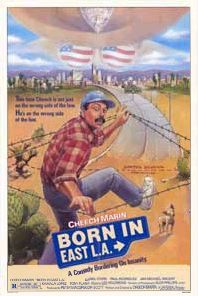
Born in East L. A.

Born in East LA posterCheech Marin's Born in East L. A. is a Chicano take on "Latin America on Screen." Marin takes the questions of border permeability, national security, and identity's performativity, ironizes them, and attempts to milk what comedy results.

Marin plays Rudy, a fairly thoroughly deracinated Los Angelino (who speaks no Spanish and is completely ignorant of Latino music, for instance), who by one of those strange mix-ups finds himself taken to be an illegal and deported to Mexico. He then spends most of the film attempting to cross back over the border, hustling for money with which to pay a coyote, and falling in love with a beautiful young Salvadoran woman, Dolores.

The romantic subplot, though at first sight (like, frankly, much else in this rather incoherent movie) incidental to the main narrative, is in fact significant. For the film shows the process by which Rudy's desires and habits are re-engineered as he learns to become Mexican--or perhaps assume his own mexicanidad. At the outset he trawls round Silverlake and environs in pursuit of a leggy redhead with a French accent. Indeed, the whole community's desire seems to be concertedly fixated on this vision in a skimpy green dress: whenever he stops to ask passers-by if they have seen a redheaded woman recently, as one they turn and point in the direction she has gone; they have been tracking her movements, but she has also been synchronizing their gaze.

Once in Tijuana, however, Rudy learns to appreciate the perhaps more homely virtues of the latina woman, as he also accepts that as far as US immigration is concerned, he himself for all his protestations of US citizenship is as shifty and untrustworthy as the next wetback seeking work north of the Rio Grande. (Of course, it hardly hurts Dolores's case that, though she lives in a trailer and cooks Rudy arroz con pollo, she does so in an immaculate white strapless cocktail dress.)

So by the end, far from asserting his difference from his brown brethren by insisting on his rights as a citizen, Rudy not only gives up his place in a coyote's truck to a more deserving border-crosser, but also like some Chicano Moses leads a flood of Mexican humanity across the frontier, overwhelming the border police's attempt to stem the tide, all to a soundtrack of Neil Diamond's "America".

For sure, this is the film's ideological blindspot: the United States remains very much the Promised Land; while Mexico is dirty, corrupt, and dangerous, paradigmatically experienced in and as prison. Still, there are wrinkles even here to this binary dichotomization. For instance, an apparently harmless and helpless middle aged gringo couple in their winnebago turn out to be up to their necks in smuggling.

Above all, Chicano identity (at least) is revealed as a set of discrete and transferable gestures and vocalizations. Rudy teaches a group of Asian (Chinese or Korean) immigrants how to pass in East LA: a bandana properly tied and cocked; one hand thrust into a jeans pocket, the other lazily waved behind; and the all-purpose exclamation "Waas Sappening." So if the film evidences some ambivalence as to whether Rudy learns to become Mexican, or rediscovers his forgotten heritage, ethnicity in the United States is seen to be thoroughly constructed.

Waas Sappening
And just as Rudy plays a German folk song (picked up as a GI in Europe) to seduce appreciative European tourists to part with their money, so he teaches a band of Mexican buskers to play rock and roll. Though Mexico may still (just) be a cradle of authenticity, it can also be a site for the experimentation in multiple identities and identifications, preparing the intrepid for the risky step of crossing the border and claiming all the same rights and benefits as those actually "born in East LA."

Labels: ,

Thursday, November 10, 2005

The Border

The Border posterIt's no surprise to learn that Bruce Springsteen is a fan of Tony Richardson's The Border. This film's emotional tone is very much the understated disgust and despair characteristic of Springsteen songs such as "The Line" or "State Trooper"; indeed, "The Line" is said to have been inspired by the movie.

For Richardson as much as for Springsteen, the border between the US and Mexico points up a series of divisions that are in fact internal to the USA. And all of these borders provoke anxiety because they are so permeable and unfixed.

There is the US's institutional hypocrisy: the state throws resources at keeping Latin American immigrants out, and yet the economy of the South West would collapse were it not for this cheap labour willing to take on work that white Americans regard as beneath them. Caught in this contradiction, the corruption that this movie portrays as endemic to the border patrol is inevitable. The patrolmen know better than anyone that their task is both counter-productive and impossible, as they continually send the same people back again and again, only postponing their successful crossing, so drawing out their suffering in the meantime.

Then there is the fact that these migrants are simply taking the American Dream at its word. The Border hardly has a sanguine view of the pursuit of happiness through consumer goods or social distinction. But it shows that white Americans who want no more (and no less) than a new condo, with pool in the garden and waterbed in the bedroom, have little solid ground from which to criticize Latin Americans who come north similarly seeking material benefit. (Charles Taylor's "The Broken Promised Land" focusses on this aspect of the film.)

Keitel and NicholsonFinally, there is the line that border agent Charlie Smith (magnificently played by Jack Nicholson) literally draws in the sand: his is an attempt to stake out a limit, a personal code of ethics in the midst of the contradictions and corruption that surrounds him. His limit is a refusal to condone his patrol buddy's extrajudicial killings. "You see this line?" shouts Charlie. "That's as far as I go! No murders!" "Okay," replies Cat (Harvey Keitel), "I can respect that."

But on the border the law no longer makes sense, and the film shows both that Cat can provide some rationale for killing drug-runners but letting other immigrants through for a profit, and that Charlie too eventually takes life and death into his hands in an effort to enforce his own code of honour.

The border is a zone of exception in which the law is suspended, and what Giorgio Agamben terms force-of-law takes its place: in the absence of any coherent or consistent legal framework, the border patrol's actions have the force of law without its rationalizing justification.

Perhaps the greatest irony comes when the border police chief tries to explain to the boss of the coyote people-smuggling operation why a truck full of migrants has been stopped: it's been chased down by a couple of honest border guards and "Goddamit, I ain't got no control over that! That's just gonna happen sometimes."

Meanwhile, Charlie's doubts and moral uncertainty are played out over and around the figures of three Guatemalan refugees: a brother and sister, plus the sister's little baby, who leave their village after an earthquake in the movie's opening scene. Charlie sees the sister from across the Rio Grande while the brother is on the US side, stealing his car's hubcaps. From that point on he gradually becomes obsessed by the trio's fate, saving the brother from the wheels of a freight train, and trying to save the sister from prostitution in a seedy strip joint in the Mexican border town. When the child is stolen (to be sold for adoption to a rich white family), Charlie makes it his mission to recover and return him to his mother.

To all intents and purposes, this young woman is essentially mute: she speaks no English and is given only a few lines of (untranslated) dialogue in Spanish. She's a near perfect subaltern. (Interestingly, the same actress, Elpidia Carrillo, plays a very similar part in Oliver Stone's Salvador.)

And when Charlie tries to explain why he has become so obsessed with her salvation, the best he can come up with is that "I wanna feel good about something sometime."

But Charlie fails to get this group over to the US. He fails even to ensure that they all survive through to the film's final frame. The best he can manage is a kind of second-order compensatory restitution, effected in the middle of the Rio Grande, in the shadow of the transborder bridge and US flag in the background.

Rio Grande
In the end, this physical frontier, no more than a dirty stream, is the least substantial of any of the borders featured in Richardson's film. The Border can only gesture towards larger, systemic issues, in the face of which it suggests revenge is feeble and reconciliation fleeting.

And perhaps this is the film's grandeur: that it is an "issue" movie without even pretending to offer resolution.

Labels: ,