Friday, July 27, 2018

Apocalypto

"Apocalypto" (2006) is an adventure and action movie directed by Mel Gibson which portrays the Mayan civilization myths and decline, and the oppressive rule it had over the surrounding indigenous communities. Gibson takes us to late pre-Columbian Mesoamerica where the Maya empire was located and anxiously waiting for the Apocalypto, a new era in their calendar that is marked with the arrival of the Spanish explorers. Thi movie shows us a different version of colonization which is imposed by the Mayas over smaller communities in Latin America, and which makes the European colonization seem nothing compared with the brutality of human sacrifices and manipulation practiced by the pre-Columbian empire.

The movie is filmed in is full-length in Mayan language and in the tropical jungle of Veracruz and Oaxaca, Mexico, where the community Zapotec developed before the Mayan conquest of their territories. Its plot is built up over myths and legends of the Zapotec culture and historical accounts of the Mayan civilization. The indigenous looking characters speaking ancestral languages, the historical plot, and the jungle and Mayan pyramid sets provide this movie with an extremely realistic atmosphere and a feeling that we are watching an "insider" point of view.

It all starts in the middle of the Mesoamerican rainforest in which a group of indigenous hunt the food for the whole village. With a couple of laughs arose from jokes about the marital life of one of the men, we know that Gibson tried to portray the "normal" life of an indigenous tribe of that time creating feelings of sympathy among the viewers. But then something strange and terrifying happens. Another tribe is migrating because its village has been destroyed. The encounter of the hunter with the tribe migrating in look for a "new beginning" (the meaning of the word Apocalypto) profoundly marks the life of Jaguar Paw (Rudy Youngblood) who fears the cause of the migration and the end of the world as he knows it. Then the action begins. Jaguar Paw's village is invaded and destroyed by warriors of the Mayan civilization who kill almost all the people and take prisoners the survivors, except for the children. In the middle of this tragic scene, the expressivity shown by the characters while praying to their Gods or accepting their destiny to connect with nature in the afterlife reinforces the imagination of a Latin America that suffers real struggles.

The plot is based on traditions, myths and prophesies of the Mayan culture. However, Gibson chooses only those controversial practices that will boost the drama and suspense of the movie. The most shocking scenes are the destruction of the villages to take war prisoners, the human sacrifice of men on the top of the pyramids, and the use of astrological knowledge by the leaders to manipulate people making them believe fearful of a false God, the sun. The anxieties of the people become stronger when a plague infests them and their crops which is understood by some as the beginning of the end (the Apocalypto), while for others it is just a call by the Gods to render more sacrifices. During one more of these sanguinary rituals, a solar eclipse takes place and it is translated by the shamans into the words of the God Sun that has heard the Mayan petitions after hundreds of sacrifices. This event saves Jaguar Paw to be the next sacrificed man. He manages to escape by getting into the jungle where no guns or fighting skills surpass ancestral knowledge of nature.

The persecuted Jaguar Paw comes back to the destroyed village where he hid his pregnant wife and son. The surviving Mayan soldiers that followed Jaguar to the coast are about to catch him, but the arrival of the Spanish ships steal their attention. Jaguar rescues his family and hides in the middle of the jungle to start "the new beginning".

Gibson portrays a part of Latin America that seems quite realistic. It is hard to think that the level of expressivity and historical accounts involve in this movie are not accurate. It is the same strategy Gibson used to screen the Passion of Christ. From the beginning, this movie divides indigenous into two groups: the good and the bad ones, the sanguinary Mayans and the peaceful jungle inhabitants. The division, however, projects more than the complex history of the Mayan civilization. The interpretation of indigenous culture and traditions portrayed in this movie supports the European colonization that aid by Catholicism, demonized practices such as human sacrifices to the Sun. By showing two different "types" of indigenous from what seems an insider point of view, this movie criticizes unacceptable traditions of a (un)civilized culture.

Apocalypto represents in the movie the end of the Mayan empire, but it is also the beginning of a new one when the Spanish arrived. In the last scene, we see the ships getting close to the Mesoamerican coast and it is when Jaguar Paw finally escapes and decides to hide in the jungle. Gibson finishes this adventure film with airs of a promising future, at least for those communities oppressed by the Mayans. The end is paternalistic towards the indigenous communities (Did they need help to survive the Mayan rule?) and reflects the coloniality of justifying in some extent the superiority of religion over indigenous beliefs and colonization itself. The depiction of indigenous practices as inhuman is implicitly contrasted to the imaginations of the audience when the Spanish ships appear on the screen. There is no need for a further development of the storyline that would include the establishment of colonies and overthrow of Empires in the Americas.

Latin America and its history (the myths, the culture, the traditions, and even the language) brings to the film industry the complexity and beauty necessary for creating a plot that is both realistic and fantastic at the same time. Apocalypto might convince its audience that the purpose is sharing the struggles lived by indigenous, even before the colonial period. And even though it does show events that are part of history, it only reaffirms imaginaries of implicit Western superiority that were once used to justify colonization.

Labels: , ,

Friday, June 15, 2018

Tetro

Francis Ford Coppola described his movie Tetro (2009) as symbol of reinvention for his now more personal narratives (autobiographical in some respects) and opposing to the Hollywood mold that “makes the same movie over and over again”. “I view this as the second movie of my second career” Coppola commented about Tetro and the first of his 2000s’ movies “Youth Without Youth”. Both movies very different to the ones that made him famous like The Godfather trilogy, but in which cinematographic images of colourful but confusing memories, dreams, and traumas typical of Freudian psychoanalysis persevere. Following this new wave in Coppola’s work (but maintaining some of the recurrent themes of previous productions: black-and-white films, family dramas, and Italia American influences), Tetro comes with a plot about a truth that is being repressed.

And what better way to give a new face to the plot than to take it to a place like Latin America. Presented at first in black and white, the movie starts with the arrival of Bennie Tetrocini (Alden Ehrenreich) to La Boca neighbourhood in Buenos Aires looking for his older brother Angelo (Vicente Gallo), an unsuccessful novelist who now is known under the name of Tetro. Bennie wants to understand why Tetro moved to Argentina and why he hides his past. To unveil Tetro’s mystery, Bennie reads and completes an unfinished novel written by Tetro and that seems to be based on his life. This codified text allows every character to remember fractions of Tetro’s traumatic experiences like the death of his mother, and the treason of his first love with his father the opera conductor Carlos Tetrocini (whose fame always overshadowed Tetro). This text triggers flashbacks, but it also influences the creation of dreams and stories for a play that are the only colourful parts of the movie.

Convinced that his bother’s dark personality is explained by the traumatic stories of the novel (and aware of the potential of the material) Bennie decides to publish the novel to help his bother overcome the past, and produces a play using his brother name, Tetro. However, the cure ends up being worse than the disease. Like in psychoanalysis itself, interpretations might be relative to those trying to materialize what is in the mind. Even though dreams and memories are fragments of a truth, they are still a fantasy representation that projects something else, and in this case, it is also the repression of Bennie’s own memories.

Tetro means many things. It is the apocope of the surname Tetrocini. Tetro is also the new name that Angelo Tetrocini has decided to use in Argentina to start a new life. "Angelo no longer exists, I am Tetro" the protagonist exclaims, referring to Tetro as a totally new person, with no past (although in reality he is hiding one that torments him). But Tetro is also an artistic name. It represents the ambivalence of the family drama that is recurrent in Coppola's films. This ambivalence is also part of the family trauma that makes us see several flashbacks and surreal mental representations (quite expressive and colorful moments) are characteristics of neo-noir cinema. But despite the color scenes, most of the video is true to the black and white of the classic noir.

In this movie, the way in which Argentina is portrayed contributes a lot to the family drama of the plot and to the style of the movie. The streets of La Boca neighbourhood are surrounded by a bohemian life environment: people going out all the time, enjoying street art and open sexuality, and meeting at nightclubs to present their new creations. Music, theater, literature and the importance of art as a whole in Tetro’s life help to build a plot charged with emotions and mystery. Those same elements maintain the noir genre though it is adapted to new audiences and times, as the New York Times called it: “Family Dynamics, Without Bullets”.

Labels: , ,

Saturday, July 15, 2006

The Emperor's New Groove

Emperor's New Groove posterThe Emperor's New Groove is not the first Disney film to feature animated llamas: in an extended sequence in Saludos Amigos Donald Duck attempts to ride a llama, with predictably chaotic results. But the differences between the two llamas, and the two films, are salutory, and demonstrate perhaps the changing nature of Disney's relationship with its audience in recent years.

Saludos Amigos, as I have discussed before, presents itself as a quasi-educational, semi-anthropological exploration of the distinct and unfamiliar cultures found south of the border.

It is true that, as I have quoted Jean Franco saying of The Three Caballeros, in animating difference Disney also constructed a world that was distinctively Hollywood, more simulacrum than representation. But still it worked with and on found material to which it purported to maintain some kind of fidelity. So though Donald's llama is given anthropomorphic qualities, it is still recognizeably a llama, whose anthropomorphic animation brings it closer to the film's audience without eliminating altogether a sense of wonder at real world cultural difference.

By contrast, the llama in The Emperor's New Groove is no longer an animated animal, but rather the cartoon incarnation of what is already in the first place a cartoon character, an Inca ruler by the name of Kuzco who has been transformed into the beast by his wicked renegade advisor, Yzma. And Yzma herself is more a new incarnation of Cruella de Vil than a figure whose referents are to be sought outside the pre-existing universe of Disney tradition.

In other words, any claim to external referentiality has been definitively abandoned. Here, as in the movie's tagline, self-referentiality is everything: "It's all about me."

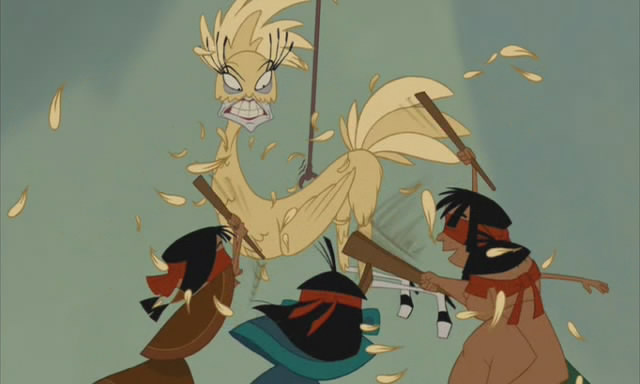
It would be pointless--and here more than ever, missing the point--to detail all the inaccuracies purveyed by this film. Suffice it to say, for instance, that though the civilization depicted is clearly based largely on the Inca empire, the opening title song states that we are in Mesoamerica, and at one point we see some children playing the typical Mexican party game of trying to break open a piñata.

pinata
So the culture purveyed is at best the image of some kind of generic pre-Columbian society, leavened (much like, say, The Flintstones) with aspects that are clearly only very slightly distanced versions of twentieth-century Americana, here most obviously the fast food restaurant to which Kuzco and his unlikely buddy, the peasant Pacha, repair for lunch.

But the film knows that its only referents are drawn from film itself, and indeed revels in the fact. It opens with Kuzco's voiceover commenting about the filmic process, and attempting to direct audience sympathy his way; early on, one of the characters is introduced as "theme tune guy"); and later, Kuzco also stops the film action in order to refocus our attention from a figure that he sees as peripheral to himself as protagonist. At one point Yzma's sidekick and love interest, Kronk, exclaims of one particular plot twist: "By all accounts, it doesn't make sense!"

In short, a double displacement is at work: first, from the US to Latin America in terms of the movie's ostensible content; but second, from external referentiality to internal self-referentiality, or perhaps better filmic self-consciousness and intertextuality.

This is not an "animated feature" in which a pre-existing story or history is transformed into caricatured form; it is a cartoon that pertains only to the world of cartoons. (Roger Ebert also notes the difference between animation and cartoon.) In this, it is closer to the Warner Brothers "loony tunes" than to Disney's traditional fare. Indeed, it is only the second Disney animation to present an original storyline, rather than an adaptation of a book, fairy tale, or the like. (And the first was The Lion King, which has serious epic or melodramatic ambitions wholly lacking in this light-hearted romp.) Meanwhile, the DVD commentary claims that this is the first feature-length animation to employ the trope common to shorter cartoons, of portraying characters stuck in a dark space by simply rendering their eyeballs.

(NB the film wasn't always going to be this way: its production history was troubled indeed, and what we have here is a much reworked version of a film originally to be called Kingdom of the Sun. See "The Long Story Behind the Emperor's New Groove" and "a precise and enlightening story of how Kingdom of the Sun became The Emperor's New Groove...")

As a cartoon, then, doubly displaced to its own alternative universe, the film is almost as abstract as a Mondrian painting, or perhaps a piece of classical music--better, the incidental film music that, in this movie as many others, works almost imperceptibly to build and fill in affective states. For The Emperor's New Groove concentrates on portraying affective and moral essences: Yzma, for instance, as a woman who is "scary beyond reason"; or Pacha as the epitome of goodness. In the film's own terminology, it portrays characters and their "grooves."

"Groove" isn't a bad way of thinking about affect. It captures the idea of a particular consistency, a particular capacity to affect and be affected, but also a certain proximity to habit: it takes of a shock to the system to jolt somebody out of their groove. We tend towards specific grooves, specific ways of grooving, in the absence of dramatic change. Here, the Emperor undergoes a series of disruptions (transformation into a llama, abandonment by his former confidantes, physical suffering) finally to change his groove, to habituate himself to a new affective state, to become generous rather than uncaring.

The film works to express, as only cartoons can, the purity of given characters' grooves, and to chart the inertia that prevents any easy deviations. (This is a constant theme in cartoons, where a change of state is always somehow delayed, always lags behind, archetypically when a character runs off a cliff and then hangs in mid-air before gravity suddenly, and belatedly, takes hold.) And it's in this displaced, cartoon version of pre-Columbian Latin America, with its vibrant colours and exaggerated imagery (green palm fronds, parrots, endless staircases, complex architectural patterns) that it can both express a groove and also imagine ways in which a groove can be changed.

Labels: ,

Monday, November 14, 2005

It's All True

It's All True coverA surprisingly high proportion of Orson Welles's few films deal with Latin America: Touch of Evil, of course, but also for instance The Lady from Shanghai and Mr Arkadin.

But it is It's All True that would have been Welles's most significant exercise in cinematic latinidad. Urged on by Nelson Rockefeller, Co-ordinator of "Inter-American Affairs," in 1942 Welles went down to Rio to make a film that would help undergird the US's "good neighbour" policy towards Latin America.

A plan emerged that the film would consist of three relatively independent sections: one, "My Friend Bonito," set in Mexico and about a child's relationship with his donkey; another, this time in colour, about the Rio Carnival; and a third, now back in black and white, about the epic 1600-mile sea voyage of four fisherman from Fortaleza to Rio de Janeiro.

But the film was never completed: the Brazilian government of Getúlio Vargas became skittish about Welles's increasingly politicized representation of Carnaval; one of the four fishermen was drowned in the bay off Rio; and RKO pulled the plug.

An incomplete episodic film about Latin America by one of cinema's great directors... the comparisons with Eisenstein's ¡Que Viva México! abound. And they don't stop there.

The one more or less complete section of It's All True that remains is "Four Men on a Raft," the story of the jangadeiros' epic trip to demand their inclusion within the nation. The raw footage was found only in the 1980s, and was edited together after Welles's death. But it's not simply the editing that gives the impression that this 20-minute short is a homage to (or even pastiche of) Eisenstein's Mexican film.

The theme might have been lifted straight from the Russian director's notebooks: we see rural peasants who respond to tragedy and oppression by aspiring to become historical agents, legitimate members of the national community. (Ironically, here Welles is more populist than the populist leader Vargas: the risk of populist politics is that it is always liable to be outflanked by other populisms.)

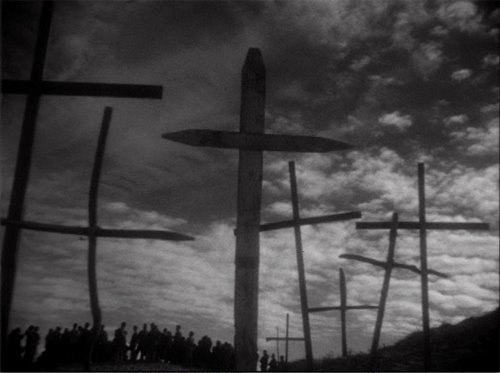
The camerawork is also pure Eisenstein: composition and mise en scène are paramount. Those who regard classic Welles cinematography to be the long takes and complex camera movements of Touch of Evil are in for a surprise. Here the camera hardly ever moves. Rather, it takes up a fixed position (usually from a low angle, sometime from above, hardly ever at eye level) and allows the characters to enter and leave the frame, emerging from and returning to the landscape. There are very few (if any) interior shots, and often we have human figures shot from below silhouetted against a cloud-strewn sky that takes up at least two thirds of the frame.

People, Crosses, Sky
Moreover, relatively little of the film is in medium shot: we either have long shots (of landscape or masses, often both) or tight close ups on faces. The few medium shots, such as of preparations on the beach or sailing on the boat, are crowded with human forms and activity that bursts out of the frame.

And as for the close ups... In Herbie Goes Bananas we heard the character Captain Blythe declare "I love your country. It's very colourful, and the children have such expressive faces." Ironically, the children of whom he's speaking have almost completely blank, inexpressive faces, and the camera spends very little time examining them. But his comment is wonderfully apt as a description of the cinematography of Eisenstein and (above all) Welles.

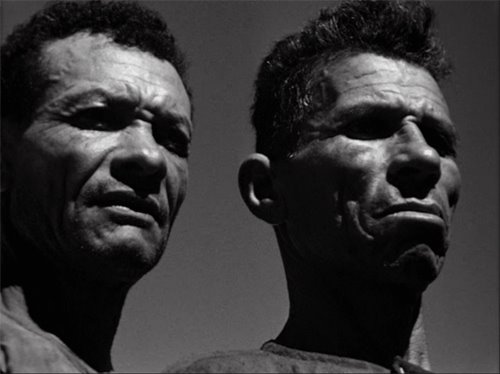
In It's All True it's the "Carnaval" section that would have been a study in colour. (In ¡Que Viva México it's the "Fiesta" section, though there texture has to stand in for colour in what's a purely black and white movie.) But much of "Four Men on a Raft" (like much of Eisenstein's film) is a study in the expressivity of the human face.

Expressive Faces
And what's at issue here is indeed expression rather than signification. It's not that these faces signify determination or despair, fear or joy, tenderness or concern (to name just some of the affects that pervade this film). Rather, they are to express something of the affective essence of the characters and individuals portrayed. Welles's close ups are studies in incorporated expression.

We're not meant particularly to wonder what (if anything) might be behind the expressions: these faces are monuments rather than windows. When they change, their motility is a change of state, the expression of a distinct essence, rather than a new aspect of the same subjective identity.

But is this not true more generally: that when Hollywood goes Latin, it reveals itself to be a cinema of expression, to be engaged affectively, rather than a cinema of signification, to be decoded linguistically.

See also Lawrence Russell on It's All True at Film Court. And Wellesnet for "discussion of all things Orson Welles."

Labels: ,