Friday, October 26, 2007

The Lady from Shanghai

The Lady from Shanghai posterThe leading lady's from Shanghai, and the film's dramatic climax takes us to San Francisco's Chinatown and then a crazy hall of mirrors in which all can be seen are the characters' multiple images. But the plot is sealed and the trap is set over the course of a long cruise across the Caribbean, through the Panama canal, and up the West coast of Mexico. And The Lady from Shanghai's guiding metaphor comes from a story told on a Mexican beach about a fishing expedition off the coast of Brazil. Once again, Orson Welles takes us south of the border, returning indeed to the truths revealed off Brazilian shores and in Mexican resorts.

The film's protagonist, "Black Irish" Mike O'Hara, addresses the film's femme fatale, Elsa Bannister, her husband, criminal lawyer Arthur Bannister, and his equally sinister partner George Grisby:
Do you know, once off the hump of Brazil, I saw the ocean so darkened with blood it was black, and the sun fadin' away over the lip of the sky. We put in at Fortaleza. A few of us had lines out for a bit of idle fishin'. It was me had the first strike. A shark it was, and then there was another, and another shark again, till all about the sea was made of sharks, and more sharks still, and the water tall. My shark had torn himself from the hook, and the scent, or maybe the stain it was, and him bleedin' his life away, drove the rest of 'em mad. Then the beasts took to eatin' each other; in their frenzy, they ate at themselves. You could feel the lust and murder like a wind stingin' your eyes. And you could smell the death reeking up out of the sea. I never saw anything worse until this little picnic tonight. And you know, there wasn't one of them sharks in the whole crazy pack that survived.
O'Hara fears he is being drawn into this fierce world of bloodthirsty, murderous and mutually destructive sharks. He is certainly sharkbait, set up to be prosecuted for a murder that may or may not even happen. As Grisby explains when they put in at their next port of call, Acapulco, he wants this Irish sailor with a shady past to kill for money, or at least to confess to having killed so that Grisby himself can get away with the money to some remote island in the South Pacific.

Little is as it seems in this convoluted film noir, and even by the end the plot remains murky. O'Hara does indeed pretend to kill Grisby, then is told that Arthur is the real victim, but on racing across the bay to prevent the deed discovers that Grisby has indeed died, at the hand of person or persons unknown, and that the faked confession in his pocket makes Mike the prime suspect, surely destined for the gas chamber. A farcical trial results, and we never even hear the verdict as O'Hara causes a commotion and slips out to a Chinese theatre where he meets up with Elsa, accuses her of being the true assassin, but is dragged off by her Chinese accomplices to the abandoned funfair in which Elsa and her husband trade shots, destroying the many-layered images that surround them until both collapse mortally wounded. Unhooking himself at last, O'Hara returns to the image that haunts him from his Brazilian escapade: "Like the sharks, mad with their own blood. Chewing away at their own selves."

All this had been foreshadowed not only in Brazil, but also in Mexico. It is in Acapulco that the seaminess of the world comes to the surface. For all its surface attractions, the tourist hotspot quickly reveals people's true natures: we glimpse a Mexican leading his gringa catch away and telling her that "Darling, of course you pay me!" Likewise, in response to Grisby's question as to how he likes the place, O'Hara responds that "There's a fair face to the land, surely, but you can't hide the hunger and guilt. It's a bright, guilty world." As such, then, Latin America functions here as the bright reflection that reveals the truth of the chiaroscuro depths to be found in New York or San Francisco. The guilt here is on the surface. In the north, the twisted contortions of the protagonists' inner natures are only revealed with extreme violence, in the crazy shootout and fractured glass of the funhouse shootout. Even then, other truths remain obscure to the end. What exactly did Arthur have on his wife, for instance? We never find out. But in Mexico we're on the point of discovering everything, even if its bright truths open up the abyss of the real that is as dangerous and clear-cut as the cliffs on the Acapulco coast.

The Lady from Shanghai still
YouTube Link: the famous final mirror scene.

Labels: ,

Monday, November 14, 2005

It's All True

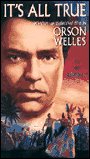
It's All True coverA surprisingly high proportion of Orson Welles's few films deal with Latin America: Touch of Evil, of course, but also for instance The Lady from Shanghai and Mr Arkadin.

But it is It's All True that would have been Welles's most significant exercise in cinematic latinidad. Urged on by Nelson Rockefeller, Co-ordinator of "Inter-American Affairs," in 1942 Welles went down to Rio to make a film that would help undergird the US's "good neighbour" policy towards Latin America.

A plan emerged that the film would consist of three relatively independent sections: one, "My Friend Bonito," set in Mexico and about a child's relationship with his donkey; another, this time in colour, about the Rio Carnival; and a third, now back in black and white, about the epic 1600-mile sea voyage of four fisherman from Fortaleza to Rio de Janeiro.

But the film was never completed: the Brazilian government of Getúlio Vargas became skittish about Welles's increasingly politicized representation of Carnaval; one of the four fishermen was drowned in the bay off Rio; and RKO pulled the plug.

An incomplete episodic film about Latin America by one of cinema's great directors... the comparisons with Eisenstein's ¡Que Viva México! abound. And they don't stop there.

The one more or less complete section of It's All True that remains is "Four Men on a Raft," the story of the jangadeiros' epic trip to demand their inclusion within the nation. The raw footage was found only in the 1980s, and was edited together after Welles's death. But it's not simply the editing that gives the impression that this 20-minute short is a homage to (or even pastiche of) Eisenstein's Mexican film.

The theme might have been lifted straight from the Russian director's notebooks: we see rural peasants who respond to tragedy and oppression by aspiring to become historical agents, legitimate members of the national community. (Ironically, here Welles is more populist than the populist leader Vargas: the risk of populist politics is that it is always liable to be outflanked by other populisms.)

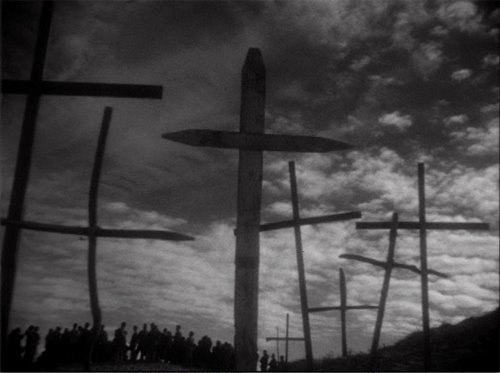
The camerawork is also pure Eisenstein: composition and mise en scène are paramount. Those who regard classic Welles cinematography to be the long takes and complex camera movements of Touch of Evil are in for a surprise. Here the camera hardly ever moves. Rather, it takes up a fixed position (usually from a low angle, sometime from above, hardly ever at eye level) and allows the characters to enter and leave the frame, emerging from and returning to the landscape. There are very few (if any) interior shots, and often we have human figures shot from below silhouetted against a cloud-strewn sky that takes up at least two thirds of the frame.

People, Crosses, Sky
Moreover, relatively little of the film is in medium shot: we either have long shots (of landscape or masses, often both) or tight close ups on faces. The few medium shots, such as of preparations on the beach or sailing on the boat, are crowded with human forms and activity that bursts out of the frame.

And as for the close ups... In Herbie Goes Bananas we heard the character Captain Blythe declare "I love your country. It's very colourful, and the children have such expressive faces." Ironically, the children of whom he's speaking have almost completely blank, inexpressive faces, and the camera spends very little time examining them. But his comment is wonderfully apt as a description of the cinematography of Eisenstein and (above all) Welles.

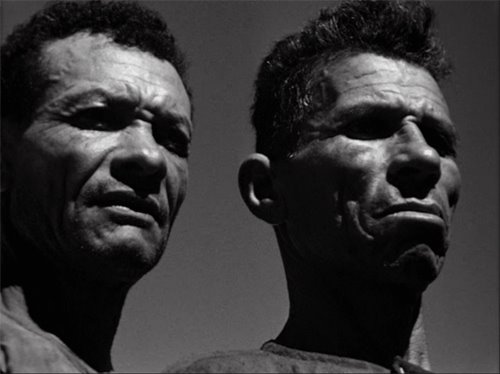
In It's All True it's the "Carnaval" section that would have been a study in colour. (In ¡Que Viva México it's the "Fiesta" section, though there texture has to stand in for colour in what's a purely black and white movie.) But much of "Four Men on a Raft" (like much of Eisenstein's film) is a study in the expressivity of the human face.

Expressive Faces
And what's at issue here is indeed expression rather than signification. It's not that these faces signify determination or despair, fear or joy, tenderness or concern (to name just some of the affects that pervade this film). Rather, they are to express something of the affective essence of the characters and individuals portrayed. Welles's close ups are studies in incorporated expression.

We're not meant particularly to wonder what (if anything) might be behind the expressions: these faces are monuments rather than windows. When they change, their motility is a change of state, the expression of a distinct essence, rather than a new aspect of the same subjective identity.

But is this not true more generally: that when Hollywood goes Latin, it reveals itself to be a cinema of expression, to be engaged affectively, rather than a cinema of signification, to be decoded linguistically.

See also Lawrence Russell on It's All True at Film Court. And Wellesnet for "discussion of all things Orson Welles."

Labels: ,

Saturday, October 15, 2005

Touch of Evil

Touch of Evil poster"This isn't the real Mexico. You know that." So says anti-narcotics cop Miguel Vargas to his new bride, Susie, in Orson Welles's Touch of Evil.

Vargas, the senior cop who has just arrested one of the drug-running Grandi family in Mexico City, wants to clean up the reputation and image of his country, and so ensure that the place is safe for his young American wife. "I suppose," he says, "it would be nice for a man in my place to be able to think he could look after his own wife in his own country."

It turns out, though, that, the American motel in which Susie seeks refuge, "just for comfort," is a place of nightmarish danger: Janet Leigh here anticipates her performance in Hitchcock's Psycho, as in this isolated and eerie motel her character is harassed, drugged, raped (metaphorically if not literally), and abducted by a gang of the younger Grandi family members. Over the course of the film, Susie endlessly crosses between the US and Mexico ("Across the border again?" she shrugs early on), but finds no respite either north or south.

For corruption and danger seep both sides of this porous border.

Nowhere is this more apparent than in the film's famous opening long take. In its three and a half minutes, we see a bomb placed in a car outside a Mexican nightclub, which we then follow as its path entwines with that of the honeymooning couple Vargas and Susie. Camera, characters, and audience are drawn in this same uninterrupted sequence across the frontier to the US side. Alongside the raucous noise and music coming from cantinas and bars, alongside the brusque questions or idle chit-chat at the customs post, we hear the timer's tick-tock on the soundtrack, premonition of transborder violence that the guards will be unable to prevent.

Suddenly, the bomb explodes, bringing the film's first cut and tearing apart two mixed race couples: the car's occupants (an American businessman and Mexican stripper), instantly killed; and Vargas and Susie, their honeymoon peace shattered and a rift opened between national interests and private wellbeing. "This is going to be very bad for us," Vargas tells his wife. "For us?" she asks. "For Mexico, I mean," he replies.

But if Vargas starts out with a clear conception of his obligations and responsibilities to the nation, and an equally clear conception of their limits--regarding the US investigation of the bombing he declares himself to be "merely what the United Nations would call an observer"--as the film progresses this sense of a boundary between proper and improper soon becomes frayed and uncertain.

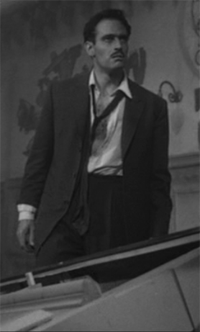
Vargas, dishevelledIncreasingly desperate, searching for his wife on discovering her absence from the motel, he charges into a seedy dive and goes about the younger Grandi clan-members with his fists. "Listen, I'm no cop now. I'm a husband!" he shouts shortly before sending the bar crashing down.

Dishevelled and disorderly, driven by an anguished sense that his wife has been unjustly taken from him, Vargas has come to resemble his would-be nemesis, the corrupt US cop Hank Quinlan, played by Welles himself as a local hero now grotesquely gone to seed.

For thirty years Quinlan has been planting evidence to frame those he is convinced are guilty, after he had allowed his wife's killer, some "halfbreed," to go free. Ever since, he has been disgusted both with Mexicans and with "starry-eyed idealists. They're the ones making all the real trouble in the world." Vargas is Mexican and, at least at first, idealist: no wonder Quinlan should try to bring him down.

Quinlan's no hero: bloated, arrogant, and devious he personifies the state at its most corrupt. Vargas has to remind him that "the policeman's job is only easy in a police state. That's the whole point, captain. Who is the boss, the cop or the law?" The irony is that it should be Latin American chiding a US citizen about corruption and the dangers of dictatorship. But Quinlan's response poses a further irony: "Where's your wife, Vargas?" he asks, indicating his awareness that this macho Latin has failed to protect his woman. And Quinlan's intuition always seems to prove correct: in the film's closing moments, we learn that the man that he had tried to frame (another Mexican in a mixed relationship) has finally confessed to the crime of planting the bomb in what was his girlfriend's father's car.

Welles's vision is dark and unflinching. He allows us few certainties. This isn't the "real Mexico," and there's little pretence that Charlton Heston, playing Vargas, is a "real" Mexican: national identity and difference are presented as illusory; but these are illusions nurtured by the prejudice that drives almost every aspect of the film's plot. Even the otherwise innocent Susie displays a casual racism in nicknaming a Grandi minion "Pancho." "Why?" she is asked. "Just for laughs, I guess," is the best she can answer.

There's not much in this movie that's a laughing matter. Any attempt to save face or to present the law as other than a fundamentally dirty business is as self-defeating as Quinlan's final gesture, his attempt to wash his hands in the fetid rubbish-filled waters of the canal in which he finally dies. In the end, judgement is futile: Quinlan was "some kind of a man," as his former lover Tanya remarks, but "what does it matter what you say about people?"

Tanya (a remarkable cameo from Marlene Dietrich) is one of the few characters who retains self-control through the film. Tanya, whom we see calmly doing her accounts, a financial reckoning that abstracts from the desires and waywardness upon which her brothel thrives. "It's old, it's new," she says of the pianola installed in her parlour. "We got the television too."

Quinlan after shooting Menzies
And behind all the characters, often present somewhere within the frame, are the oil wells that like capital itself know no nationality. The oil wells, "pumping up money... money," that are the imperturbable, mechanical, inhuman backdrop to this tale of jealousy and prejudice, corruption and carnage, cross-border desire derailed.

Labels: ,