Sunday, June 10, 2018

Salt and Fire

Filmed in Bolivia, Salt and Fire (2016) is another episode from from Werner Herzog’s catalogue of man-vs-nature stories. This time, Herzog’s fascination for Latin American nature is presented as a manner of critique to environmental studies that separate human interrelations from their “objective” measurements of natural disasters. A scientific delegation funded by the United Nations travels to Latin America to finish their studies of Uturunku, an active supervolcano whose eruption could cause a worldwide catastrophe. Upon arrival, the delegation is taken hostage by the CEO of an international company that has been declared responsible for producing the ecological disaster in Salar de Uyuni, the largest salt flats in the world, whose growing toxicity will soon affect the surrounding villages.

A militia group led by a company easily bribes the government, police, and people in the airport to take their place when the international scientific delegation arrives. With fake documents, they convince the group that there was a change of plans and then take them hostage to an unknown location on the mountains.

As in Aguirre, Wrath of God, the plot of this Herzog movie develops around mystery and the unknown. Soon the dialogues are only between the leader of the scientific delegation Laura Sommerfeld (Veronica Ferres) and the CEO Matt Riley (Michael Shannon). Many days pass and the long conversations of Laura and Riley only confirm that there is something that we do not know. We see a lot of dysmorphic art distorting reality or exposing a different one. Typical of Herzog’s nihilist messages of his movies. Everything is in question.

Laura is taken to an island in the middle of the Salar de Uyuni and she is abandoned with two blind children called Huascar and Atahualpa. After a week, the few supplies Laura and the kids had on the island are at an end. Riley comes back and explains that everything was part of a plan, from the hostage-taking to the week with the two blind children in the island. The mystery is exposed. The salt flats were a man-made disaster (Laura already knew that), but Riley wanted Laura to understand that studies of nature with statistics and calculations could not reflect a deeper layer of the problem which is the human cost of the disaster.

Bolivian landscapes are the perfect set for Herzog's story. As in many of his movies, Latin American history, resources, culture, people and landscapes are the inspiration for fascinating plots for fictional stories. Herzog portrays the beautiful scenery of the Bolivian salt flats and Andean volcanos, but at the same time presents another reality in which those same elements could be equally disastrous. Latin America can be dangerous, its governments easily corrupted, its tourists easily kidnapped, but it can also be a beautiful place with incredible geological formations that are so magnificent that seem close to fantasy. We can see this dichotomy at the end of the movie. Riley is tormented about the noxious atmosphere his company has created around the salt flats which killed the mother of Huascar and Atahualpa (the same toxins caused their blindness), but then they take pictures that foreground the remarkable beauty that looks like it is taken from a surreal painting.

Though the extraordinary locations of the movie are real, Bolivia is not once mentioned throughout the movie. the salt flats and the volcano are the only places that are important. Other locations, like the airport where the group arrives or the village to which they are taken, remain anonymous. There is nothing to learn about Latin America in this movie. How can someone learn something from a fictional place with fictional history? Following the pattern of Herzog's previous films, this movie asks us to make our conclusions. Everything in this movie (locations, kidnapping, dialogues, images) exposes different manner to see reality, multiple intentions, theories and points of view.

Labels: , ,

Thursday, April 23, 2009

Fitzcarraldo

Fitzcarraldo (1982) portrays a European man impassioned to the verge of madness with the goal of building an opera house deep in the Amazon Basin. The opera house never becomes more than a gleam in his eye but the film is centered on a spectacle of even greater proportions. Director Werner Herzog drew his inspiration for Fitzcarraldo from an event the life of Carlos Fermín Fitzcarrald, a nineteenth century rubber tycoon, in which he had his approximately thirty-ton boat disassembled and transported over a Peruvian isthmus in the search for new rubber exportation routes.

Herzog aggrandized this event for his film, envisioning a promethean undertaking that would illustrate the maximum of the human capacity to surmount barriers when driven by a passionate idea. The result is an astounding scene in which Fitzcarraldo mobilizes an indigenous tribe to drag his steamboat over a mountain, a feat Herzog directed entirely without special effects. In Fitzcarraldo, as is apparent in the documentary Burden of Dreams, Herzog expresses his ambivalent relationship with Latin America through his protagonist. Like Herzog, Fitzcarraldo is spiritually moved when he experiences the landscape as sublime but at the same time repelled by perceiving it as vicious and base.

The film begins with a “civilization versus nature” motif that is ongoing. The first scene pans over the Amazon Basin, which appears prehistoric, then cuts to a grandiose theater in Manaus, Brazil. Fitzcarraldo (played by Klaus Kinski) arrives with his lover Molly via a rowboat, and the flustered pair stumbles into the theatre for the final scene of an opera starring Caruso. Fitzcarraldo catches the idea of building an opera house to bring Caruso to his town of Iquitos like one catches a fever. He becomes agitated and reckless, screaming from the bell-tower that Iquitos must have an opera house and drunkenly insisting that his contemporaries share his rapturous appreciation for opera. A sympathetic Don Aquilino shows him a regional map where there is an unexploited tract of rubber trees on the side of an isthmus that is inaccessible due to treacherous rapids.

Fitzcarraldo eagerly purchases the tract of land and a steamboat, signing a contract with the Peruvian government to productively use the land within nine months. The voyage southward is initially leisurely and filled with surreal elements, such as the partially blind captain who warns that the jungle impedes the ability to discern between reality and illusion. However, as the steamboat enters the territory of an allegedly headhunting tribe, a sinister mood intensifies to the point that most of the crew abandons ship. Tribesmen board the ship soon afterward, but do not harm the crew because they believe that gods in a white vessel will bring them salvation. Though they do not consider the crew to be gods, Fitzcarraldo intends to use their fixation with the ship unscrupulously to his advantage.

The steamboat finally reaches the isthmus. Fitzcarraldo plans have it pulled overland, used to exploit the rubber trees, pulled back and returned to Iquitos until he has sold enough rubber to finance the opera house. In the following months the indigenous people toil until the steamboat is dragged over the blasted and deforested mountain by a series of pulleys. However, the night after it reaches the opposite bank the tribesmen cut it loose, sending it northward towards the deathly rapids. The ship is heavily battered but survives, as does its crew of four men. Fitzcarraldo learns that the indigenous people toiled for their own ends, believing that delivering the sacred vessel would quell the rapids. Because Fitzcarraldo is now destitute Don Aquilino repurchases the steamboat. With this cash, Fitzcarraldo converts it temporarily into a theatre stage to carry an Italian opera production past the shores of Iquitos, thereby realizing a smaller-scale and fleeting version of his original dream.

Compared to their temperate environment, colonial Europeans cast the tropical environment of Latin America as both awe-inspiring for its beauty and grandeur and loathsome for its chaotic, promiscuous and pestilent growth. This conflicting projection is present in Fitzcarraldo, as is the typically colonial concept of nature as something to be conquered by technology and refined by culture. Fitzcarraldo is constantly antagonized by nature and he fights back with dynamite and opera. Interestingly, such attitudes do not only belong to the nineteenth-century characters but to the director himself, as is clear in Burden of Dreams. Herzog’s own feelings of desperation, wretchedness and struggle seem to permeate the film.

The native people of the Amazon have no notable roles or dialogue. We learn very little about their culture, but Herzog does subtly satirize European misrepresentations them as shrunken head collectors and the objects of civilizing projects. Fitzcarraldo simultaneously romanticizes the native people, by likening their belief system to a type of opera, and abuses them by working them to the bone. However, Fitzcarraldo is more akin to them in their indomitable spirit that is capable of moving mountains for an abstract belief than to his social class of rubber barons and railway tycoons, whose only aim and skill lies in finding the easiest way to make the most money.

Labels: ,

Tuesday, March 17, 2009

Alive

Alive posterAlive is a 1993 film based on the true story of the survivors of the crash of Uruguayan Air Force Flight 571 on October 13, 1972 in the Andes. The protagonists are the members of the Uruguayan rugby team of Stella Maris College in Montevideo and their friends and family members who have chartered the flight to Santiago, Chile, where the team is to play a match. The film is a flashback being told by John Malkovich, who is character Carlitos Paez. It begins on the airplane, as the jovial young rugby players joke around and tease the flight attendant. Their jokes soon end as the pilots, who have already notified the air controller in Santiago that they are beginning their descent, realize that they have misjudged the time required to cross a mountain pass and are heading straight for a mountain. The airplane clips a peak, losing its wing and tail, then continues sliding down a steep slope until it comes to rest in a snowbank. Of the 45 people on the plane, twelve people die in the crash or shortly thereafter, in a mess of screams, injuries, and blood. Of those still alive and minimally injured, the team's captain Antonio Balbi, medical student Roberto Canessa, and Carlitos seem to take charge, binding limbs and freeing passengers who are stuck under chairs and pieces of fuselage. The fatally injured pilot asks Canessa to find his gun so that he can commit suicide, but Canessa refuses to be a part of it, leaving the pilot to die. The dead are laid outside in the snow. As the night comes, the survivors settle down for the night, sure that the next morning they will be rescued. The first night is freezing, with the cold wind blowing into the fuselage. Despite the fact that they block the back of the fuselage with luggage to maintain heat, another five people die during the night from cold and injuries.

The next day, the survivors are suffering from altitude sickness and hunger. Antonio collects all the food on the plane, which amounts to little more than some chocolate bars and some wine, which he rations out among the remaining 28 passengers. He continues to reassure everyone that they will be found very soon. At one point, they hear a plane fly overhead, but the cloud cover prevents them from being seen. They settle in for another night. In the following days, the survivors continue consuming their rations, starving and sick. A young man who had suffered a head injury in the crash, Nando Parrado (Ethan Hawke), regains consciousness after a few days, only to discover that his mother has died and that his sister Susanna is severely injured. On the fourth night after the crash, as the survivors huddle in the fuselage, Canessa decides to give away the rest of the rations because he is convinced that they will be discovered the following day. The next morning, as Antonio goes to hand out the rations, he is enraged to discover them gone; Canessa and the rest of the team admit to having eaten them. Antonio spends his days listening to a radio that was found in the plane, listening to news of the search. The others organize an expedition to try to find the tail, where the battery for the transmitter radio is; however, they find they are too weak with hunger and altitude sickness and must return to the plane. On the ninth day, Antonio hears on the radio that the search has been called off. Nando hears the news and announces to everyone, "Good news! They've called off the search". The others, devastated, ask him why this is good news, and he replies, "Because it means that we're going to get out of here on our own". The following day, Nando's sister Susanna dies. The survivors are eating nothing and get weaker every day. Nando proposes that a team of men travel west into Chile, which must be quite near, to try to find help. When asked how he will achieve this without food, he replies that he will eat the flesh from one of the pilot's bodies. This is initially received as a joke, but as the survivors get hungrier, Nando proposes it to everyone. Some are shocked and indignant, calling it a sin against God; others argue that if at death the soul leaves the body, God will want them to eat the flesh in order to stay alive. The following day, they agree to eat the frozen flesh of the dead bodies.

A few nights later, the fuselage is hit by an avalanche, killing eight passengers, including Antonio, and burying the plane. Nando manages to dig a hole to the surface, allowing the survivors to breathe. For three days a blizzard blows, trapping them inside the plane; on the fourth, they emerge, digging out the plane and clearing it of snow and dead bodies. One of the victims is Liliana Methol, who had just decided with her husband Javier to have another child. The next day a young man whose broken legs were infected dies as well. At this point, the survivors are devoid of hope and very downhearted about their prospects of survival. Carlitos, however, has a spiritual experience, where he realizes that God is all around them, helping them; he is instrumental in raising everyone's spirits and giving them hope. Nando continues pushing for an expedition West, but Canessa insists that an expedition must wait until the spring, when it is warmer and chances of survival are much higher. Nando, Canessa, and some others do a minor expedition to try to find the plane's tail, which is successful; however, their discovery of batteries for the transmitter radio is useless because they are unable to hook the radio up. On the way back from the expedition, they are caught in a blizzard. Two more young rugby players die. Finally, on December 12, two months after the crash, Canessa, Nando, and Antonio "Tintin" Vizintin, who have been building their strength and eating much, set off on their expedition West, taking with them a pack of meat and a warm sleeping bag they have sewed together from quilts of insulation from the plane's tail which is big enough for the three of them to weather the freezing nights. Carlitos tells them at their parting that he has dreamt of the green valleys of Chile, where they are headed. The three young men trek for three days, thinking that they must be very close, but upon climbing a peak they see only mountains for what seems like forever, far from the green valleys of Chile that they expect. Devoid of hope, Canessa proposes they return to the plane, but Nando is convinced that if they send Tintin back to the plane and take his rations, they can make it to a small "Y" in the mountains which he hopes is the way out. Nando and Canessa continue for several more days and do indeed reach green valleys with lakes of unfrozen water. The final scene shows the survivors emerging from the plane upon hearing helicopters and seeing a rescue team coming their way with Nando directing them. 29 passengers have died, and 16 remain.

Several of the actors in the film are Uruguayans of European descent, but all of the main characters are American actors. The dialogue is quite North American, complete with Superman references, and the rapport between the young men appeals to that very team-oriented sports culture that Americans love. However, the magnitude of the story makes these details fade into the background. One cannot help but imagine oneself in the extreme situation faced by the survivors of the crash; the fact that they are Uruguayan becomes an irrelevant detail in the face of such a powerful feat. The plight of the team becomes a universal plight against nature which crosses all cultural and geographic boundaries; the film is a testimony to the transcendence of survival stories which make nationality dissolve and humanity the most important classification. The Andes could be any hostile, majestic mountain range, not necessarily the defining geological formations of South America.

A strongest Latin American cultural element of the film is the undeniable influence of Roman Catholicism in the plot and dialogue. In the beginning, John Malkovich's Carlitos tells of his closeness to God in the solitude, of the spiritual plane that one reaches through bodily suffering. During the freezing nights, Carlitos leads the team in praying the Rosary, which gives them hope in their most downhearted moments. Only one of the 27 survivors refuses to pray; this is Fito, who claims to be an agnostic. After the avalanche, however, he too joins the nightly prayers. Often the characters' survival is attributed to God, a God that takes care of them in the most hostile of environments. The discussion about cannibalism is essentially a discussion about whether eating a dead man is violating God's law; the consensus is that the benevolent and understanding God would want them to eat the flesh in order to glorify life by fighting for survival. The references to the Eucharist in the discussion of eating the flesh of a body are undeniable. When a young man whose legs are broken is dying from the infection, he begins to weep because of the beauty of being "so close to God". Everywhere in those blinding white peaks is the presence of God, who gives them the tools to survive, the hope to continue, and the good leadership which saves them.

Labels: , ,

Saturday, October 29, 2005

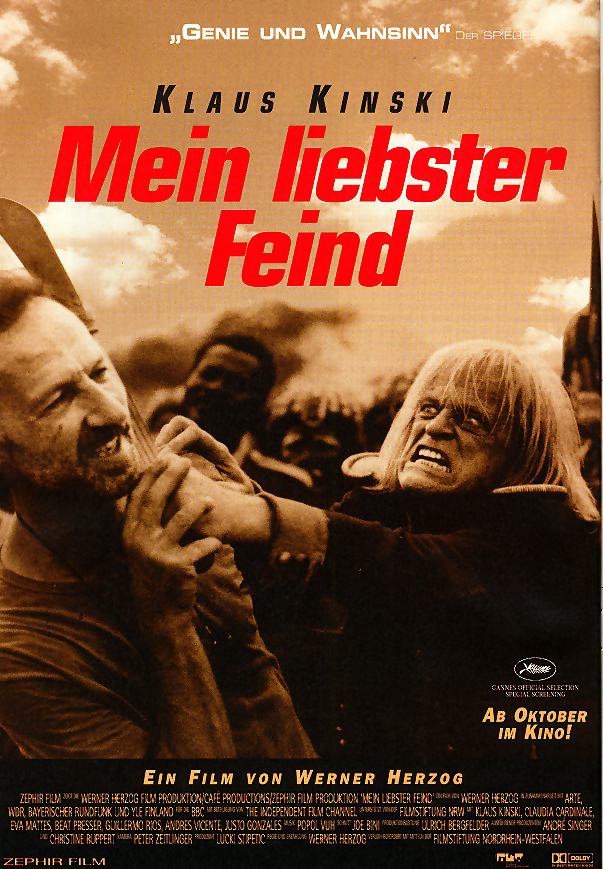
My Best Fiend

My Best Fiend posterMy Best Fiend is ostensibly Werner Herzog's film about Klaus Kinski. But it is soon clear how much it is a film about Herzog himself.

Herzog tells us endlessly about Kinski's madness, his fits, his ravings. But Herzog protests too much. He talks too much. He raves.

An early sequence is paradigmatic: in what used to be the boarding house where the young Herzog and the young Kinski once lived together, a building that has now been renovated and turned into a swish bourgeois home, Herzog goes on at far too much length about Kinski, his eccentricity, his obsessiveness. The building's current owners start tuning out. It is Herzog who has begun raving, allowing his own obsessions to dominate the screen.

The various other people we meet--such as the actress Eva Mattes, the still photographer Beat Presser--all seem to have heard Herzog's schtick before, and treat him warily, carefully, respectfully. " You would also have been a good Fitzcarraldo," says Presser cautiously, measuring his words, watching Herzog for his reaction. But of course it wasn't Herzog. It was always Kinski who was Fitzcarraldo (even though Jason Robards was Herzog's original choice).

The madness is Herzog's, however much he spends the entire film performing reasonableness, recounting his patience in the face of the untamed beast that was Kinski.

Herzog and Kinski
And the mourning, for this is a film that is a prolonged work of mourning, the mourning that is Herzog's despair at being without Kinski, that he can only fill with a torrent of words, of recrimination. It is as though finally he also blames Kinski for leaving, for leaving his friend (his fiend) alone again.

So much of Herzog and Kinski's relationship played itself out in Latin America. They fought each other against the backdrop of an encroaching, suffocating sense of Latin America as a natural force that threatened always to overshadow the puny rages of these all too human f(r)iends.

"Between Kinski and me there was an unbridgeable gap," Herzog tells us. "This had to do with his feeling for nature." And then we see archive footage of Herzog, for almost the only time in this film, talking in English. It is during the filming of Fitzcarraldo, in Amazonian Peru:
Of course we are challenging nature itself, and it hits back. [. . .] And that's what's grandiose about it and we have to accept that it is much stronger than we are. Kinski always says it's full of erotic elements. I don't see it so much as erotic, I see it more full of obscenity. It's just that in nature here it's vile and base. I wouldn't see anything erotic here, I would see fornication and asphyxiation and choking and fighting for survival and growing and . . . just rotting away. Of course there is a lot of misery, but it's the same misery that is all around us. The trees here are in misery and the birds are in misery, I don't think they sing I think they just screech in pain. Taking a close look at what's around us there is some sort of harmony. It is the harmony of overwhelming and collective murder. But when I say this I say this all full of admiration for the jungle. It's not that I hate it; I love it, I love it very much, but I love it against my better judgement.
It is Kinski himself who is also, of course, this uncontrollable natural force, "much stronger than we are [. . .] full of obscenity," that Herzog loves "against [his] better judgement."

But it is the jungle that, as so often, is the figure for the psyche, exemplifying our impossible (but unavoidable) relationship with the other.

Labels: ,