Saturday, July 07, 2018

Zorro: Return to the Future

The animated film Zorro: Return to the Future (2007), directed by Stuart Evans, relates the adventures of a new Zorro (sometime in the future), this time helped by high technology and an equally skillful partner called Scarlet Whip. Instead of a sword, Zorro is equipped with a laser weapon in the form of a Z that works equally as sword, whip, or a laser shotgun as needed. And instead of riding the traditional black horse, this new generation Diego de la Vega rides a purple motorbike.

The movie is a spin-off from the series Zorro: Generation Z (2006), whose animation is identical to this one and which likewise presents Zorro and Scarlet Whip in a futuristic scenario. However, the movie provides a back-story to explain how Diego became Zorro, which is not a part of the series.

Diego de la Vega is a rich guy from Pueblo Grande city. He spends his family's money buying expensive toys like cars and bikes. He also has a personal assistant of the same age as his who is dumb, like the servant of McCulley's Spanish Californian Don Diego. His deceased grandfather, the Diego de la Vega of a previous generation, leaves a note for young Diego introducing him to the legend of Zorro which was carefully kept as a secret from Diego's dad, Alejandro de la Vega. In a hidden cave under his house, Diego finds the tools of all the previous Zorros, including swords and whips. "Every generation has a Diego, and so every generation has a Zorro," young Diego's grandfather had told him as a kid while relating Zorro's fairytales and legends.

Evans uses several of the resources of previous Zorro movies. He takes inspiration from "Zorro's Black Whip" to create the character of Scarlet Whip. Just like the Black Whip, Scarlet Whip is a female hero with a mask and a whip inspired by Zorro, but she is a totally different hero. Although the plot of this animation seems to be much further away from the old California to be developed in the future and combine previous incarnations of Zorro in one, there are many returns to base elements of the established tradition. It is then repeated names and very familiar stories of past occasions. Diego de la Vega fighting to remove the corrupt Mayor Martinez from power. Martinez helped by an incompetent Sergeant Garcia who is now presented with a strong Mexican accent and spends most of his time eating.

The repetition of characters and their names are explicit (although with the futuristic touch that predominates throughout the plot). But it is not a simple repetition of the original story. In addition to returning to the name Diego de la Vega and showing that this is one of a number of generations of Zorro, Evans has borrowed characters from incarnations of this hero that are very particular. In this movie the plurality that was seen in Blasco's Three Swords of Zorro since just like that movie, this animation shows us three Zorros, two men (one Diego de la Vega, the second is the dumb assistant Bernardo) and a woman (Scarlet Whip) which adds on to the complexity that is already present in masked heroes' dual identities.

So beyond the laser weapons, motorcycles, cars, and planes, Zorro: Return to the Future is hardly as innovative as one expects it to be from its title. Moreover, Zorro's motivations are not futuristic at all. There are the same problems of government corruption, and the poor are still poor (this time living in shelters). What has changed is the geographical situation. Pueblo Grande is a city named in Spanish, and a few words in Spanish are heard throughout the movie, but the reasons for this are unclear unless the audience has some prior knowledge of the Zorro tradition.

Labels: ,

Thursday, July 05, 2018

The Many Faces of Zorro

"The Many Faces of Zorro" (2002) is a documentary directed by Brett Ellis about the filming tradition in Zorro movies throughout time. This documentary contains three sections. First, there is a summary of the different versions and characters behind the mask of Zorro since its creation in McCulley's comic-like, Californian adventure stories, to the latest (at that time) incarnation in Campbell's "The Mask of Zorro" (1998). Second, Ellis interviews the stars of Codwall's Zorro: Caroline Zeta-Jones, Anthony Hopkins, and Antonio Banderas; additionally, there are interviews to few actors and actresses of previous Zorro versions such as Linda Stirling from Zorro's Black Whip and Britt Lomond from the Zorro Disney series. And third, Ellis includes two interviews with sword and whip choreographers who explain the importance of those instruments in history and in Zorro movies.

Appart from being a documentary about Zorro, it is a documentary about "The Mask of Zorro". According to the research made for this documentary, the stories of Zorro were widely popular since its first appearance on screen with Douglas Fairbanks acting as the dual-identity hero. With the time many other producers found the potential of Zorro's character and its versatility to inspire new stories with the same, or new heroes that were basically imitations of Zorro. Nevertheless, none of those reincarnations of Zorro reached the popularity McCulley's writings had. That seemed to have changed with the Zorro Disney series. With a bigger budget, talented actors, and under the Disney slogan, Zorro became one of the favourite TV shows of a Saturday morning. All previous or future movies about the masked legend stayed under the shadow of Fairbanks for being the first or Disney for its fame. But there it comes Ellis' Zorro, the promise of reviving the old Californian hero and take him finally to the big screens of Hollywood.

Why did a hero that has been incarnated more times than we can count take so long to arrive at the big screens? For Ellis, Campbell movie is the final and necessary come back to the traditional Spanish Californian Zorro that helps the less fortunate. History and tradition kept Zorro stories alive, but relegated to low-budget production, to easily forgotten weekend matinee series, or to inspire imitations of new invincible superheroes that over the years have lost almost every connection to their father, Zorro. Ellis tracks and shows those connections of the most famous Hollywood superheroes such as Superman, Spiderman, Captian Marvel, Batman, among others, with the original stories written by McCulley. All of them emerged from the Spanish and later the Mexican California popular legends and reflect its history of struggles for decolonization and national independence. And each new modification in the plot again reflects a period of instability or conflict. Lots of Zorro movies are produced after wars or are about wars.

Through interviews with sword and whip choreographers we introduced to the history behind the use of those instruments and their importance for the Zorro movies plots. Just like dialogues in Spanish remind us of California's past as part of Mexico, swords and whips create a permanent attachment between any Zorro movie, and colonial Latin America, especially with Mexico and the Spanish rule of California before becoming part of the United States.

But more importantly, Zorro and the performative nature that is deeply-rooted in the duality of the character (one actor performing the roles of two different characters) say a lot about what is acting itself. Since its beginnings, Zorro's double personality was used by Douglas Fairbanks to demonstrate and promote his acting skills on screen. This is the case as well in The Mask of Zorro. From learning how to use the sword and whip as Spaniards would use them, to pretending to be a romantic Latino in Banderas case (as an actor), or an aristocrat when he is the peasant son-on-law to-be of Don Diego de la Vega (as Alejandro de la Vega character).

Though we have become more familiar with the repetition of heroes hiding second identities, Zorro is by essence different. It carries in itself the origins of those new masked heroes. It portrays Latin America's history from the colony to how we know it today. It is a reflection of California's evolution and transitions out of Latin America to being an American state. And it is the display of character appropiation in acting, making the viewer forget that is seeing Banderas, de la Vega, and Zorro at the same time, instead we are convinced of being seeing one at the time.

Labels: ,

Sunday, March 02, 2008

Don Q Son of Zorro

Don Q Son of Zorro posterDouglas Fairbanks made his name with the box-office smash The Mark of Zorro, which made his name as a daredevil athlete and swashbuckler. It's no wonder that he should want to capitalize on this success: Don Q Son of Zorro was the first Zorro sequel, and so a franchise was born.

But this is the strangest of sequels, as though the filmmakers had yet to realize the essence of Zorro. What carries over from the previous incarnation is the star (Fairbanks), the rather ridiculous catchphrase ("Have you seen this one?"), but above all the stunts, including a prodigious amount of whip-play. The film's protagonist, Cesar de Vega (aka Don Q), son of Zorro, is seldom without his trusty lariat, which he puts to a variety of uses: to trounce his rivals, of course, but also to lasso wayward bulls, to cut up pieces of paper, to transport himself around the place, to put out candles, and even (as you can see in the film poster above) in one bizarre moment to light his cigarette. No wonder he's known to all and sundry as "the man with the whip." Indiana Jones, eat your heart out!

What gets left behind, however, includes the Spanish-Californian setting, the campaign in favor of the poor and needy, the mask, the black clothes, the horse, the subterranean lair, the double identity, and even the name Zorro itself. Yet in just about every other Zorro iteration, these are staples of the hero's persona. Don Q is like a James Bond without Moneypenny, martinis, or motorcars: barely imaginable.

For the movie finds Cesar de Vega in Madrid, a young gallant entertaining his friends with his whip and speaking highly of his father, Zorro, who is left back in the Americas. De Vega finds himself attracted to a local beauty, one Dolores de Muro, and so earns the enmity of the young lady's other suitor, a Don Sebastian who is an officer in the Queen's guard. The dastardly Sebastian frames Cesar for the murder of a visiting aristocrat, the Archduke Paul, forcing the man with the whip to go underground and somehow plot his revenge. But apart from one very brief scene in which Cesar adopts the pseudonym Don Q (hence the film's title), his stratagems involve no fictitious personae, let alone taking on the black mask of the caped crusader.

Zorro himself (the father, also played by Fairbanks) is belatedly called out of retirement so that he can take part in the final battle in which (of course) young Cesar turns the tables, proves his innocence, and wins his heart's desire. Moreover, Zorro's recall to action motivates a brief flashback to the previous film, in which he'd embedded a saber in the wall of his hacienda, leaving it there until he needed it again. So the trusty weapon comes in handy as he comes to the aid of his son. But though we are repeatedly told that the son is a chip off the old man's block, in fact Zorro's appearance provides only a momentary blast from the past rather than the sense that the same struggle continues.

Subsequent Zorros will reinvent the story's basic premises for their time. This one fails to see what those premises were, and so almost puts an end to the possibility of further sequels even as it inaugurates a flood of cinematic repetitions.

In short, if the Zorro franchise as a whole is about performativity and power on an ambiguous and shifting frontier between Anglo and Latin America, Don Q misses that point spectacularly by giving us a tale of individual rights back in the old world. But future incarnations will not make the same mistake twice.

Zorro and Son. Spot the differences?

Labels: ,

Monday, July 30, 2007

Assassins

Assassins posterFor its tense and bloody finale, the Wachowskis’ Assassins takes us to Puerto Rico. Or rather, it takes us back: the film’s first few minutes, in grainy black and white, also take place in the Caribbean. And so the climax is at the same time a repetition: a return to history that is both the return of the repressed and an attempt to put an end to history.

As with all repetitions, however, what comes back is never exactly the same. In the interval, hired gun Robert Rath (played by Sylvester Stallone) has morphed from hitman to target or “mark”; taking his place fifteen years later at the other end of a telescopic sight is young buck Miguel Bain (Antonio Banderas), who wants to prove that he is now number one in the world of assassins and that Rath is, as Bain puts it, “anticuado.”

Moreover, the final twist in the tale is the reappearance of the “mark” that Rath thought he had eliminated a decade and a half ago. But by killing him now, Rath can finally expunge the stain of (as he had thought) betraying his friend. For Rath is apparently a man of principles in this brutal world of contract murder, though these are suitably old-fashioned: he hesitates over killing women, children, and fellow chess-players.

The Spanish Caribbean is handy for a showdown for a number of reasons. First, the night before the final face-off can be the celebration of the Day of the Dead: the ceremony at the cemetery is a both picturesque and symbolic locale for yet another shoot-out. Second, the tropic heat provokes even the iciest of killers to lose his cool: Bain is bathed in sweat as he waits for the chance to take Rath out, and eventually storms into the bank where his target is taking his air-conditioned time. But third and most importantly, Puerto Rico is itself the site of history and the place to witness history’s effects. In this colonial city, the old endures, but it also shows its age.

So the first shot we’re shown of the island is of the crumbling but still imposing fortifications of Old San Juan, which mark a dramatic contrast from the Seattle Space Needle and monorail that had been the setting for much of the action hitherto. Then we find that the hotel in which Rath had stayed for the original hit is now a decayed ruin, an almost hollow shell home only to pigeons and dust. A taxi driver explains that it had been destroyed by fire, but nobody had the money to pull it down or build it back up.

In the mainland United States, all that is solid melts into air: targets are eliminated without too much rancor or regret; what counts is the contract, a mercantile exchange in which lives are reduced to mere numbers.

But Latin America’s colonial and neocolonial ruins hold the key to some other economy, some other relationship with temporality. Here, memory, shame, and honor are what matters. And it is only here that our protagonist has the chance to replay history, if only finally to eliminate the mark, and so the historical repressed, all the more effectively, and now in full color.

Stallone and Banderas in Assassins
YouTube link: the whole movie in under four minutes.

Labels: ,

Saturday, October 22, 2005

Fun in Acapulco

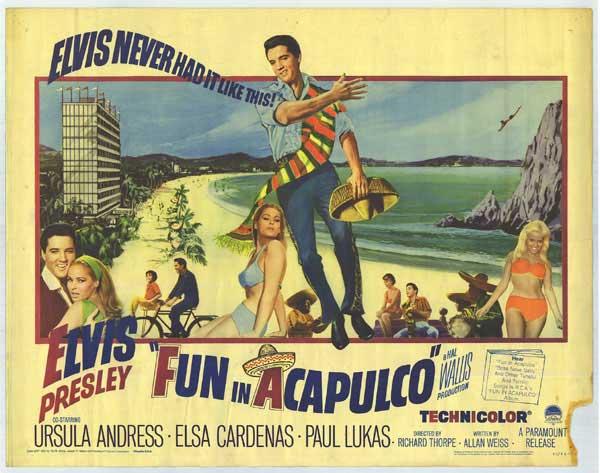
Fun in Acapulco poster
"There's something about Elvis that a single ethnic or racial identity cannot contain. [. . .] You have a figure who breaks down if you fix him narrowly." (Greil Marcus)
It's perhaps fitting that Elvis Presley made Fun in Acapulco without in fact visiting Mexico.

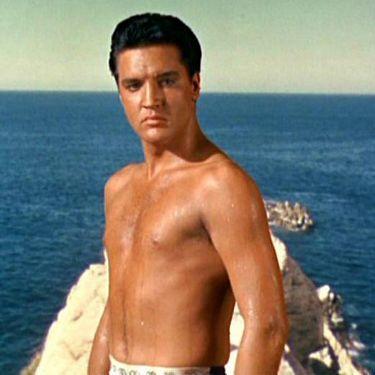
Though the film makes much of Acapulco's stunning coastal setting, and especially the cliffs from which Presley's character, Mike Windgren, dives to prove his manhood and get over the vertigo "problem" caused by his involvement in a circus accident that killed his brother, Elvis's presence in Mexico is only ever virtual, achieved through the use of back projection (previously discussed here), body doubles, and sets and stages recreated in a US studio.

Elvis functions like a spectre, a mediatized ghost overlaid over images of sun, sand, and coast, city streets, bars, hotels, and lounges. The magic of film and recorded sound can place this spectral Elvis anywhere, anytime. No wonder he continues to have hit records thirty years after his premature death, his image and voice transcending temporal or geographical distance.

A key component of popular culture, and the property that allows for its dispersal by means of the mass media, is its iterability. Fun in Acapulco was Presley's thirteenth film, but by no means his last, one in a series of what became increasingly formulaic repetitions of the same basic plot in which the singer played down-at-heel characters redeemed through music and irresistible to women.

Here, he is a fired deck-hand turned lifeguard who makes his name as a singer in hotels and clubs and who has to fend off the simultaneous advances of a young Mexican woman bullfighter (Elsa Cárdenas) and his hotel's Eastern European Assistant Social Director (Ursula Andress).

Most importantly, however, the film has to allow for the various set-piece musical numbers in which Elvis plays, well, Elvis, with his trademark vocal and physical gestures, all here adapted to a Latin beat. A certain reciprocity ensues: Elvis goes Latin (the film's big hit was the catchy "Bossa Nova Baby"), while Latin goes Elvis (the various hotel managers are made to bid for his performances, Cárdenas pursues him single-mindedly, and his macho Mexican rival has finally to admit defeat). Again and again: Elvis's music, and his spectral image, triumph over all adversities.

In some senses, then, the latinidad adopted by Fun in Acapulco is simply one more example of the minor variations within difference that constitute US (and more generally, Western) pop culture. Here, Elvis goes Latin; in King Creole he had gone jazz; in Blue Hawaii, Pacific Islander; and so on and so forth. Elvis proves himself to be a musical chameleon--without, for all that, ever ceasing to be instantly identifiable as Elvis.

Elvis the diver
Mediatized iterability, expansive reproduction through virtuality, and domesticated hybridity: these factors explain the now global spread of US mass culture. Any resistance is overcome first through charm, and second through the reiteration and (re-)representation of the potential sources of such resistance, but now on US terms.

So Elvis does Latin better than the house singer ("el trovador") that he rapidly eclipses, and Elvis (or rather, his double) even reproduces Acapulco's prime, exotic spectacle of the cliff dive: the tourists come to see the great Mexican diver enact this somewhat savage (because life-threatening) ritual, but find instead the all-American Elvis re-enacting it (complete with visit to cliff-top shrine) in his place.

Labels: ,