Friday, March 06, 2009

Butch Cassidy and the Sundance Kid

Butch Cassidy and the Sundance Kid posterTwo American outlaws escaping to Bolivia at the turn of the century seems like improbable concept for a movie, but Butch Cassidy and the Sundance Kid is loosely based on the real lives of Robert LeRoy Parker (alias Butch Cassidy) and Harry Longabaugh (alias the Sundance Kid). The history of this notorious duo is an amalgamation of fact, hearsay, journalistic sensationalism and American Old West mythmaking. What director George Roy Hill offers is a portrait of a powerful friendship that stayed true under the stresses of pursuit by lawmen who wanted them dead or alive, love for the same woman, relocation to a foreign continent, and the impossibility of escaping their past.

Early in the film, Cassidy (played by Paul Newman) explains his plan to Sundance (played by Robert Redford) to go prospecting in mineral-rich Bolivia. Cassidy is the brains of the operation while Sundance is a lightning fast gunslinger. When they return to the Hole in the Wall Gang hideout, a member challenges Cassidy for its leadership. Cassidy boots him in the crotch then appropriates the idea of robbing the Union Pacific Flyer twice, for its owners would refill the train with money not expecting a robbery on the return trip. After a successful hold-up, Cassidy and Sundance gloat on a balcony overlooking the mayor, who is ineffectually trying to rally townsfolk to catch the Gang. We meet Etta, who while being the devoted girlfriend of the gruff and reticent Sundance, has a tender relationship with the affable Cassidy. This is illustrated in a dialogue-free interlude where they ride a bike and monkey about in the countryside to the soundtrack of “Raindrops Keep Falling on My Head.”

The mood becomes darker and strained when, after they are surprised during the second train robbery by cavalry hired by the railway tycoon, they are forced into a lengthy chase sequence. The Hole in the Wall Gang splits in separate directions, but the pursuers follow Cassidy and Sundance. They are betrayed while hiding out at a brothel and denied amnesty by a friendly sheriff, who tells the pair of their inevitable demise. The posse tracks them through the night and the next day with amazing skill and persistence; the pair determines that among them are the expert Indian tracker Lord Baltimore and notoriously tough lawman Joe Lefors. Cassidy and Sundance are pursued over much terrain before being forced to jump from a cliff and be carried away by the rapids far below. They end up back with Etta and learn that E.H. Harriman, the railway tycoon, put together the outfit to stay on their track until they were killed. At this point they decide to go to Bolivia, and Etta states her intent to go with them, but adds ominously that she wants to be absent when they are finally killed.

The journey is illustrated in a series of sepia photographs. When the trio arrive in their Bolivian destination they are dismayed by its rustic appearance, and Sundance curses Cassidy for his harebrained ideas. They resume their criminal life after Etta gives the men Spanish lessons with “specialized vocabulary” for bank hold-ups. A humorous sequence shows the pair blundering through a robbery with a Spanish crib-sheet, and struggling to recite with Etta phrases such as “This is a robbery. Esto es un robo.” Soon their routine is perfected and they are living decadently, with wanted posters for the “Bandidos Yanquis” showing their notoriety. The honeymoon is over, however, when a potential sighting of Joe Lefors scares Cassidy into wanting to go straight. The men are hired as bodyguards for a humble and eccentric American mine owner, which they fail at when Bolivian bandits kill him. Being forced to kill the bandits shakes Cassidy, who has never killed a man, and the pair decide to return to robbery. Etta, perhaps with a premonition of their demise, leaves the next day. In the town of San Vicente, a boy recognizes a stolen mule and alerts the police to the outlaws. The police descend upon them, starting a climactic shoot-out in which Cassidy and Sundance are seriously wounded due to lack of ammunition. While the bloodied men are recovering strength in an abandoned building, poignantly discussing their next destination of Australia, the Bolivian military gathers outside. When the pair unwittingly exits the building, the camera captures them in a sepia-toned freeze frame to the sound of repeated volleys of rifle fire.

Butch Cassidy and the Sundance Kid
enthralled the American public, evidenced by being amongst the 100 highest grossing films of all time (adjusted for inflation) and multiple Academy Award accolades. The pathos generated by the close male friendship between the outlaws, who are bound to meet with an untimely death, plus their fetching yet vulnerable female counterpart, largely accounts for the film’s appeal. However, the heroes are also partly conceived as Old West Robin Hoods, an archetype with universal appeal. Partly so because they rob from the rich and keep for themselves. In the United States, the noose of capitalism and modernity tightens around Cassidy, an older cowboy who remembers freer and simpler times; he curses the newly impenetrable banks, the immensely rich and powerful railroad barons, and the bicycle, a modern invention that threatens to replace the horse. He rebels against this by blowing up trains and appropriating easily and ill-gotten wealth, but then is forced to escape to Latin America. In doing so, Cassidy steps multiple decades back in time. Bolivia recalls California in the height of the Gold Rush, when humble but hardworking folk could become rich, not just aristocratic sons who inherit railroads. The charmingly outdated Bolivia is the only apt place for Butch Cassidy and the Sundance Kid, symbolic of the romantic frontier spirit outmoded by the modern commercial one, to meet with their inevitable death.

Labels: , , ,

Sunday, February 22, 2009

Amazon

Amazon posterAmazon (1990), which begins with an aerial camera shot of an indigenous hut nestled among the trees and then flashes to a pitiful landscape of deforestation stretching as far as the horizon, should be commended for its sense of authenticity as such scenes were accurately filmed in the paradox that is the Brazilian rainforest.

The movie opens by introducing Kari (Kari Väänänen) and his two pre-adolescent daughters traveling the dusty road of the Trans-Amazonic highway through Brazil. Flashbacks show that Kari used to be a successful and happy businessman living Finland, until his beloved American wife was put in a coma due to a car crash. The accident devastates Kari who disconnects his wife’s breathing machine in an act of love; thus prompting him to escape to Brazil with his daughters in order to evade the authorities. The promising new life in Rio de Janeiro is dashed when Kari realizes that he can’t possibly find work without knowing the right people, which leaves him and his family surrounded by theft and shady characters. His friend Fransisco offers him a job as a driver, but they are stopped en route by police. Fransisco makes a break for it, obviously indicating that they are transporting illegal materials, and he is shot dead. After Kari avoids the same fate by claiming to be an American, he ushers his daughter onto a long road trip in search of employment and a better life, which brings us back to the Trans-Amazonic highway: a “skinny, black line through an endless wall of green” on the map, but in reality a “red dusty nightmare headed for nowhere”. The three travelers run out of gas and inadvertently meet Dan (Robert Davi), a selfish and rude American pilot whose plane has also run out of gas. After filling the car’s gas tank with alcohol, the group tows the plane to an abandoned highway construction site housing an old bulldozer which they use to siphon some gas into the plane. Here Dan tells Kari that he plans to mine for gold in the north, and when Kari pleads for him and his daughter to go as well, Dan reluctantly agrees.

They arrive in the mining town of Cerapalata, meaning ‘naked mountain’ but feeling like “Dante’s Hell where condemned miners look for nonexistent retribution”, and Kari immediately sets out to make a buck by doing the strenuous hard labour of carrying bags of wet soil out of huge mining holes. One night after Kari collapses in his hammock from exhaustion, his daughter finds a large diamond in his shoe. Kari thinks that this is his fortune at last, but Dan knows better and after he has the flawed stone appraised, he offers a partnership to Kari in the northern town of Tapacan where they will pan in a river for real diamonds. The plan is to make enough money by doing flying errands to eventually tow the abandoned bulldozer from the Trans-Amazonic highway up to north; but this plan is upset when Kari becomes enchanted with an educated and beautiful woman living in Tapacan named Paola (Rae Dawn Chong). She likes Kari as well, but disagrees with the plan to bring huge machines in order to mine the mythical diamonds because this will cause the greedy banks to sweep in on the free land and use it for their own purposes. Kari is torn on what to do as he examines the reality of selfish foreigners who disturb the balance of the Brazilian environment.

The situation is soon thrown into disarray when Dan and Kari crash the plane into the jungle and Dan dies due to a broken neck. Kari is alone and injured in the plane and dreams of him and Dan bringing the bulldozer to the mine which then causes all the indigenous people to disappear. Suddenly Kari wakes up and is surrounded by a tribe Indians who take him back to their village and tersely nurse him back to health. Kari coexists among them as a silent tribe member, until one night they are distracted and Kari escapes down the Amazon in a canoe. After days of barely surviving in the wilderness, he comes across a town on the river and immediately hitches a ride back to Tapacan, his girls, and Paola. The experience of living alongside the indigenous tribe has changed Kari and he is happy once again for the first time since his wife died. He tells Paola that he realized she was right about the devastation the bulldozer would bring to the land; despite this, however, Kari recognizes that greed and power always win when in the last scene everyone looks up to see a ominous black helicopter carrying a bulldozer to the peaceful panning river.

Amazon is a film which was clearly made to bring awareness to the public about the conflict over land in the Brazilian rainforest. The movie incorporates an almost poetic speech to discuss the situation surrounding the indigenous peoples: “The Indians say the Amazon is as long as life…you’ll never reach the end.” The indigenous culture is an ever-present, yet hidden aspect of this lush forest; more of an afterthought to greedy foreigners and officials than an actual community of people. This is demonstrated when Dan off-handedly mentions to Kari that the panning river in Tapacan was government land until 3 years ago when they decided to give it back to the Indians; however, they didn’t make it official and it has ended up being free land for anyone to use. And so it is that the Indians are living “in the stone age, but sitting on treasures of a modern world.” Dan confides to Kari before the plane crashes that he doesn’t think anyone should have any right to tell them how to live. He states that “they’ve got nothing better to do on their reservations but sit around and wait for the next white man’s disease.” Then Dan’s past is divulged about a time when he had an Indian wife and he had supplied guns to the whole village in hopes of being their saviour, but he instead became their burden when white men came with machine guns and murdered the entire community. This is the modern world of technology encroaching upon the indigenous territory. This is the thousands of hectares of abundant and thriving forests being chopped down into a wasteland in order to make to-go coffee cups in a distant country. Just as Kari declares that Rio de Janeiro looks like a paradise in the brochures but in reality it may as well be Hell, the rainforest also looks verdant and fertile until the ugly side of the conflict is illustrated. The movie ends with a note about cultural and environmental awareness saying that 40 million hectares (or roughly the state of Washington) are being destroyed annually which will lead to the final and complete devastation of the Brazilian rainforest within this generation. The words are simultaneously overwhelming and inspiring, yet as we saw with Kari, realization is only the first step, and even with this awareness the bulldozers continue to arrive. Amazon shows that a true sense of change and fervent determination are needed in order to stop the relentless loss of rainforest and indigenous culture.

Labels: , , ,

Saturday, February 23, 2008

Zorro Rides Again

Zorro Rides Again posterAs early as 1937, it seems, Zorro already needed some updating. But no problem: the story proves to be almost infinitely flexible. Zorro Rides Again, another twelve-episode Republic serial, promises its viewers "a New Zorro... More dashing... More courageous... More romantic than his famous ancestor." This is in short "the modern Zorro."

So the setting has moved to the (then) present day. This is a Zorro of planes, trains, and automobiles. Above all, however, of trains. One Manuel Vega and his US partners Joyce and Philip Andrews are building a railroad from California to the Yucatán, that will therefore unite the United States and Mexico for the good of the Mexican people. Unfortunately, these good capitalists are confronted with bad capitalists and their "money-mad plottings." The evil corporate mastermind is one J. A. Marsden, who from his office on the tenth floor of an urban skyscraper directs a band of thugs led by "El Lobo" to sabotage the enterprise in a bid to ensure that Vega and the Andrews sell him their company.

Vega is the great-nephew of the revered folk hero Zorro. So when Manuel dies in episode on and his own nephew James Vega arrives from the city to take over his interest, the newcomer happens to be Zorro's great-grandson. And like a fish to water, young James takes over his great-grandfather's disguise: mild-mannered, bookish, and ineffectual for the most part, he becomes a dashing hero and tireless avenger when he puts on the dark uniform and mask of Zorro.

James also, as part of the same transformation, becomes Mexican. His fluent US accent (presumably picked up at school or university north of the border, though logic is hardly this film's forte) is replaced by a guttural Hispanic pidgin in which he comes out with lines such as "I hav some beesneess wiv El Lobo" and "Did dey say at what time the train would get dere?" So it is not just the train line that will unite north and south: as anglicized James becomes Mexican Zorro and back again, he plays the part of a character who has no clear national allegiance.

But there's a paradox here. Presumably the benefit of the railroad to the Mexican people is that it will bring them modernity. (Though this argument is only ever implicit: apart from Manuel's brief presence prior to his untimely demise, and Zorro's ever faithful manservant and sidekick Renaldo, the only Mexicans we see are confined to the local cantina; everyone working on the railroad itself is American, as are the hired ruffians whose leader El Lobo actually turns out to be named Brad Dace.) Yet modernity can only be assured through a decidedly nostalgic resurrection of the long-dead folk hero. "The spirit of Zorro will never die," we're told, but the film depicts a transition from the Wild West of horses and gunplay in which Zorro once thrived to a new world of machines (including machine guns) in which he will surely become obsolete.

Zorro Rides Again still
As if to deal head-on with this tension, one of the serial's episodes sees Zorro fly to New York. Here he engages in firefights on the roof of one of Gotham City's office buildings, cunningly using his whip in much the same way as Spider-man would many years later use his webbing: to swing through the concrete canyons. He also shows the weaknesses of modern technology, listening in to the radio transmissions by which Marsden transmits his orders to his Mexico-based heavies. More generally, it's as though the film wanted to differentiate not only between capitalists but also between a good modernity that is constructive and still respects tradition versus a bad modernity that seeks only destruction and profit.

But the line between good and bad modernity is as hazy as the line between Mexico and the US, breached in the person of James/Zorro himself. The contradictions of modernization are displaced south of the border because it is taken for granted that a train line has to be of benefit to the Mexican people. But once there, the invocation of tradition to defend capitalist progress simply introduces further complications, rather than the imagined resolution that incarnating in the same person both Mexico and the US, past and present, as first sight seems to offer.

YouTube Link: serial trailer.

Labels: ,

Monday, October 01, 2007

Something New

Something New stillNell Shipman's Something New opens with a woman writer searching for a topic. For some unknown reason (presumably she doesn't have "a room of her own and five hundred a year") she has set up her typewriter outside, under a tree. There, however, she sees "the old--and the new," a man on a horse and a man in one of those new-fangled motor cars, disputing which is better. And so a story comes to her...

But to dramatize the clash between tradition and modernity, where better to set the plot than "beyond the border in that land of Rogues and Romance, Mystery and Murder. . . Mexico!" And so the scene shifts to the US/Mexican border, where a "lady writer" arrives to visit a gnarled old friend of the family Sid, who happens to be disputing the merits of horse and motor car with a dashing young gallant named Bill.

We are told that the lady writer is down south looking for "ATMOSPHERE, real, red, and RAW." And as she comments not longer after, "I wanted 'atmospher' and I'll say I'm getting it." For Sid has aken her to the Blue Lotus Mine, where he works, only for it to be set upon by Mexican bandits who tie the old man up, leaving him to perish in the heat, and snatch the young woman off to their lair, aptly named "Hell's Kitchen."

Naturally enough, on hearing the news Bill rides to the rescue. But the real "heroine" of the piece is the car in which he rides. For the movie turns into one long demonstration of the ancient banger's off-road capabilities as Bill drives first though the "rock-ribbed sea of sand and sage" to reach the mine and then further into the "trackless waste" to Hell's Kitchen so as to rescue the damsel in distress. Then the two of them return home across "the country God forgot" to return to civilization and so safety, signified by a distant glimpse of the US flag.

Something New stillAnd indeed to see this old sedan made by the Maxwell Motor Company (a forerunner of Chrysler) bounce over rocks and through streams and ditches, covering terrain that would give a modern 4X4 driver pause for thought, is surely "something new."

For the ride home, moreover, the lady writer and her rescuer (and his dog) are chased by the gang of mounted bandits, and the lady herself has to do much of the driving as Bill collapses with exhuastion just as the car is hurtling towards a precipitous cliff face. All this in the dark, apparently without lights. In the words of the lady writer's always dramatic prose, the young couple go "on and on through the hellish night, plunging and pounding, slipping and sliding" (yes, this is vehicular transport rather than sexual congress she's describing), "all nature arrayed against them."

Suffice it to say, however, that modernity and the internal combustion engine triumph over both horse-powered Mexican banditry and stubborn nature. And in the climactic sequence, the little car shows it has another trick up its sleeve, too: our heroine repeatedly backs the automobile up against a precariously poised boulder until it tumbles down a canyon and gives the bad guys "a Tomb of the Ages."

In the end, our writer heroine and indeed the film itself cross the border seeking "atmopshere," but they also bring plenty along thesmeselves from the industrial north. The Mexican scrub turns out to be a test track on which to demonstrate the power and excitement of motor transport, as well as the ways in which an otherwise rather mundane narrative can be spiced up when adorned with the trappings of Latin barbarism.

Labels: ,

Friday, April 20, 2007

The Girl from Rio

Jesús (Jess) Franco, prolific Spanish-born master of schlock and exploitation, has shot more than his fair share of movies in or about Latin America. Indeed, he has pretty much cornered the market in the genre of women-in-prison-on-unnamed-South-American-island-or-in-unnamed-South-American-jungle films. (See for instance 99 Women, Women in Cellblock 9, Quartier des femmes, or Sadomania).

Girl from Rio posterIn The Girl from Rio (like many of Franco's films, released in various different versions and under different titles, including The Seven Secrets of Sumuru and Rio 70), the women are, at least temporarily, on top.

The plot revolves around Sumuru (who in the film alternatively goes by the name of Sumitra or Sumunda), a "space-age sorceress" and evil bisexual mastermind who has established a city of women, Feminda, whose sole inhabitants are a small private army of half-naked gun-toting female warriors plus a quantity of gold bullion and a handful of prisoners condemned to glass-enclosed pentagons swirling with dry ice. One of those prisoners is a woman named Ulla, who may or may not be the girl from Rio of the film's title, and whose father has paid adventurer or private eye (it's never quite clear) Jeff Sutton to infiltrate Feminda and rescue his daughter.

Jeff's task is made considerably harder by the fact that he has a group of Rio-based gangsters on his tail, who think he is carrying around ten million dollars of stolen money, while the new girlfriend he has picked up, a manicurist by the name of Leslye, turns out to be a paid-up member of Sumuru's army. All ends well, however: Ulla is duly liberated, Leslye is disarmed with the words "Don't be nasty, daddy doesn't like it," and Jeff leaves town with these two and a third scantily-clad beauty all adoring his daring helicopter-piloting prowess.

The film is full of hokey and low-budget special effects, copious soft-core nudity not least in its dream-like pre-credit sequence, bizarre futuristic outfits, bikini-clad lovelies cavorting in swimming pools, torture scenes involving either portable fans or a contraption that looks like a dentist's x-ray machine, and unavoidably a chase scene through the crowds of Rio's Carnival.

Girl from Rio Torture scene
What's striking is not only the placement of this community of Amazons in the land of the Amazon, but also the way in which Brazil is imagined as the location of a science-fiction super-modern urbanism. Feminda is a city of concrete, steel, and glass, not unlike the new city of Brasilia that had risen from the Brazilian interior less than a decade before this film's release.

Brazil is thus presented as the site of a rather unsettling combination of femininity and modernity: sexually inviting but also dangerously hard-edged and not a little inhuman. No doubt this combination was at the heart of much male anxiety during the sixties. Films such as The Girl from Rio (but also, for instance, much of the James Bond franchise, likewise often set in exotic locales) attempted to re-establish the law of the father yet take advantage of the decade's sexual openness by presenting a series of man-child heroes, who negotiate the violence involved in the quest to restore order with a certain dapper reserve or irony.

There's no better example of this ambivalence in this film than the gangster boss's reaction to the torture he has ordered of the uncooperative Leslye, whom his henchmen are dunking head-first into his swimming pool. He alternates between peeking through one of the ubiquitous plate-glass windows to supervise the interrogation's progress, and turning to read a Popeye comic. It's as though Franco's comic book exploitation is a little too real, a little too close to the edge; if only he could retreat to the old-style pre-war comics, Popeye and Olive Oyl, set back in the good ole US of A.

Labels: ,

Sunday, April 16, 2006

The Wild Bunch

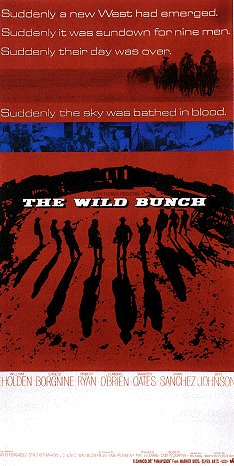
The Wild Bunch posterThe bloody action in Sam Peckinpah's The Wild Bunch takes place either side of the US/Mexican border--and in one memorable scene, on a bridge directly on the border itself--as a new nation is being born to the South, and an old one is dying to the North.

The film depicts, therefore, a moment of transition. All such transitions are times of violence: the painful uprooting of old traditions and the hard-fought emergence of the new. More violence is around the corner, as the film indicates, with World War One ushering in a global realignment of forces, and the definitive mechanization of death. This is foreshadowed by the use, here, of an automobile as instrument of torture, and a machine gun as agent of unparalleled, indiscriminate mayhem.

At first sight the border between North and South may appear blurred, but only at first sight, or so suggests the Wild Bunch's one Mexican. "Mexico lindo," exclaims the character Angel as the group arrive at the Rio Grande. "Just seems like more Texas as far as I'm concerned," replies one of his partners. "Then you have no eyes," responds Angel.

But which Mexico is this that they are entering? The Mexico of sleepy villages and welcoming indigenous peasants, or the Mexico torn apart by civil war, where Angel finds his father has been killed and his girlfriend taken by Federal troops? "In Mexico," a village elder tells them, "these are the years of sadness." Indeed, unlike so many other movies of the Mexican Revolution (and The Wild Bunch surely is one of these), we catch nor more than a glimpse of the revolutionaries themselves, or the desire for a liberating modernity that they incarnate.

It's hardly a coincidence that shooting wrapped at the end of June 1968. The the Mexican student movement was about to unfold, which was abruptly terminated in the October massacre at Tlatelolco, definitively putting an end to the myth of a beneficent Revolutionary state. The Wild Bunch is heavy with disillusion about the prospects for a liberatory violence: modernization has put paid to all such dreams, whether in Mexico, Vietnam, or the USA itself.

Not that the film allows any sentimantal nostalgia for a more heroic past, either. The leader of the outlaw band that is the wild bunch, one Pike Bishop, is haunted by the string of betrayals and broken alliances that he has left behind him in his life of crime. Or rather, they are not so much left behind as catching up on him as his former comrade, Deke Thornton, is on his trail in the reluctant pay of the railroad bosses.

But in this moment of "interregnum", before the old has fully died and while the shape of the new is yet uncertain, Bishop sees a brief chance for something like redemption. Angel, whose name is always here pronounced by his partners in anglicized fashion to underline his association with the divine, siphons off a case of stolen weaponry for his villagers' defensive cause. Captured by the Mexican General Mapache, he is at first left to his fate by Bishop and his gang. But then, with the simple words "Let's go," Pike leads them in the famous walk back to the general's encampment, in a gesture that they all know to be suicidal, but ultimately honourable.

the wild bunch
The Wild Bunch opens and closes with laughter. It opens with the rather sinister sniggers of small children as they cast scorpions to deadly ants, shortly to set fire to the lot in their glee at torture and destruction. It closes with a series of flashbacks of the various members of the wild bunch, now all dead, laughing and loving some aspect of their precarious lives.

But the most significant laughter comes in the still small moment of quiet around which this endlessly busy, endlessly violent action movie turns. With their enemies all around, with their partner the Mexican Angel sacrificed in front of them, and just after they have shot dead General Mapache, Bishop and his three remaining comrades find themselves in a sudden pause, at the eye of the storm. They look at each other and begin to smile and laugh. Not, as Tim Dirks suggests, because they think "for an instant, they just might succeed." But because they affirm the interregnum itself, the moment at which everything is possible only in that nothing is possible.

We can't go on. We must go on.

And perhaps the most famous massacre in film history follows on immediately.

Labels: ,